If everything worked as well as the product called Evapo-Rust, the world would be a much better place.
That’s just one of the many lessons learned during my recent — successful! — project to transform my old, nonfunctioning gasoline-powered generator into something much better.
Though it might seem otherwise to anyone who has read this column for the last six weeks or so, I am not obsessed with portable generators. But living in the woods as I do, I find having a good, working emergency generator is important. When it is winter and the snow is falling, the wind blowing, and a bad, feverish cold is raging, going from power out to power back in a minute or so is good.
That’s why I was angered when I was shipped not one but two non-working generators by an unholy alliance of the Wen and Amazon.com companies.
The reason I thought I needed a new generator was because a law, passed solely to serve a special business interest, destroyed the reliable emergency generator I had happily used since July 2012. That law requires the sale only of gasoline that over time effectively turns into water. It has been in effect in various worsening iterations since 2007.
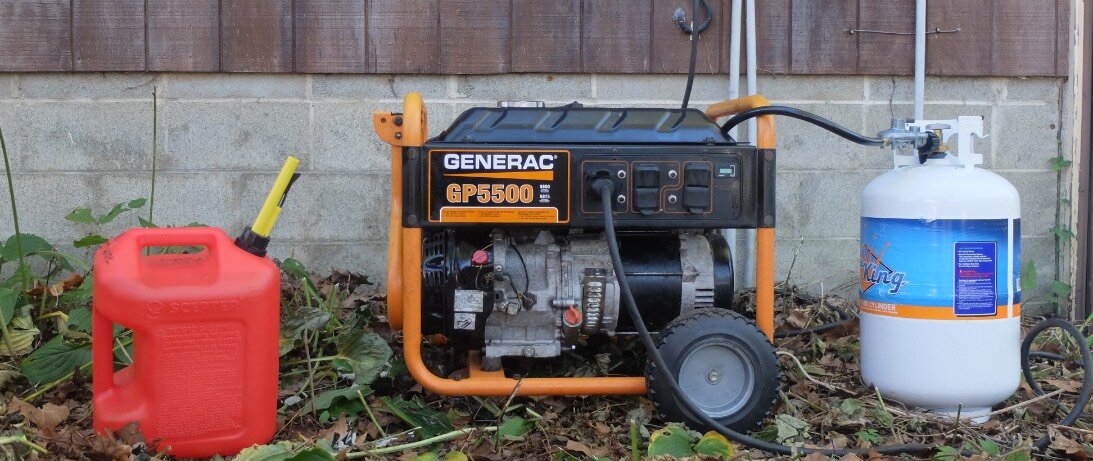
After sadly squandering my new-generator budget on a range of non-working ones from Wen/Amazon, I decided the only solution would be to repair my existing Generac GP-5500 from a decade and a half ago. I wish I’d decided on this before I’d blown, ultimately, $500 on modern junk.
It’s worth noting that generators are two separate machines: the generator itself and the engine that spins the generator so it can produce electricity. What I needed to restore was the engine; the generator is well beyond my ken, and has always worked.
I doubt that there are many generators that have outsold the Generac GP series. This fact is especially useful if you have a broken one, because the thing is thoroughly known, with repair tricks perfectly formulated.
When mine was new (purchased in a panic when my John Deere generator vibrated its blower cover to pieces — literally — during the derecho of 2012, a day into what turned out to be a 10-day blackout), gasoline poured from its carburetor after its first, 9-day use. I took it back to Lowe’s for warranty repair. I do not know what Lowe’s did, though I think they shoved it in back, waited a month, then called me to come pick it up. Whatever they did, they didn’t fix it; when I got it back home, it still spewed gasoline onto the ground.
I went looking online and found that the Generac GP’s carburetors were allergic to the government-mandated adulterated fuel — the needle valve would corrode quickly when exposed to ethanol, and stick — and one should get an after-market carburetor and even then treat it carefully when forced to use polluted gasoline.
One skill that’s not essential but that is highly useful when one owns a “Honda clone” generator (as my Generac and about 75 percent of others made this millennium are) is replacing the carburetor. With the gasoline that’s currently sold, you’ll probably do it sooner or later.
Yes, the old carb can probably be restored, but that takes several hours, possibly some expensive equipment — do you have an ultrasonic cleaner? — and knowledge that’s easy to forget if you don’t do it often. Clone carburetors, which fit as I said about 75 percent of current generators, are $25 and take half an hour to replace. You know what your time is worth. You need to restore the original only if you plan to show your machine off at classic generator shows, if there are any. (Which I suppose there actually are.)
So after the Amazon/Wen fiasco I figured I’d replace the Generac’s carb, again, and fix the trusty old GP-5500 which for the first time had failed to start, because its gas tank contained a lot of water. That water had rusted the bottom of the tank. It wasn’t yet close to rusting through, but it might have ruined the tank.
Enter Evapo-Rust, a product of the CRC company which makes many good things). It is not particularly poisonous. It is not flammable. I do not know why it works, but if you immerse something rusty in it and leave it for a day or two, the rust is gone. Where did it go? I don’t know. Another dimension, maybe. It’s just gone. Then you funnel the Evapo-Rust back into its jug to use again the next time it’s needed.
I learned of Evapo-Rust from a friend named James Condon. I say he’s a friend, but we’ve never met and he has never heard of me. Still, if a friend is someone who makes an effort to help you out while expecting nothing in return, he’s a friend. Unlike me, he is obsessed with generators. He has an office job for a living, I think, and lives in New England, which mustn’t be held against him — I lived in Connecticut for a time, until I repented. I have relatives there and am even on speaking terms with one.
Anyway, somehow I happened upon his YouTube channel that’s mostly about fixing generators (and that’s linked to his name above). He mentioned Evapo-Rust and I followed his advice. I bought all I could find in town, two quarts (I needed a couple of gallons, but you do, as Teddy Roosevelt said, what you can, with what you have, where you are). I shifted the position of the tank every few hours for the next couple of days as the EvapoRust did its job. It made the inside of the tank like new again.
Meanwhile, I had discovered that BFS Petroleum, which sells me my heating gas, has for sale “recreational” gasoline. That’s apparently what you have to call it if you want to legally sell gasoline that doesn’t contain the agribusiness-lobby corruption. It is high-octane gasoline with no ethanol in it. It’s more expensive than what’s called “crap gas” from the pump, but not by a lot. So it could be that once I put a new carb on the Generac, with its now resurrected gas tank, as long as I continued to maintain it all would be well.
There are many, many clone carburetors at a wide range of prices. Are any better than others? I went looking and again landed on a video by James Condon.
It had to do with a Generac LP-5500 generator, which has only brand and number in common with mine. It has a more powerful engine, because (as the “LP” suggests) it is powered by liquid petroleum gas — propane — so to achieve 5500 watts it needs more power. And it is designed to use propane only.
With some excitement I watched it, anyway. He described replacing an expensive propane regulator on the machine with a cheap tri-fuel — propane, natural gas, and gasoline — carburetor made by the Hipa company. It being a “Honda clone,” it should work just fine on my Generac GP-5500, which was sold as a gasoline-only machine.
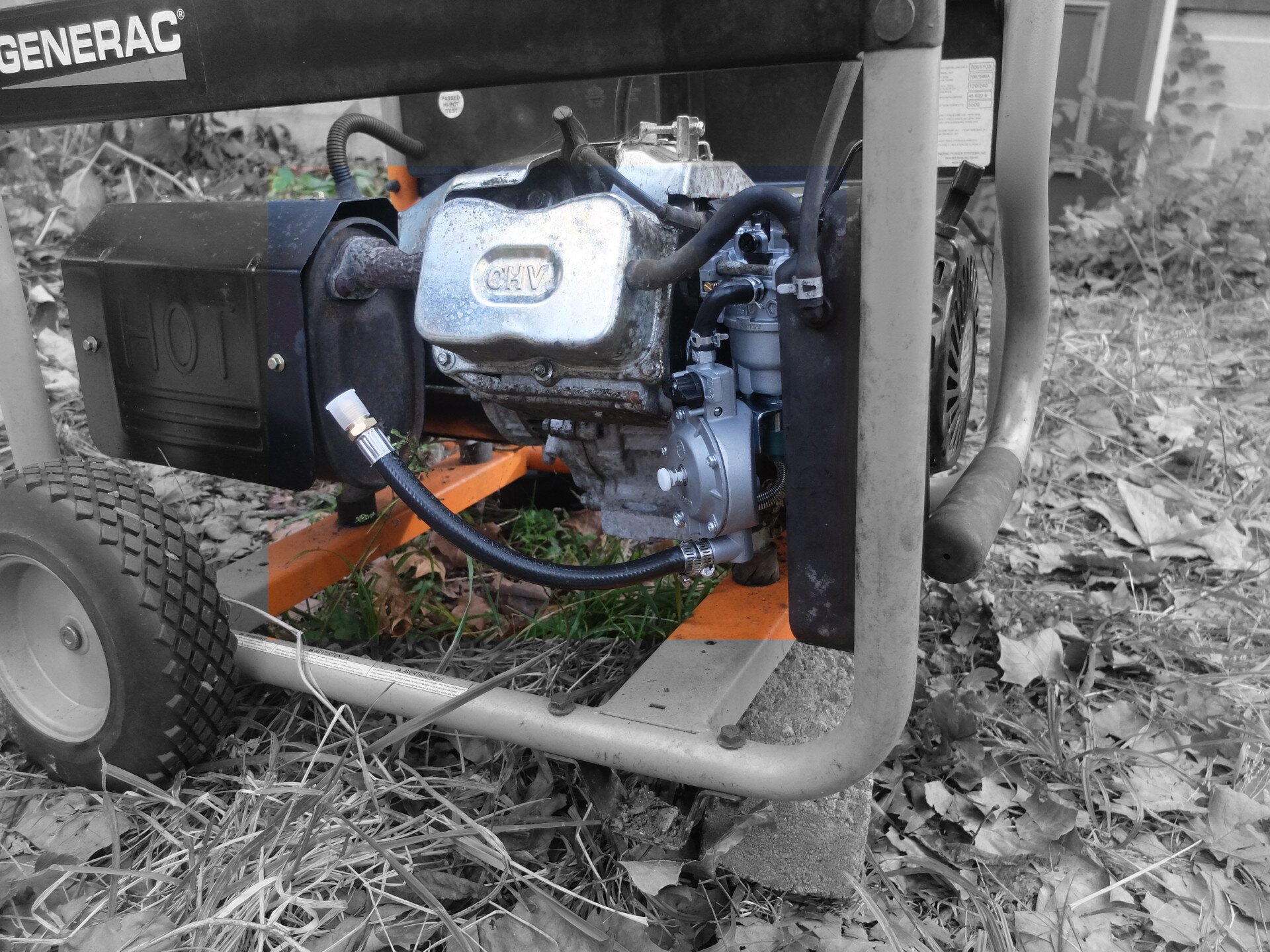
I ordered one of the Hipa carbs.
Why would this interest me?
Simple: In most respects, propane is better. It is cleaner, both in general and within the generator, where it doesn’t foul the machinery so oil lasts longer, and spark plugs last longer, and, well, everything lasts longer. Its exhaust, though not safe to breathe, is less toxic than gasoline exhaust. I have a small stock now of ethanol-free, non-crap gasoline, and with a tri-fuel generator I could fill the tank with gasoline and use that if needed, at an event or a neighbor’s house, for instance, without dragging a propane tank along. And as previously noted, it is not rare around here to encounter “free gas,” natural gas coming from a hole in the back yard, so that third choice is a real possibility. Propane has only about 75 percent the energy density of gasoline, but it costs half as much as gasoline, so it is noticeably cheaper per unit of electricity rendered. Oh, and I have a 500-gallon tank of propane in the back yard. (I haven’t hooked it to the generator yet, because if I make an error I could lose my $1000 worth of winter home heating gas. I’ll wait until I can get someone from the gas company to come round and make sure everything is set up correctly. Meantime, I have a couple of 30-pound propane bottles, each good for about a day.)
Getting the Generac connected even to a 30-pound bottle was non-easy.
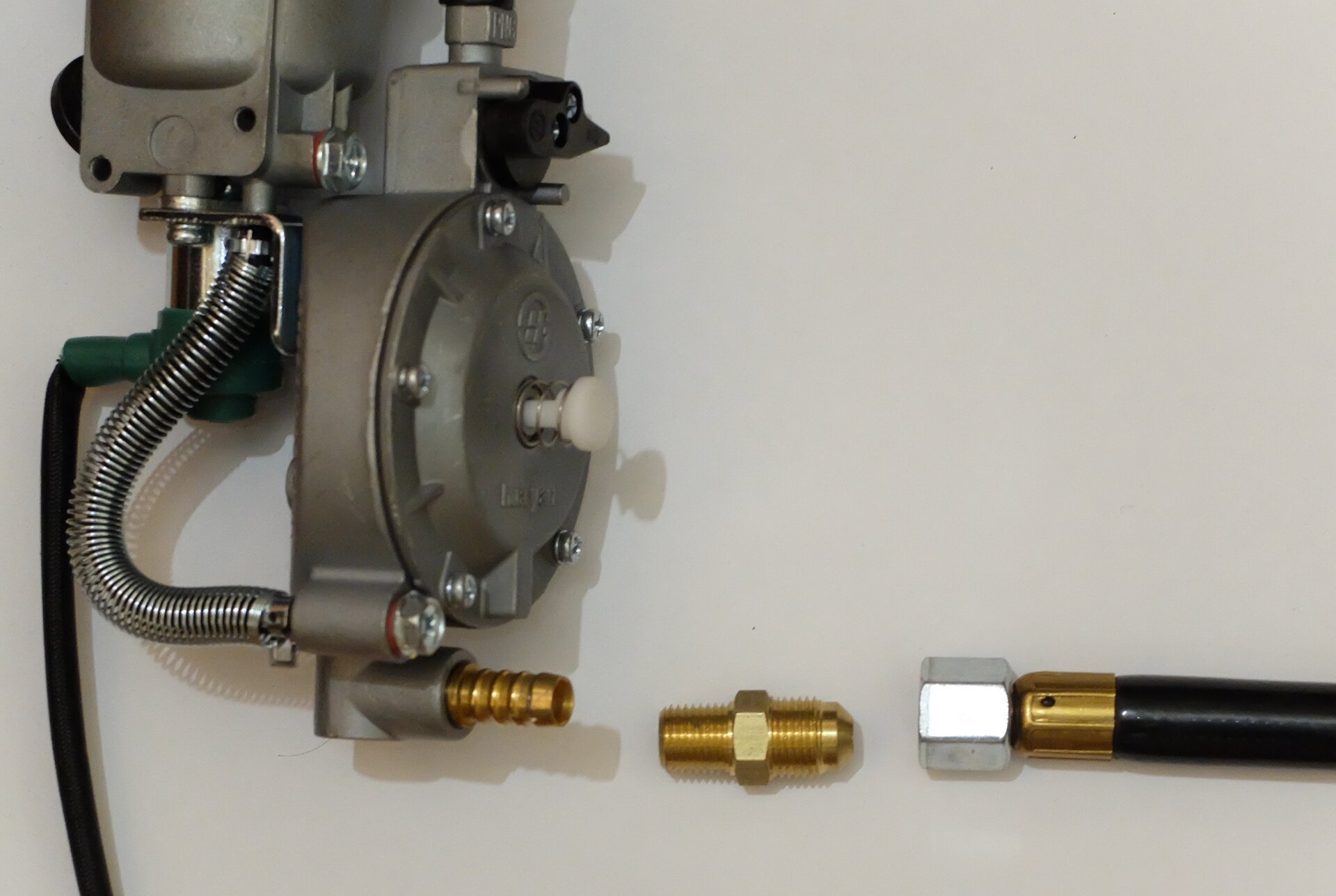
The typical propane-powered residential device, a grill, for instance, connects to its gas bottle via a hose that terminates in what’s called a “3/8-inch flare” fitting. It’s standard. But the Hipa carburetor doesn’t have that kind of fitting, nor is one available for it, for reasons unknown to me. It comes, as one sees in the Condon video and the picture here, with a “barb” fitting.
The Hipa people said the barb fitting could be easily removed. I had decided that the best solution would be to remove the barb, screw in a fitting that offered a male 3/8-inch flare connection, and call it a day. But the Hipa people were not truthful.
It turned out that the barb fitting wasn’t easily removed. So I then thought I’d lop off the barb, drill it out and thread it for the other side of the flare fitting I’d purchased, put on some pipe dope and screw in the fitting, and let that be that. Maybe lock it in place with some J-B Weld.
I am not equipped to thread such a hole. So I made inquiry at a company I know that is so equipped. They made a variety of suggestions. They didn’t want to do what I wanted done. Fair enough. Nor could I find a local machine shop that does piece work. I do not have James Condon’s workshop filled with every tool ever made or imagined.
If I find a local machine shop, or if Hipa wisely begins producing its carburetor with interchangeable fittings or a 3/8-inch male flare, I’ll purchase another one and replace the one I cobbled together. That’s the elegant solution.
In his video, Condon simply cut off his propane hose and stuck it onto the barb. This wasn’t ideal, but it was on a propane-only generator that carried around its own propane tank, so having a hose sticking out of it was going to happen anyway. That wasn’t what I wanted, but if the thing were going to work at all I was going to have to compromise.
There being no existing fitting that would work, I had to buy a propane hose that terminated in a 3/8-inch male flare. Then I cut off about a foot of it on the male flare end, slathered the barb with pipe dope, heated the end of the hose so as to soften it, slipped it over the barb, and quickly tightened a couple hose clamps a la Condon over the connection. I had a 3/8-inch male flare connection. Not pretty but maybe it would work.
It is not an elegant solution. I chose the length I did because I thought a keeping little bit of hose it would reduce the stress on the connection. It would not give me a long hose to have to deal with, which is important when using a recoil-start generator — it would take a lot of pulling on that starter cord to get the air out of a long hose and replace it with propane (though there is a purge valve on the carburetor). Even with the foot of hose and six feet from the bottle to the connector, it takes a couple dozen pulls (I haven’t mastered timing the purge valve. There is some zen to it that I haven’t yet mastered).
I phoned my neighbor, Tom, who helped me unload the generator the Saturday night in July 2012 that I brought it home new from Lowe’s. Did he want to see a miracle? (I’d told him what I was up to; his skepticism was modest and friendly.)
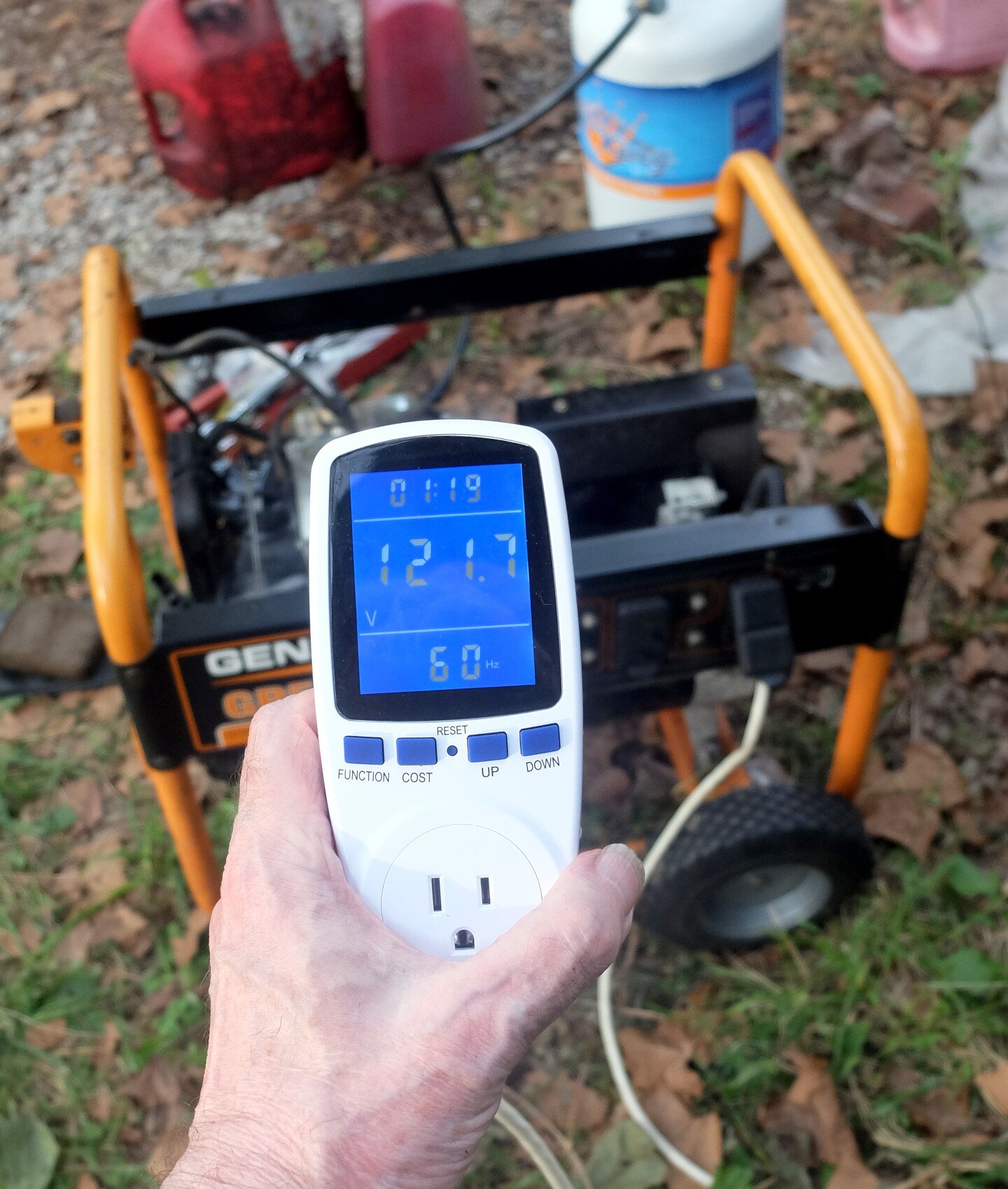
When he arrived, the great experiment was put into action. I tested the whole rig without any gasoline tank on the generator at all. As shown, it produces electricity in the form we use to power our homes. I plugged it into the transfer socket on the side of the house and flipped the switches, transferring my house from the power company to the generator. There wasn’t even a hiccup, on either end. At 5500 watts the GP-5500 more than provides everything I need for the house — I don’t think I came even close to using that much power; my electric bill tells me I use about 1 kilowatt hour per hour, though it’s not a constant draw — the refrigerator, for instance, switches its compressor on and off..
The generator isn’t as loud now as it was when running gasoline. That’s not to say it is quiet — it isn’t. And much of the sound from a generator isn’t from the combustion of the fuel. All those pieces of metal banging around and vibrating make noise, too. To reach from the 500-gallon gas tank to the transfer socket I got a much longer cable, so if I need to run the generator for any great length of time and therefore hook it to the big tank I can shield much of the world from the noise by putting the generator near the tank itself, and by pointing it off into the woods, making life less annoying for the neighbors. Around here we take such things into consideration, and when the power is out no additional irritation is needed.
So my Generac GP-5500 is better now than it was when it was new 14 years ago.
At the end of each video, James Condon always says, “I hope this video helped someone.”
In this case, it certainly did.
Though I should warn you: his videos are addictive, even if you don’t have a broken generator (or, as I do, four of them, two brand new). They reminded me, too, of lessons previously learned: Marvel Mystery Oil might do something useful, but it certainly smells really good, so use a little in the machine’s crankcase along with the regular oil. It’s good for oiling the air filter, too.
And when you need a 12mm socket, all your 12mm sockets except one turn into 1/2-inch sockets, and the one that didn’t is hiding inside a much larger socket. Somewhere. Wrenches like to play hide-and-seek.
They will be punished. Even if they get corroded, no EvapoRust for them! 

Dennis E. Powell is crackpot-at-large at Open for Business. Powell was a reporter in New York and elsewhere before moving to Ohio, where he has (mostly) recovered.
Pass along this article.
Never Miss Another Article from Dennis E. Powell.
You need to be logged in if you wish to comment on this article. Sign in or sign up here.


Start the Conversation