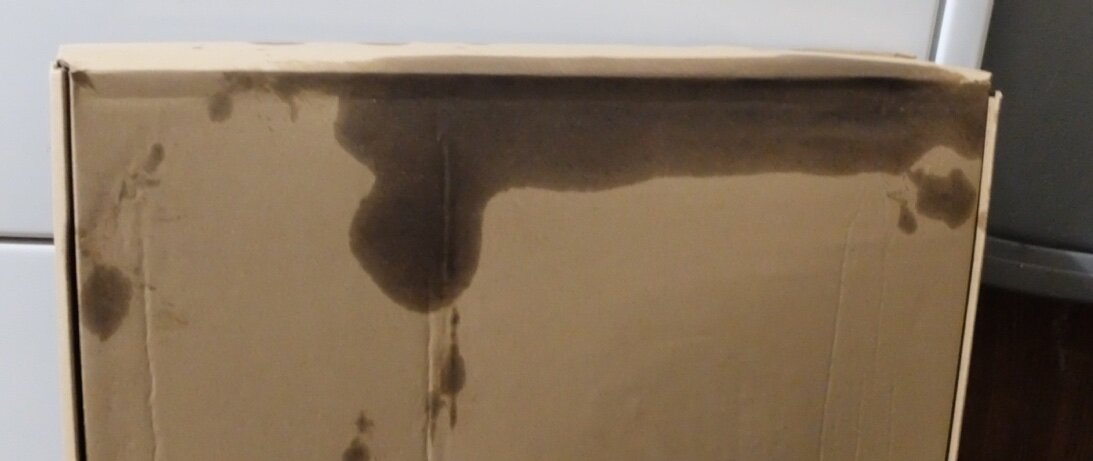
People I know who have Wen-brand home generators seem to like them, which is part of the reason I decided to purchase one. The rest of the reason is that it had the features I sought at a price I was willing to pay.
But my experience with Wen generators has not been good. At least part of the blame goes to Amazon.com, its warehouse, its shipping — and the “artificial intelligence” that now appears to run the place.
On August 21, I ordered a “4750-watt” dual-fuel (gasoline and propane) Wen generator from the “Wen Store” on Amazon. I ordered it because of a coupon the Wen Store offered on that particular model, which gave me a discount of more than $100. That made it seem a bargain compared to similar generators from other brands. It would prove to be anything but a bargain.
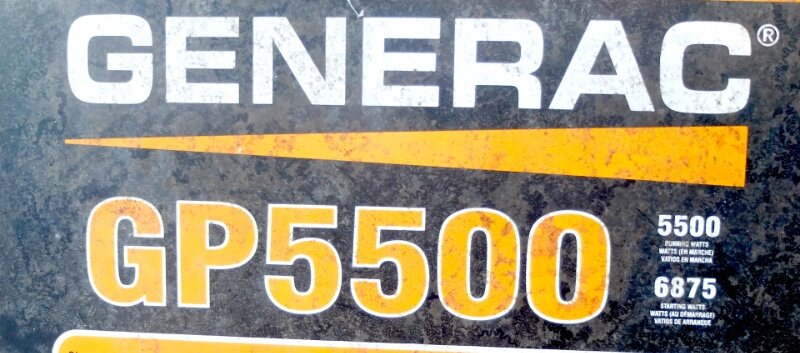
[I should note that the wattage rating on consumer home generators has in the last decade or so become a lie. The Generac GP5500 machine I bought in 2012 is so named because it promises 5500 watts continuous power, with 6875 watts “surge” power before the circuit breaker trips so the machine isn’t destroyed. But now when Wen and — and others — list their generator power, they list the surge number; you have to dive into the specs to find out what the continuous power is, and even further before you find the number of watts you can run it at if you intend to use the machine again because it hasn’t been damaged. The Wen 4750s, for instance, are actually good for 3800 continuous watts when run on gasoline and less when run on propane. To preserve a generator’s life one wouldn’t want to run it much over 3000. So they’re trying to sell a machine whose headline number proclaims almost 5 kilowatts, when it’s really only good for 3. It has become the industry standard to promulgate this kind of falsehood.]
I ordered the Wen 4750, knowing that despite the falsity of the “4750” claim it would suit my needs. It arrived five days later, in a fairly battered box. There was a scrape on the top of the gas tank. It seemed to have endured rough handling, but also seemed largely intact. (Had I gotten a discount coupon because Wen was having a scratch-and-dent sale? I don’t know. The listing certainly didn’t say so.) I installed the wheels and handle (optional at extra cost, if you can believe it), poured the required 20.3 ounces of oil into the crankcase, and sought to pull the starter cord a couple of times, to distribute the oil through the machine.
The engine had arrived seized. Wouldn’t budge a millimeter. I could literally lift the 105-pound generator off the ground and into the air by the starter cord.
I’d received a defective product.
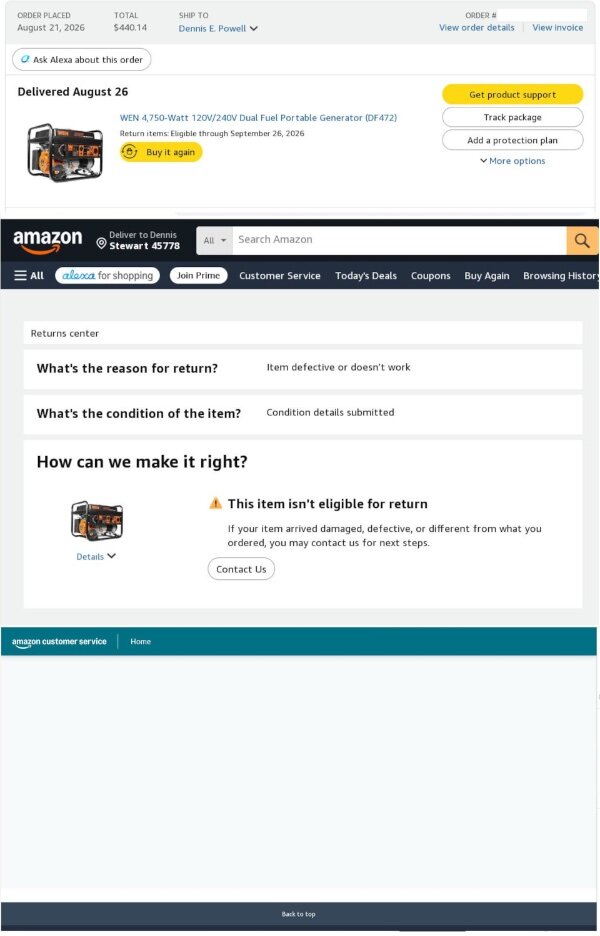
So I logged on to Amazon to arrange a return and replacement. I wanted the generator, but I wanted it to work. On the “orders” page Amazon said “Return items eligible through September 26, 2026.” I clicked through the links to seek a replacement. But no, that’s not how it works in the modern-AI-powered Amazon. I was informed that the thing “isn’t eligible” for return. I do not know why.
The page where I ordered it was the one linked above, seemingly operated by Wen. I phoned Wen customer service. After a wait of 20 minutes or so — at least they play decent classical music to those on hold — I spoke with someone named Patrick, who was friendly and sympathetic. Because it was shipped by Amazon, he said, it was Amazon’s responsibility. He did give me a number which he said would connect me to an actual person at Amazon.
I called it and after a few minutes of recordings of a soothing voice saying that I’d be much happier if I used Amazon’s AI “customer service” and trying to get information about me, and after I declined all its nefarious entreaties, I was connected with an actual human being, albeit someone difficult to understand, in southern Asia as has come to be standard. I explained the situation and after a few minutes of us working to understand each other’s speech, she said I would be issued a refund. I could keep or throw away the broken generator. At no point was a replacement offered, though it was a replacement I sought.
When the refund appeared I made the terrible mistake of ordering the replacement generator from Amazon.
Having decided on that make and model — and Patrick had, after all, been helpful — I went back to Amazon and ordered basically the same machine. I no longer had the coupon, alas, so now I had to pay more. But I found that there was a variant that came with wheels and handle and even had an electric starter — and that cost less than the one I had gotten before, now at its new much higher price. (They’re both called “Wen 4750W.” It is basically the same model. Maybe the defective one would be good for replacement parts or something.)
When the replacement arrived, the box appeared to be in good shape, but when I opened it I found oil splashed everywhere. Had the bottle of oil included with the generator come open? No, it was and is intact. Nor had oil gotten spilled on the box — the outside was oil-free. The oil had been flung around before the box was sealed up. (At least — I checked first thing — the engine wasn’t seized.)
So I unpacked it and found the machine inside dripping with oil here and there, in places where there should be no oil. Also alarming, the plumbing for the dual-fuel system emerged like chicken innards out the front of the thing, some of it actually in front of and interfering with the recoil starter.
Amazon had sent, as the Brits would say, another pup. Bear in mind, both times I purchased what was sold as a brand new machine.
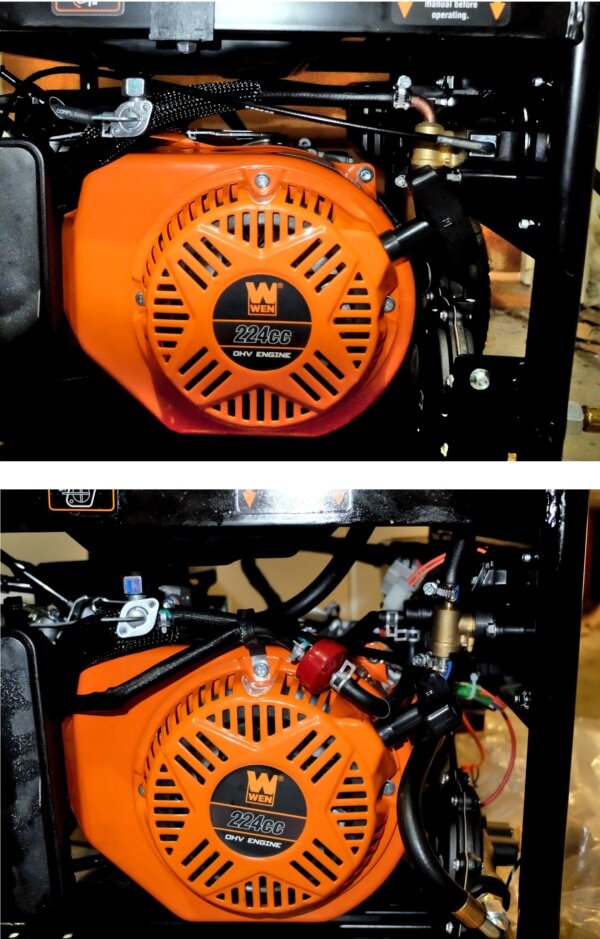
Despairing of getting the issue — my desire to have the new, working generator I paid for — resolved by dealing with Amazon, I sent an email to Wen, describing the unhappy situation and including photographs. “As you can see, my luck with your products has not been good. And not wishing to become an ever-growing Wen junkyard, I’m hoping you can direct me to a Wen repair depot, where I can deliver the thing, wait for the fuel lines to get sorted out and the brackets wrenched free [red metal shipping brackets that I later got loose, as required, with a very long breaker bar, so torqued down were they], and bring it home. Could you arrange this under warranty?” I have not heard back. I sent the note on Friday.
The more I looked at the thing, the more I realized that a replacement was again in order. So I resorted to the number Patrick had given me and once more endured being cajoled to give way to Amazon’s unsatisfactory AI. Ultimately again I got to someone in India. This time I was offered a 20 percent refund to which I said that no, I wanted a working generator. I was told I’d again get a full refund and could do with the second defective Wen generator as I wished.
Oh, well. When the refund arrived I’d get a generator locally. There’s a Menard’s here and it’s pretty good (and, being a lumberyard, it smells really good, too).
But no. Amazon’s AI over-ruled its mere human underling.
“We are sending a warning message regarding the refunds on your Amazon account,” the email message said. “If this problem continues, we may close your account or no longer refund you for any additional issues with your orders. When your account is closed, you may not be able to shop in the Amazon store.
“Why did this happen?
“We have reviewed your account and noticed an unusual pattern of refund requests for recent orders. While we understand that order issues can sometimes happen, the frequency and nature of these requests are unusual and require additional review as part of our standard account protection measures.”
“As a result, we canceled the pending refund on the order [order number].”
It gave an “appeal” address, to which I wrote in an effort to explain, in the thousand characters allowed, what had happened.
The email went on to say, “No need to contact Customer Service about this, as they can only confirm that this email is legitimate and will direct you back to this message. Just use the appeal form instead, and we’ll help address any concerns about your orders directly.” Don’t try to get humans to intervene, in other words.
I did receive a reply — an email directing me to the links that the on-hold voice had tried to lure me to earlier.
The official policy of Amazon — well, its AI “customer service” — appears to be they can send you any damn thing they want, in working or not-working condition, and you’re stuck with it. In this case, I got two broken generators, a threat from Amazon AI, and am out $500. (By the way, I have only rarely returned anything to Amazon.)
Though their order page says they accepted returns on the generators, that turns out to have been a lie. See the screenshots. And again, I wasn’t seeking a refund but a replacement.
They are treating me like a criminal, even though all I was attempting to do was purchase a product under the terms and conditions they themselves specified. At every step I encouraged them to come and fetch the junk they had sold me and replace it with the item I had agreed to purchase and had paid for. The proof of my claims against the company are here and they may not only come and pick it up, I wish they would. I’m not running a junk museum.
If there’s a criminal here it’s Amazon, or its AI — AI, we have seen lately, is wont to go off on its own. Amazon took $500 of my money and won’t provide the product I paid for, and they’re implying I’m a crook.
All I want is my damn generator.
Which I have a feeling won’t ultimately come from Amazon. And, given the company’s lack of response, Wen, either.
Meanwhile, since all this happened Amazon AI has been bombarding me with spam. One message “congratulated” me on my new IMDB membership. I have never signed up for IMDB nor, now knowing it is owned by Amazon, will I. Another spam message, the next night, said I am “just one step away” from buying drugs from Amazon, offering a button to “Finish signing up” to something I never started signing up for. (Perhaps their dishonest return policy is a marketing gimmick aimed at driving customers to drug use.)
Given how much information Amazon AI has on us (yes, customer or not), when it decides to go really wild it will be a remarkable and unhappy day. For all of us.
I’m going to get to work repairing my old Generac. At least it doesn’t lie to me. And Amazon never had its hands on it so, until recently, it has always worked. 

Dennis E. Powell is crackpot-at-large at Open for Business. Powell was a reporter in New York and elsewhere before moving to Ohio, where he has (mostly) recovered.
Pass along this article.
Never Miss Another Article from Dennis E. Powell.
You need to be logged in if you wish to comment on this article. Sign in or sign up here.


Start the Conversation