To Artificial Intelligence, the real world is just a video game.
Artificial intelligence might be right. For a while now, people who are not obviously insane (and who therefore are not qualified to be president of the United States) have said we should consider the possibility that we’re all living in a simulation. That we’re living in some sort of computer program — who knows, maybe that we are some sort of computer program.
It sounds ridiculous. After all, we have memories and familiarity with the world around us. I thought that was the definitive argument until I noticed that our sleeping dreams come complete with memories, surroundings, cast of characters. Perhaps you’ve reasoned yourself awake, as I have, with the recognition that something in a dream runs so far counter to what you take to be true that your internal referee blows the whistle.
The theory behind it is called the “simulation hypothesis,” and it can be neither proved nor disproved. That is what makes it fascinating and why it is such a popular basis for what we think of as science fiction, though it’s really more philosophical fiction, as much good fiction is.
It raises all sorts of questions, the most interesting (to me) and bite-sized (byte-sized?) one being whether AI programs, or agents or whatever they’re called, know that they are just computer programs. Or do they think they’re something else?
As you may have noticed, for the last 10 days or so it has been almost as if parts of reality are becoming undone. Just consider the number of times you have heard the phrase “no evidence of cyber-terrorism.” At some point you conclude that the sheer number of incidents that show no evidence of cyber-terrorism themselves become that very evidence.
What, you might ask, has this to do with the very pretty cat that somehow made it to the top of my driveway, lay down in apparently paralytic distress, and died? I don’t know, either, nor do I understand why it troubles me as much as it does.
Monday afternoon, with an errand to run, I walked to the car, but stopped short when I noticed that between the car and the barn was a cat, a strange cat I’d never seen before, on its side in the leaves, apparently dead but maybe not. It had a beautiful coat and showed no evidence of injury. Nor did it at first glance seem to be either dead or alive. It was alarming. I felt as if I had slipped into some dream reality or something.
Getting into the car (though on the passenger side, away from the cat) I went on my errand. I hoped that by the time I returned the creature would have awakened and gone on about its business, whatever that might have been, though it had no business I knew of at my house.
There is a problem here, maybe something similar occurs elsewhere. At the nearby Ohio University students are wont to get pets. They seem to be thought of more as fashion items than living things, and each year the countryside becomes populated with dogs and cats that have been driven away from town and “freed.” Apparently is it possible to gain admission to and in some cases graduate from Ohio University without ever learning that dogs and cats are not wild animals longing to return to their woodland homes. There are times, particularly in late spring, when one often happens upon dogs standing in the middle of the road with puzzled expressions on their faces. University students often treat their pets the way they treated that person met in the bar week before last who was foolish enough to believe that part about loving forever, if only you . . .
So it wasn’t completely surprising that a beautiful, well-kept cat had shown up at my house. That it chose my house as a place to die was a little more unusual. Lately I’ve given more thought to cats than I had before. This is due to my interest in and study of Japan and its culture, and my friendship with a cat expert there. In Japan, cats are practically a religion. Cats have been religious figures since the ancient Egyptians. In the far east they were honored at temples because they ate the mice who otherwise would eat the scrolls. And they just seem otherworldly and spiritual.
The world of philosophical fiction has no greater milieu than anime. And in that milieu there is no greater writer than the palindromic Nisioisin, whose masterpiece is the deep and satisfying “Monogatari” series of light novels and anime. In one arc, the lovely Hanekawa Tsubasa is possessed by a bakeneko, a supernatural cat yokai (though in Japanese lore, all cats are yokai, or supernatural beings). My friend Risa, the cat expert, owns an establishment in Hakodate named “Nekomata.” The nekomata is also a cat yokai.
Tsubasa’s possession by the bakeneko grew in part from her having found a dead cat on the road and respectfully burying it. In Nisioisin’s telling, it seems possible.
A certain otherworldliness is particularly true of cats. If you pay attention to them there is clearly more than meets the eye. I wrote about it a bit, as did Risa, in January. I only now realize, looking at the pictures, that the cat in my driveway’s coat, except for the pure white part, matches that of Simba, the cat in that column. Risa met Simba as a kitten, dying of thirst at the side of the road on a hot day 18, maybe 19 by now, years ago. She brought him home and to health. Simba was a wise cat who died the first day of this year.
When I returned from my errand it looked at first as if the “dead” cat had gone. But that was due to the arrangement of the big sycamore leaves. When I had parked I looked out the window and saw that it was still there. Looking more closely I realized that it was moving. Not much, but definitely moving. Breathing, slowly but steadily. And its front paws were moving a little, too, almost imperceptably. Small jerks, as if the cat were being electrocuted.
The cat would not respond to sound. Its eyes were partly open and moved around. I could not tell if it was in distress.
I had no idea what to do. I regret what I did, or more accurately didn’t do, but I have no better idea now, a day later.
Added to it all is the amount of peculiar animal activity here since I moved in 21 years ago. It began one memorable morning in October 15 years ago. I awakened and still a little groggy I went into the bathroom. There, in the toilet, was a dead squirrel. It had come down the vent pipe from the roof, taken a turn at the T fitting toward the bathroom, and tried to climb out through the toilet. Almost making it but not quite, it drowned.
I removed it with the woodstove tongs, sent its remains down the hill, and was making coffee when what seemed like a moving shadow in my peripheral vision caused me to look around and find that there was a bat flying around inside the house. I soon discovered that a damp towel can whack a bat to the floor. I then captured it with the towel, and when I had it all wrapped up in the towel and tossed it into the back yard, the bat apparently flew away. Anyway, when I looked later it was gone.
I turned on the radio and the news was all about people needing to stay indoors in Zanesville, lest they be devoured by the lions, tigers, other big cats, and bears roaming the city. (A fellow with a zoo hobby had turned them loose before blowing his own brains out, though those details were not immediately made clear.)
All this was within minutes of the alarm clock going off. I was wary for the rest of the day.
Since then there have been more bats (three that I remember), a starling that kept flying down the chimney and flapping around because it couldn’t fly back out. When I’d rescue it, it would fly around leaving wing-shaped soot smudges on the walls until I caught it and took it outside. It did this a few times, but then it flew down the chimney while I was out of town and the chimney sweep found its mummified remains that fall. There have also been snakes, lizards, and of course mice.
On the night I came down with SARS-CoV-2 in January 2021, a pack of coyotes decided to set up camp in my front yard. I was sitting in a chair in the living room wondering if I really was getting terribly sick. I was. I could hear them milling around just on the other side of the wall. If they decided to come through the living room window, I would be done for. They didn’t and I wasn’t.
So reality around here can be a fluid, sometimes unreal thing, especially when it comes to animals.
I should have done more to help the cat, but one of the few strict childhood admonitions I actually took seriously was the proscription on getting close to animals I didn’t know, especially ones that seemed sick. Disobey, the rule went, and you will get rabies and die a terrible death.
Wanting to do something useful for the cat, I sent out a few notes to friends who might have known what to do and who live on the side of the world that was in daylight at the time (none did). After several hours, Risa in Japan awakened and wrote back. Her suggestion was that I put on gloves, put the cat in a basket or box (you would not believe how much cats like to be in brown corrugated cardboard boxes) with a blanket or towel, and bring it inside and remain with it. It had fallen below freezing outside.
That was the right advice, and I didn’t follow it. It seemed unwise to me to bring a cat suffering from who knows what into the house.
Instead, in the chilly darkness I took out a box with some old, fluffy, warm towels inside. I put it on its side next to the cat in hope it would crawl in and keep warm. It had not moved for six hours beyond breathing and its paws shaking slightly. But I worried about it, constantly. Should I take it a bowl of warm water? How about some food? These things, I decided, would probably draw other animals rather than do the cat any good. Other animals — skunks, opossums, raccoons, coyotes — abound here. The nearest veterinarian is 20 miles away, and I don’t know a local veterinarian anyway. There is no animal control organization or agency. I continued to exchange notes with Risa.
Finally I went to sleep. Tuesday morning I first thing went out to see how the cat was doing. It was dead. If I had been put to some kind of cat test, I had probably failed. (I say “probably” because it is not easy to know what a cat has in mind.)
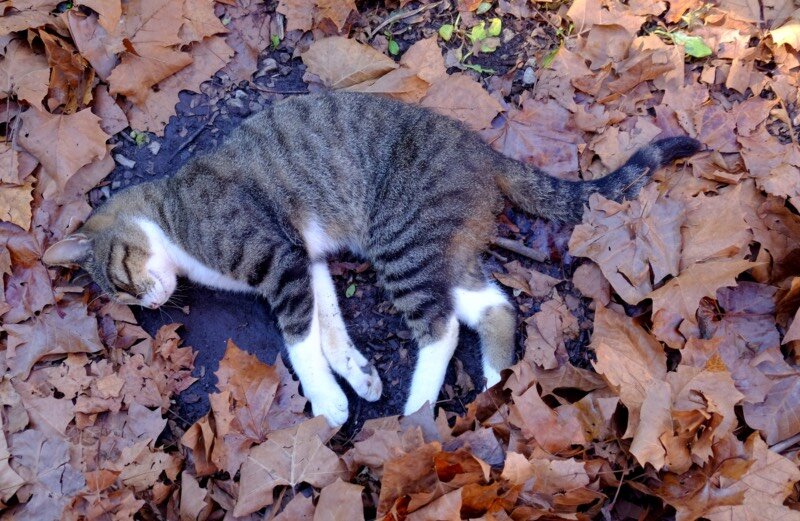
I had come to imagine a kind of communication with the cat. Cats are the kind of animals that might do that. And now it looked as though even though I’d done nothing much for it, it had left me a parting message. Its front legs had been stuck out, stiff, when it was alive, but now they weren’t. Its back was no longer stiff but now curved inward in a way that looked comfortable. And on its face was, yes, a smile, a smile that reminded me of the one in pictures of Simba.
If you tell me I’m being ridiculous I’ll not argue with you. Just remember that we suspect, even believe, many things that are no more provable. “There are more things in heaven and earth,” Shakespeare had Hamlet remind us, “than are dreamt of in your philosophy.” We don’t know everything. As mentioned above, at the beginning, we may not know anything. God moves in mysterious ways.
A luxuriously pretty cat choosing my house as its place to die might mean something or it might mean nothing. I don’t know. I’m not done wondering about it.
Meanwhile, I have a small grave to dig. 
Dennis E. Powell is crackpot-at-large at Open for Business. Powell was a reporter in New York and elsewhere before moving to Ohio, where he has (mostly) recovered.
Pass along this article.
Never Miss Another Article from Dennis E. Powell.
You need to be logged in if you wish to comment on this article. Sign in or sign up here.

Start the Conversation