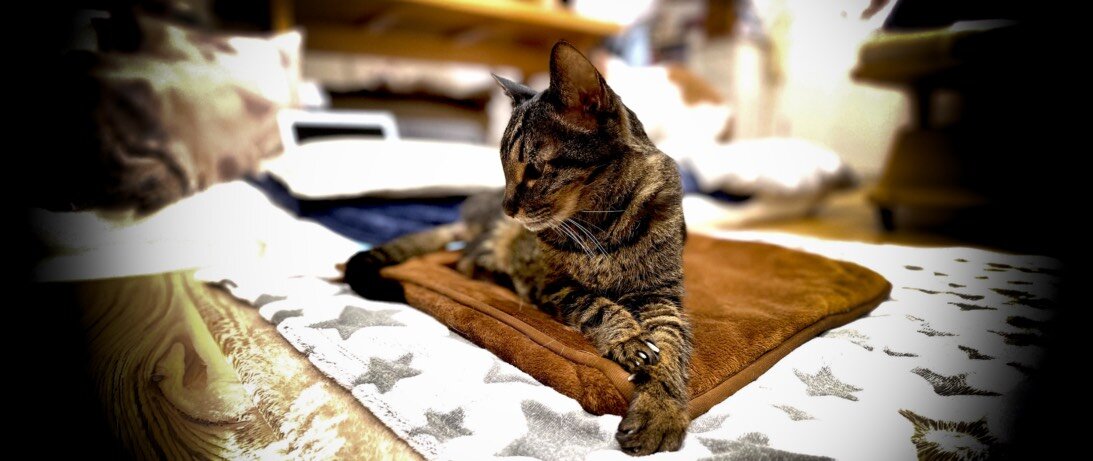
Simba-sama made it to 2026, but just barely. It matters.
His real name was just Simba, but he was wise, so it made sense to add “sama,” an honorific signifying high rank and wisdom, to that name. “Sensei” would have worked, too, because he taught the several other cats in Risa’s house how to be cats.
The Catholic Church, of which I am a member, holds that only humans have souls. I think that this is just something someone made up — I don’t find it in any trustworthy teaching. And with Simba’s death I think I could make a stronger case for cats having souls than for, say, the current president of the United States having one.
My first vicarious knowledge of the remarkable Simba came nearly three years ago. Risa told me that the oldest of her cats wasn’t doing very well. Simba, then 15 years old, was having trouble getting around well and was suffering accidents en route to the litter box. Over the next weeks I learned that she had now constructed a ramp so that he could get up onto her bed to sleep. He couldn’t jump up there anymore.
I remember my thoughts at the time. Simba was an old cat by any measure. Had he lived in the United States, chances are he would have been carted off to the vet to be “put to sleep” once he became inconvenient and required cleaning up after. He was lucky to live in Hakodate, Japan, where cats are revered, and with Risa, who is impeccable in caring for her cats.
Simba got better, it seemed, or else a way of dealing with his continence issues was found. I heard regularly about the cats. Often, quiet, untroublesome Simba was sort of a background character in the household. Other cats demanded attention, too, sometimes but not usually so much over health issues as other things.
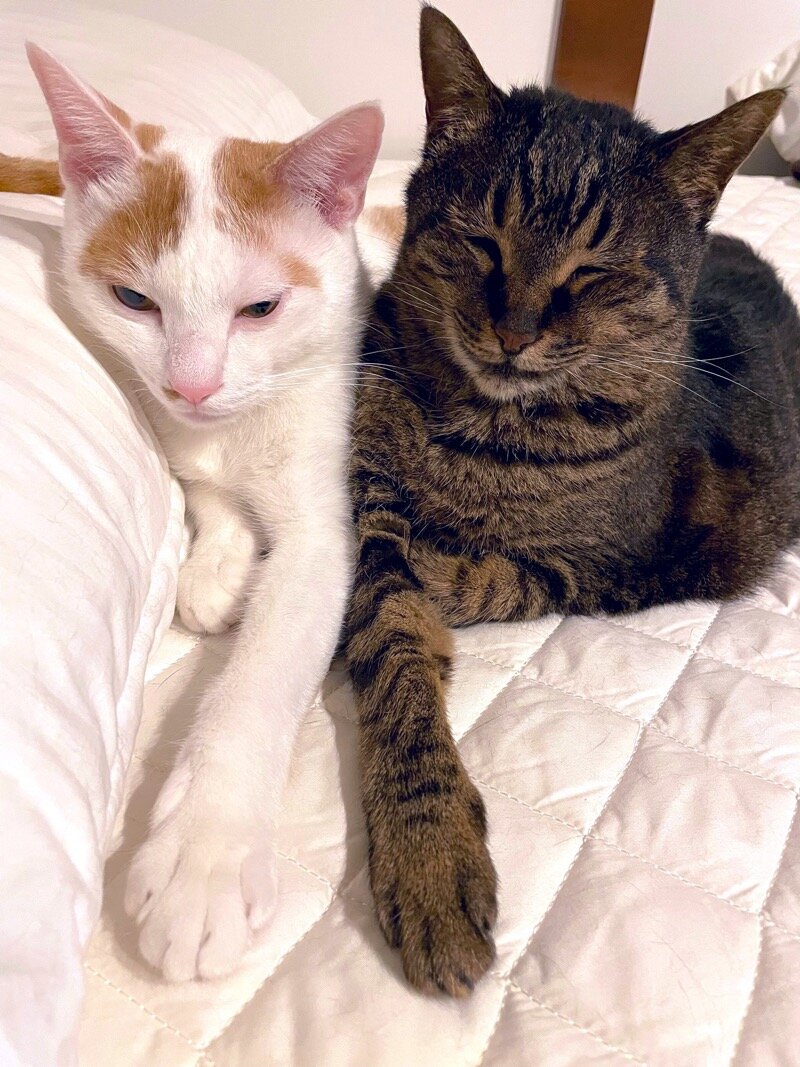
Recently there had been the problem of “cat politics.” A cute, fluffy, white kitten, named Matsuri (the Japanese word for “festival” and originally translated in the kitten’s case as “Marie”) had been rescued by Risa. She had been abandoned near the fishing docks and was sore in need of attention. Much of 2025 was spent tending to her ringworm (which required shaving away much of her hair, resulting in a cat that looked like a poodle with the hairless tail of a rat), and roundworms, eye issues, and a number of other things. The political problem came with Tenten, a rowdy male cat who didn’t know he had grown up. So his play with Matsuri-chan was a little rough. That led to what it seemed likely to be an intractable feud between the two. It was so bad at one point that Risa would place little Matsuri in a shopping bag and take her along to work. You can do this in Japan, especially when you own the business. Matsuri would sleep quietly in the bag while Risa worked.
I became especially fond of Matsuri-chan because it is impossible not to. She is the kind of small, big-eyed cat that makes you want to look for the key where she’s wound up. But I would ask about Simba from time to time. He seemed to be doing fine, like the other cats (I think there are seven in all, but don’t quote me) he devoted much of his attention to sleeping. (Where do cats sleep? Wherever they want.)
The main cast of Risa’s Hakodate cat situation comedy were, then, Simba, Tenten, and Matsuri, with special guest appearances by the others. I could not name them all. There is Maetel, a black long-haired cat whose name came from the furry hat worn by a character in a very old anime. There is Neo, who I think is the one who looks like an artist’s rendering of a cat from outer space. And the others.
There is the one that got terribly constipated a few weeks ago such that Risa had to help him by massaging his belly. This was painful, and the cat responded with a bite. Not a little warning bite, either, but a full-blown, chomp-down bite that rendered that hand unusable for a few days.
On December 8 (Eastern Standard Time — with Japan 14 time zones away it’s not especially easy to keep track of the exact day, never mind the hour), there was a considerable earthquake in northeastern Japan. There was damage over a large area, but Risa and her business, house, and cats were safe. It was followed by more earthquakes and messages of a sort one is not used to seeing.
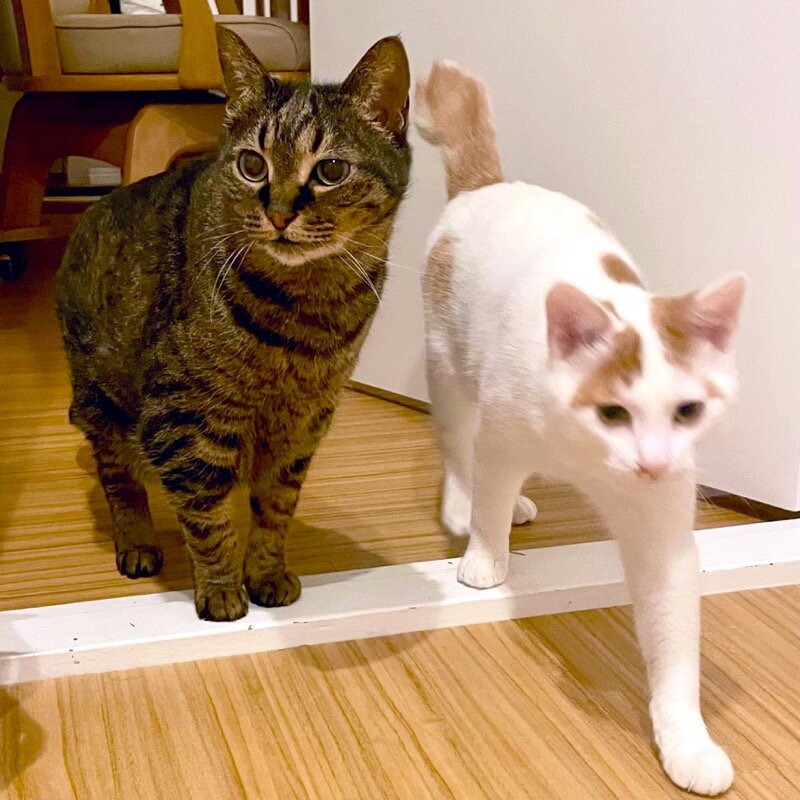
“Small earthquakes continue, but the cats are all asleep,” Risa wrote. Then, the next day, “Last night I couldn't sleep. I never imagined the aftershocks would keep going like this. I don't feel like going to work.” Most of us have never been kept awake by the constant earthquakes.
A couple days later, there was another: “It was a big earthquake. I'm okay though.” And the next afternoon: “There was another earthquake yesterday. There were two big tremors, and I was worried about my cats, so I didn't want to go to work, so I took the day off work yesterday. It's very cold in Ohio, but it's getting pretty cold here in Hakodate too.”
Life does not follow a single plot line. While you’re tensely awaiting the next earthquake, a completely different crisis can emerge. Which is what happened December 22, as described the next day.
“Simba coughed up blood yesterday morning and passed a small fibrous blood clot. I immediately took him to the vet. His blood work yesterday showed no signs of kidney disease.
“So, Simba is going to the hospital again today. He's currently waiting in the car for his turn.”
The following day, bad news: “Simba had an ultrasound today and was found to have a tumor in his abdomen. An x-ray confirmed the tumor and it appears to be causing problems. However, since Simba is 17 years old, my vet and I decided not to perform a biopsy. He was prescribed a week's worth of anti-nausea, stomach medicine, and bleeding medication, and I told the vet to only use Prednisone as a last resort. I will continue to provide care to keep Simba in good health.” The last may have been the announcement that any talk of putting Simba down had best be left unsaid.
I wouldn’t have said it anyway. I grew up on a small farm where there were always animals and pets, so there were sometimes animals that got sick. The only animal I can remember that we had “put to sleep” was a tiny and adorable dog, half chihuahua and half toy poodle, who had been taken to the local university’s veterinary clinic for the usual shots and came home — the clinic was famous for this sort of thing — with distemper. It got worse, became hepatitis, and soon the little dog with its plaintive eyes, who had been all licks and wiggles, was constantly shaking and having spasms. Its spirit was unchanged, but its body was failing and before long it was clearly in pain. It was decided that it would be taken for the veterinary visit whence it would not return. There was a lot of crying around the house that week. So no, I’d not be suggesting anything like that.
“Last year, I put all my energy into taking care of Matsuri-chan,” Risa wrote, “and I'm so happy that Matsuri is doing well every day. I never expected there to be any problems with Simba this year, though.
“The vet told us that the reason Simba vomited the blood clot was probably due to bleeding from the tumor, and that if his blood pressure dropped suddenly after vomiting, he might die.
“Simba is 17 years old, so anything could happen, so I was prepared for it, but I still want him to live a little longer.”
Odd as it is, I felt the strong desire to do something to help this cat that I had come to hold in high regard even though we’d never met and he lived half the world away. I asked if there was anything I could do.
It turned out that there is a kind of specialized, very mild cat food. It is expensive, but I have a Japanese Amazon account and the exchange rate is currently very favorable to the dollar over the yen. So what is very costly in Japan isn’t here, if ordered from Japan and paid for in dollars.
Usually, delivery there is within a day or two. But the holidays intervened and it ended up taking more than a week. Whether it would have made a difference will forever be unknown.
On Christmas came news of another tremor: “I was feeding my cat in the middle of the night when the earthquake hit. Thank you. I'm fine.
“I think Matsuri-chan has become a little stronger recently. When the earthquake hit last night, it was Simba's midnight snack time, so I was feeding him while the quake was shaking, but Matsuri-chan was next to him, hoping to get some of the leftovers.” Normally, during thunderstorms and other disruptions, little Matsuri skedaddles under the bed. It was good to hear and it seemed almost as if the crisis had passed.
In fact, by the Saturday after Christmas things seemed almost to have returned to normal.
“I think Matsuri-chan is growing up to be a very unique cat. She seems to know she's safe near Simba, and sometimes sleeps nearby. When Tenten gets too close to her, she growls lowly to intimidate him. Lately, when she gets bored while I’m brushing her, she's started complaining to me in a little monkey-like voice. But if I don't stop brushing her, she'll bite. Matsuri doesn't have a strong bite, so maybe she's being gentle, but it doesn't hurt. While the other cats are sleeping, Matsuri-chan runs around like a horse, chasing toys enthusiastically, drifting, and braking suddenly — it's so entertaining to watch.”
There was another outbreak of cat politics between Matsuri and Tenten. We had from the beginning tried to sort out the cause — everybody got along with everybody else. I thought that perhaps Tenten was jealous of the attention Matsuri had received.
“When Tenten came to our house, she was still a baby and everyone loved him, so even now he approaches everyone crying like a baby,” Risa said. “Maybe he approaches Matsuri-chan in the same way. Matsuri-chan looks bigger because of her long, fluffy fur…” The funny thing is that Matsuri is a small cat, and Tenten is bigger, facts apparently unrecognized by Tenten.
Yes, perhaps Simba had gotten past the crisis, as had happened before. “Simba had breakfast and moved from my futon to his own kotatsu. Matsuri-chan is standing by the window with everyone, looking out the window.”
That would be the last of the happy, hopeful messages. From that night: “Simba wanted food in the evening and enjoyed some catnip, but then the pooping commotion started. He was constipated so he strained and then vomited, but a lot of food came out that was almost undigested. When he still tried to pass stool, tarry stool came out. He continued to strain for a long time after that, so I helped him pass stool, but he strained so much that Simba's tongue came out too, so I watched over him, worried that he might die, when he got up and walked to the toilet to pass stool again. I helped him again and he passed stool, but he is now asleep.
“Simba's breathing and heart rate are stable and he is now sleeping soundly. Simba sleeps warmly in the kotatsu, so today I'm going to sleep on the floor with a futon next to him.” A kotatsu is a table with a heater beneath it and a blanket over it that hangs down on the sides to the floor. If you’ve read manga or watched anime, you’ve undoubtedly seen how fond people there are of falling asleep under the kotatsu, with only their heads sticking out.
I didn’t entirely understand the next message, which was both alarming and hopeful. “Simba is moving towards a stage where he can lighten himself out of the container that is his body.”
The Japanese approach to death is different from the Western one. This is in part due, I think, to the mixture of religions there. I have heard it said that people in Japan want a Shinto birth (a ritual called Miyamairi), a Christian wedding, and a Buddhist funeral. I haven’t really discussed it with Risa, but bits of all three religions seem to permeate most everyone there and together provide great comfort.
Buddhism finds a spark of the divine, a soul, in everything. It would not be unusual to hear someone who had accidentally banged a chair into a table apologizing to the chair and table — and meaning it. And I have not found anyone in Japan who doesn’t believe in the afterlife. In some cases it is thought of as heaven, while in others it is envisioned as reincarnation. So while death is thought of with sadness, it is more like the happy sadness someone graduating and moving away.
That is the spirit in which I interpreted Risa’s inscrutable note.
The next update was New Year’s Eve.
“Simba has not eaten or drunk anything since the evening of December 29th. However, his usual daily routine involves slowly walking to the bathroom, relieving himself, and stopping by the water fountain. Although he no longer drinks, Simba still checks the water. While I was sleeping, Simba went to the bathroom by himself and returned to the kotatsu. Simba has urinated six times in the past two days. On the 30th, he vomited a large amount of water, and then vomited a little again, which was bloody. Simba's heartbeat is still clear and strong, but his breathing is very slow and shallow.”
And very early New Year’s Day, with a picture. “This is Simba right now. He walked out of the cat kotatsu and sat on the heated carpet. Happy New Year! I'm overwhelmed with emotion as Simba welcomes 2026.” The new year has far more significance in Japan than it does here. The note arrived just after 1 a.m Japan time.
The special food arrived January 2. It was too late to do what we had hoped.
“Simba passed away around 2:05 PM. His last meal was on December 29th, and although I had been giving him water with a syringe for the past few days, he was only able to swallow about three drops. Simba lived in a cat's body for 17 and a half years, but his heart was very strong, and even when he was in a coma, his pulse was still strong. He was a big eater, so that may have been the secret to his longevity. He couldn't eat the dry food you sent him, but it was a small pellet and was cute.”
The outcome was no real surprise, but I didn’t expect to be so moved by it. It was not especially grief or sadness but instead in the style of Risa’s words. She approached it with the attitude that Simba made all the choices himself as to how, now that his time was up, he would go on to what’s next. It would be hard to argue with her reasoning. I think she is right.
“Simba chose to align his own lifespan with the end of the New Year holidays. He was a wise cat after all.”
There was even, perhaps, something on the order of passing the torch.
“Tenten became sensitive to the Simba Festival held at this house during the New Year holidays and would walk around the house howling very sadly, so I think he still has something hidden in his heart.” He knew what was going on and had his own cat ritual, it seemed.
Nor was it as simple as an animal getting sick and dying.
“Seventeen and a half years is a long lifespan for a cat, and I am grateful to Simba for being my lifelong companion cat.
“However . . . before the New Year holidays began, I helped Simba with his constipation, and after he passed a hard stool, he lost consciousness. I performed artificial respiration and cardiac massage, and then he passed another hard stool, which made him lose consciousness again, but he woke up again. While he was in a daze, some mysterious substance in his body functioned, and Simba performed all sorts of miracles over the course of five days, which was full of surprises.”
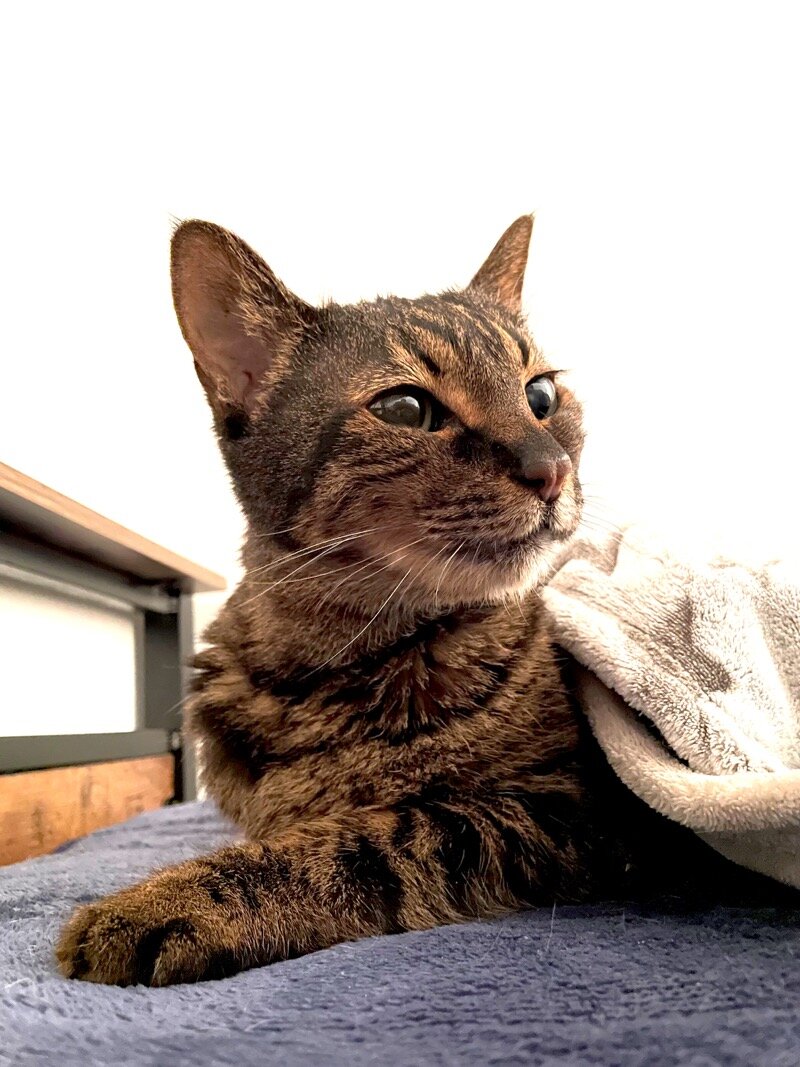
Miracles? Well, yes, when you consider that Simba-sama was dying.
“I had been sleeping on the floor with Simba, yet he walked to the bathroom by himself, did his business, climbed the ramp, and was sleeping in the bed where he always slept with me. I woke up on the floor and was surprised to find Simba sleeping on the bed.”
There was more, Risa said.
“Yesterday, when I thought Simba couldn't move anymore, he moved over to sleep next to me on the floor, so I guess Simba was worried about me.
“And then, like a handsome hero from an old manga, he took his last breath, coughing up blood. I listened to Simba's heartbeat with my stethoscope until it faded into the distance, hoping that maybe he'd come back to life. Even now, I have the illusion that Simba's corpse is still breathing. Simba never lost his appetite until the very end, so I didn't force him to eat, which meant he didn't become wary of me. I used a syringe to give Simba water, even though I'd never used one before with him, and he understood right away. I thought Simba was such a clever cat.”
And, as one would find in any of a multitude of old Japanese stories, it all gave Tenten time to grow accustomed to his state in life.
“Tenten will be 6 years old this year. He may have realized that he is no longer a baby.”
I think that Japan has it right about rituals. They are invariably beautiful and reverent. Significance is sought, and it is found. It is impossible to deny. And it is full of confidence for the future, and peace of mind. Of course cats have souls!
“At Simba's final tea party, I asked him, "Would you like just one cup of coffee?" as I ate my matcha tiramisu. As I finished my coffee, Simba fell into a coma. 2026 began in a truly miraculous and mysterious way, like Risa chasing a brown tabby cat in Wonderland.” Things had unfolded in the way they were meant to unfold. And the way Simba chose.
“Simba must have been targeting my long New Year's holiday, as he chose the day when we promised to welcome the New Year and the end of the New Year's holiday in Japan as his death anniversary,” she wrote me yesterday. That anniversary is observed in Japan more reverently than it is usually observed in the West. It is both touching and heartening.
“Looking back, Simba's farewell ceremony began in a slightly unusual way. As I was getting ready to leave for work, Simba came over, sat in a beautiful posture, and gazed at me intently. And at that moment, Simba was smiling with a gentle look in his eyes. His back was straight, his front paws perfectly aligned, and his eyes were fixed on my face. ‘That's unusual. Did you come to see me getting ready for work? It's been a while,’ I said, stroking Simba's head and body. Then, he began to smell catnip. Simba must have been reflecting on his 17 years of life.”
It might have been his formal goodbye, and encouragement for the trying days to come. Perhaps thanks for 17 years during which Risa had never failed him.
“That's why I placed catnip in Simba's coffin today. It was cremated along with Simba, so Simba will be reunited with his fellow cats in heaven and enjoying some more fun parties!”
Here, far away, never having seen Simba-sama in person, I am nevertheless filled with gratitude. If a cat in Japan can have such dignity, he has taught me that maybe I can, too. Though it came naturally to him. 
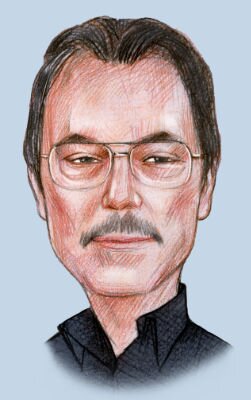
Dennis E. Powell is crackpot-at-large at Open for Business. Powell was a reporter in New York and elsewhere before moving to Ohio, where he has (mostly) recovered.
Pass along this article.
Never Miss Another Article from Dennis E. Powell.
You need to be logged in if you wish to comment on this article. Sign in or sign up here.

Start the Conversation