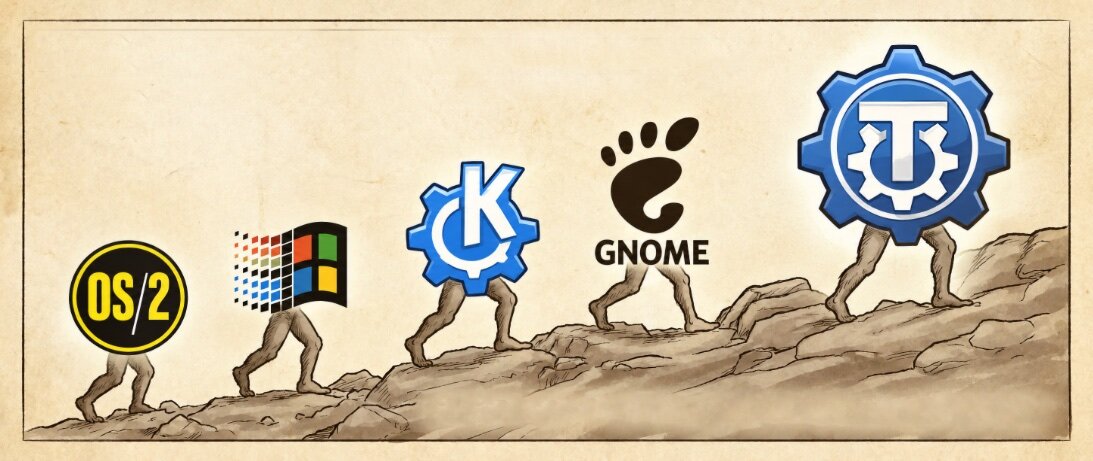
The days ahead were bright but vexxing.
People I knew at IBM, just up the road a few miles in Armonk or at the Watson lab a little farther away in Yorktown Heights, had all moved around. The famous “Blue Ninja,” Lee Reiswig (whom I just found out died a few months ago; RIP) was nowhere to be found. The IBM people I could get on the phone, young, enthusiastic, soulless IBM drones, were now saying to use Windows of all things.
I was trying to get in touch with the IBM OS/2 folks for an article that it turned out wouldn’t be published for a while and that it turned out would bear the title “Who Killed OS/2.” But now, in 1996, there was a more immediate problem: I needed to find a new operating system and in that search I wasn’t alone. It certainly wouldn’t be any flavor of Windows, because Windows then and even now, well, sucks. And for official IBM people to now tell me to drop their excellent operating system was more than one should have been expected to bear.
My good friend from the OS/2 user world, Bob Bernstein, had been fiddling with this strange new thing, a Unix clone system put together by a Finnish college student named Linus Torvalds. It was not easy to install and configure (at the time; it is easy to do now). He encouraged me to give it a try. OS/2 had a feature called “Boot Manager” that let a user switch among operating systems on one computer, so why not?
At that time, when internet was via dialup and I was king of the online would because I had a genuine US Robotics HST Dual Standard modem and therefore could theoretically connect to the web at 9600 bits per second, one didn’t usually download Linux. Instead, you would go to the local mega bookstore and purchase for $50 a thick book that had at its back one or more CDs containing one Linux distribution or another.
Which I did. The one I got contained Caldera Open Linux. I selected it because the screenshots looked good. That was because it shipped with something called “Looking Glass,” a graphical user interface that was commercial and closed source and that quickly disappeared. It had no native applications and if you did want to add applications to it you’d have to write a text file to configure it.
I didn’t stick with Caldera for long, and soon the company became anathema in the Linux world when a guy named Darl McBride became head of the company and turned it into a company specializing in lawsuits. I met him at Linux World Expo in New York and interviewed him. He was a jerk. He died a couple of years ago; every so often even now someone buys what’s left of the company and starts suing again. At one point it was claimed by Caldera or one of its successors that every Linux user owed it $200.
Anyway, 30 years ago there were various do-it-yourself graphical user interfaces for Linux. You could mix and match, parts from one joining parts of another. All were configured by a text file that you would write yourself. I got pretty good at it, but it wasn’t optimal. In those days, things like copying from one file and pasting into another were either impossible or complicated and difficult. (Though I did like XFMail.)
It’s possible to reminisce endlessly about all this, but let’s not. Nor need we, because in July on 1998 the first sensible, organized, attractive, free, open source desktop for Linux appeared. It was called KDE (the “DE” stands for Desktop Environment, but there has never been agreement what the “K” stands for). I installed it the day it was released — back then, you would download a series of source packages, compile them yourself, and install them someplace you thought appropriate. But that was no big deal because we all compiled everything ourselves. It went together pretty easily and it was by Linux standards beautiful. I never looked back. Well, sort of didn’t.
I unexpectedly revisited those early days when a few days ago I happened upon a little movie, “KDE: The Documentary —- The Story of Free Software Underdogs.” You can watch it for free, here. I did, but I’m not entirely glad of it. I thought it would be nostalgic and heartwarming, and to some extent it was. But it brought back things I’d just as soon not remember. The birthing of KDE and the things that were followed had aspects of a horror show.
It includes many names I hadn’t thought of for years. The developers seemed very cool in our online communications, and in many respects they were and are. But the mental images of them one formed were not matched by reality. They were actually kind of the stereotypes of computer nerds, living in the basement on a diet of Cheetos, and showing it.
When KDE-1.0 was released I thought that the Linux desktop issue was resolved, and for me it was, but I was writing about Linux for a living now, so instead of going merrily on my way I had to be in the midst of what followed.
First, a fellow named Richard M. Stallman, universally known as “RMS,” began a religion in which he claimed that all information should be free and all software should be free. “Freedom” was oddly defined in his world. Anyway, to him KDE was not free. He cast his lot with “Gnome,” a different, at that point nonexistent, desktop that met his definition of freedom. For years, maybe even now, the desktop wars were fought. Gnome finally released, and it was awful. (Gnome version 51 recently was released. It is still awful.)
A leading light in Gnome development was young programming star Miguel de Icaza. He was a nice guy when I spent an afternoon with him and his business partner Nat Friedman at the Boston office where they ran a Gnome-based company called Ximian. He would later work for Microsoft Corporation, and for that was attacked by RMS. A program that he wrote a long, long time ago, Midnight Commander, is the first program I add to any Linux installation. I use it every day, so I am in his debt. But in the early days of the desktop wars Miguel (who had already written Midnight Commander and who was known by his first name throughout the Linux universe) was a villain to those of us who preferred KDE. He is interviewed in the documentary.
Initially, KDE was excellent, I thought. In fact, in 1999 I wrote a book about it. For a time, we were most of us mostly happy with KDE.
Appropriately, a good amount of time is devoted in the documentary to the monstrosity that was KDE-4.0, released in January 2008. It was bad. Very bad. It actually forced KDE to change the name of its desktop to “Plasma.” It was a total disaster.
I tried to run it for a time, but there was no fixing it. It was broken and when it was finally gotten to work the changes the boys had made were unacceptable. (In my estimation, the current KDE Plasma remains unacceptable. Added to that are strange offshoots such as the unusably bad “Plasma Bigscreen,” which is blessedly absent from the movie.)
Included in the documentary, though, is the excellent community response to KDE-4.0 called the “Trinity Desktop Environment,” or TDE. I’m writing this on a machine that is running TDE. I have had TDE on all my machines since its release years ago. It is an updated, modern fork of KDE-3.5, the last good version of KDE. It is wonderful, and it has a friendly, knowledgeable user community.
When KDE 1.0 came out in 1998, many Linux users said that it would do until Gnome was released. I was not among them. Instead, I said that it would do until Enlightenment was released. The brainchild of Carsten “Rasterman” Haitzler, Enlightenment was already in the works when KDE-1.0 was released. It is still in the works. It is not yet to version 1.0 these nearly 30 years later, but it is still under development, is gorgeous, and I keep it on all of my machines and recompile and start it from time to time. If I had to, I could use it exclusively without too much pain, though the sensation would be a little like those early days I spent running Linux, but that’s more my fault than it is Enlightenment’s.
I had just finished digesting the KDE documentary when I happened upon a new video by Christopher Barnatt in his “Explaining Computers” series. It basically takes the view that everything we currently do with computers, and the computers as we know them, will be obsolete before too many years have passed.
Artificial Intelligence will change everything he says, including the hardware we use, and he wonders why like many he is not excited about it. It is excellently reasoned, as his work is wont to be, and the questions he raises are worth pondering.
Both Barnatt’s video and the KDE documentary are well worth watching, though neither will impart peace of mind. 
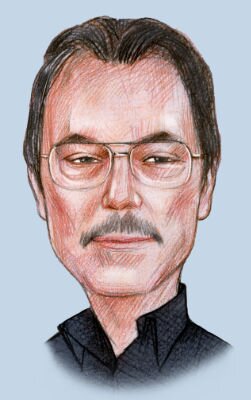
Dennis E. Powell is crackpot-at-large at Open for Business. Powell was a reporter in New York and elsewhere before moving to Ohio, where he has (mostly) recovered.
Pass along this article.
Never Miss Another Article from Dennis E. Powell.
You need to be logged in if you wish to comment on this article. Sign in or sign up here.

Start the Conversation