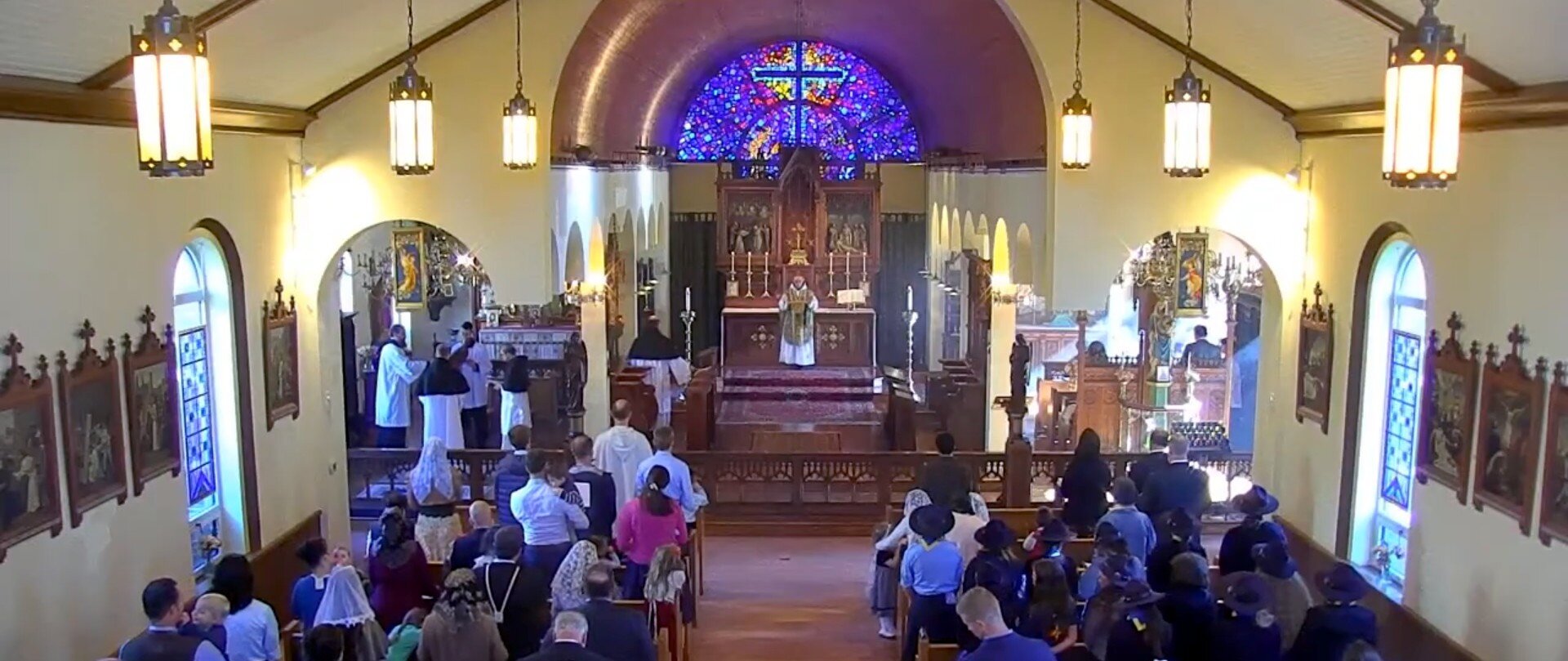
One would never have guessed the power of just zooming the camera back.
In late spring, as I’ve written, our beloved local priest, Father Mark, died of esophageal cancer at age 49. The grief-stricken congregation was oddly denied admission to the parish church for his funeral. The church ended up being half empty; the service was to be streamed for those who cared to watch.
Which I did. And, armed with the knowledge that televised Mass was apparently as valid in my parish as being physically present, I found a parish that was not the corporate Catholicism that is currently the way of things. It is the Canons Regular of the New Jerusalem, located in almost-Maryland West Virginia, in a diocese a 20 minutes east of me. Except for two occasions — once when the link was mislabeled and once when a storm had knocked out the power, leading to my summer’s quest for a reliable generator — I have “attended” Mass there every day since Father Mark’s funeral in mid-June.
The Mass there is celebrated in Latin. That is important.
The abuses of the documents resulting from Vatican II 60 years ago are many and awful, each worse than the one before. As a result, the liturgy itself has been sundered. Its translation, as well as the shameful Bible translation approved by the U. S. Conference of Catholic Bishops — the American board of directors of Catholicism Inc. — have sucked the sanctity and solemnity right out of it.
Not to put too fine a point on it, but I was born alone and will one day face my Creator alone. I care about my eternal disposition more than a bunch of bishops who are more trendy politicians than spiritual guides do. I daresay I care more about everything important than they do.
There are a few, just a few, bishops who remember why their bishoprics exist. Among them is Raymond Leo Cardinal Burke, one of the leading advocates of a Christ-centric, traditional Catholic Church. It has cost him.
There is little more boring, while at the same time more disgusting, than Church politics. There is no church, I think, that doesn’t have earthly politics, often ahead of the purpose of the church itself; this seems to have been the case always. Its practitioners can explain themselves on Judgment Day. I’ll be over at the side begging for the forgiveness that I do not deserve.
My hope in making it through that ordeal without ending up in the sizzling, flaming pits of Hell rests on my embracing every drop of sanctity I can find during this life. The traditional Mass, in Latin, is a pure distillation of sanctity.
The Canons Regular of the New Jerusalem was formed in 2002 by Cardinal Burke and Dom Daniel Augustine Oppenheimer. It was originally in LaCrosse, Wisconsin, then for a time in Chesterfield, Missouri, before moving to Charles Town, West Virginia. It is a monastery living under the Augustinian Rule established by St. Augustine 1600 years ago, now in a town established by George Washington’s brother Charles.
The Mass there is streamed, thank God. Perhaps in concern for the souls of those of us who keep odd hours, the Masses (and daily Vespers) are kept available online. That means I can partake of the day’s celebration whenever I wake up. I’m not sure that this is approved, but each day I am a bit amazed when, as I have noticed has been true at every Latin Mass, there’s a wave of relief and peace that comes over me at some point during the Mass, even if I participate hours after it was actually said.
This week it reached out and embraced me even more, in a way I didn’t expect. It added something important.
The Mass as usually broadcast there has had the camera zoomed in on the sanctuary and altar. This has its intimate aspect, but it can make one feel isolated.
This week, the view was zoomed back, showing the nave — the pews and the congregation.
The lovely, holy congregation. I’m not sure I’ve ever been so moved.
It is a small church, the nave comprising two ranks of pews, each pew with room for four or five people. The sanctuary is beautifully but not gaudily decorated. On Sundays, when Mass is sung, there is a small but powerful choir of men in Gregorian chant. It always amazes me that there are so many servers and altar boys — “acolytes,” they were called in the Episcopal high church of my youth, since largely disbanded. At many parishes, it’s hard to find any, though with the new Mass they’re not especially important.
I love the congregation, true, Biblical love. There are old people. There are young people. There are families with children. I think that close to half of the congregation is children. Many, many babies (Catholic babies can be very loud, and that makes us smile).
Seeing the congregation fills one with the sense of being warmly welcomed into an extended family.
This serves as just the right buffer, the soft edges in what is very formal liturgy.
When the camera is zoomed in, much of that is lost. You do hear the congregation where appropriate, but you lose the sense of being among them.
The liturgy is augmented, and if I may say so enhanced, by its surroundings. Several times each week at the 8 a.m. Mass one has to listen carefully because of the horn of the freight train going by. There’s occasionally a loud motorcycle roaring past, or the siren of an ambulance. And as I said, Catholic babies can be very loud. The sounds of daily life are unexpected at a traditional Mass, but I now think they are important. They bring that oh-so-holy liturgy to us, to we ordinary people, there to worship in the hope that our perfectly ordinary lives may become holy.
When the whole church was made visible, it warmed the heart to see even very tiny children who knew to genuflect in the aisle before taking their seats. Little boys and girls often dress up for church on Sunday, as was once customary. A new suit or dress for Easter used to be a regular thing. I think I saw one dress or two that had been made at home, with more care than a commercial dress factory can provide.
Not everyone dresses up, nor is everyone expected to dress up, but those who can do.
With the camera zoomed back, I felt surrounded by the warmth of everyone there.
I wonder if the people of the congregation are aware of the online parishioners out in the world. I hope that they are, and that they are know they are appreciated in sharing their worship with us. In my case, my local church is almost 20 miles away. When Pope Jorge Bergoglio tried to crush the Latin Mass, the traditional liturgy was banned in the Diocese of Steubenville, and I lost any desire to make that trip. (Also, I got the sense that if a nearly 2000-year-old liturgy could be eliminated on the whim of an overly political pope, the Church was saying it shouldn’t be taken seriously. I caught weekly Mass on EWTN and let that be that.)
I hope and pray that Pope Leo, perhaps awakened by his recent health issues, decides to undo Francis’s unhappy decision to ban the Latin. And I give thanks for the holy work of the Canons Regular of the New Jerusalem.
Because we’ve never been more in need of sanctity than we are now. 
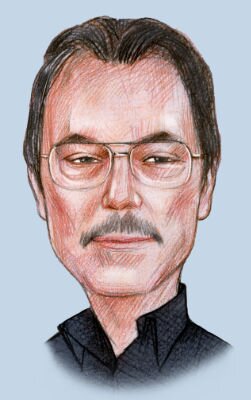
Dennis E. Powell is crackpot-at-large at Open for Business. Powell was a reporter in New York and elsewhere before moving to Ohio, where he has (mostly) recovered.
Pass along this article.
Never Miss Another Article from Dennis E. Powell.
You need to be logged in if you wish to comment on this article. Sign in or sign up here.

Start the Conversation