My grandparents, whose little farm was next door to ours so my sisters and I grew up effectively with two houses and two very different sets of parents, were lovely people.
I remember them as always having been old because during the time I knew them they were old. They seemed not so much to have come to terms with advanced age as to have mastered it.
They did what one thinks of as old people things. One of those things was the careful placement on the knotty pine breezeway wall of little wooden Pennsylvania Dutch plaques, brought as gifts by their son, our Uncle Willard, and his family from Pennsylvania. The plaques offered little mottoes, hand-painted, I think, with amusing illustrations. “I was sad that I had no shoes,” said one, “until I saw a man who had no feet.”
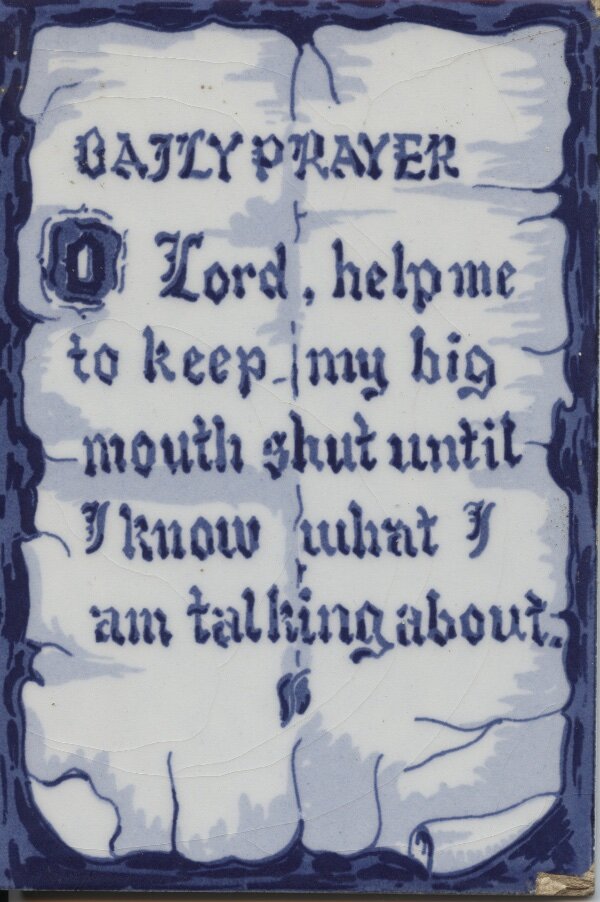
The one that I inherited isn’t made of wood but ceramic, like a glazed bathroom tile, instead. It reads, “DAILY PRAYER. O Lord, help me to keep my big mouth shut until I know what I am talking about.” On the back it is rubber stamped that it was hand painted in Holland.
The one that is most vivid in my memory (which is more vivid about many things than I would have expected) was a wooden one, like the other wooden ones with the ends cut in jagged fashion as if it were to resemble something that washed ashore. It said “Too soon old, too late smart.”
I remember it especially because as a little kid I puzzled over it, not so much its sentiment — when you’re a little kid you don’t worry about such things — as its peculiar wording.
That plaque from my grandparents’ breezeway (the screen porch between house and garage, used especially at lunch in the summer, in front of an electric fan and a radio on which Paul Harvey was followed by Harry Caray calling the Cardinals game) nowadays doesn’t so much bring happy memory as it haunts. This especially happens when the passage of time becomes stark and unavoidable.
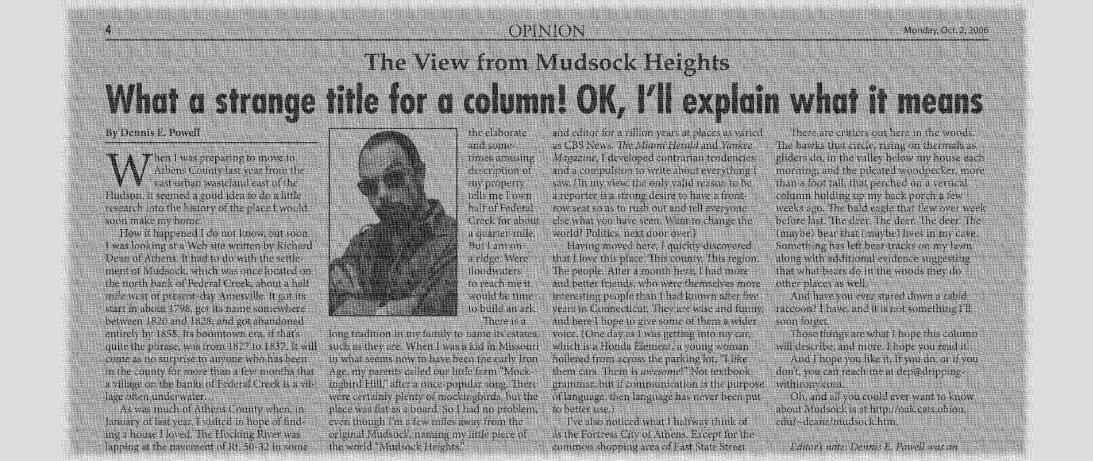
This Friday the passage of time will be stark and unavoidable. For it was on October 2, 2006 that the first edition of this column appeared, on page 4 of The Athens News in Athens, Ohio. Like many of the world’s newspapers that were being published at that time, the ANews as it was known no longer exists. Its diminution came as a surprise to me, because about the time the column started there was an article in Editor & Publisher magazine that said there were only three newspapers in the country that were growing, and The Athens News was one of them. Now it is gone. (Editor & Publisher itself was closed in 2010, though a reduced revival was resurrected.) Looking back it is easy to realize that many unexpected things happened in those 20 years. Yet for some reason it doesn’t seem like 20 years at all.
But heavens yes, it has certainly been 20 years, a column every single week but one — we did a rerun when I was covidized. When that first column appeared, George W. Bush was president and would be for two and a half more years. (There’s an argument to be made — I’ll make it — that he’s the last president fit for the job.) If you had said then that 20 years hence the pompous and dangerous New York loudmouth buffoon Donald Trump would be president you’d be urged to seek treatment. Unfortunately, the superlative criticisms that were wasted on Bush, “W” as he was called, had lost all their sting by the time Trump, or the gooey clown filling between his two crunchy terms, Joe Biden, came along to disgrace that once-honorable office.
But the original purpose of the column had nothing to do with politics or, really, national anything. I had moved to the woods of Appalachian Ohio a year and a half earlier and my purpose was to remind the people here what a delight their region was and is.
It is a unique place, though I suppose every place has its own distinctive qualities.
The people are kind — if you are pulled over on the side of the road, very nearly every passing car will stop to ask if you need help. When you’re in the yard and someone drives past, they will wave and you will, too.
People who are here have mostly been here their whole lives. After 21 years and change I’m still a newcomer. If you ask directions you might be advised to turn left where that huge tree used to be, even if that huge tree fell down in a storm a decade before you arrived.
“I don’t know half the people five miles down the road anymore,” commented June, who along with her husband Leonard — who had gotten shot in the shoulder on Omaha Beach as an 18-year-old D-Day soldier — had sold me their house when they moved to Belpre to be near her sister. They would still stop by from time to time, just to see how I was doing. Sweet people despite some traditional assumptions — if I had been Roman Catholic at the time and they had known about it, they probably wouldn’t have sold the house to me. They’re both gone now, alas. Their sons remarked on it when they believed they had detected a tinge of local accent in my speech.
The local language is unique, as are its origins. This was a mining area, and European miners from many countries emigrated to dig coal. They spoke many different languages, and came up with their own version of what passed locally for English. I remember one young woman who told me she liked my Honda Element. “I like them cars,” she said. “Them is awesome!” Even in my relatively short time here much of the colorful language seems to have died off. You’ll no longer be asked, when you’ve made a purchase, whether you want a sack for it.
It seems that Curt Cable may have moved away as well. One of my favorite people, he had the purest Appalachian Ohio accent and usage I ever heard. It flowed like honey. Sometimes it would take a little thinking to decipher; it was almost a dialect. Curt was typical of small-town Appalachia: He was a broom maker for a living, but he was also the pastor of a small neighborhood church, and he played guitar as if he were born to it. Because he was.
A lot of the people here hadn’t noticed the things I hoped to write about, or the attitude they imparted. And I now realize that I haven’t noticed as well as I should have the disappearance of many of those things.
I had lived here for more than five years, including a lot of time spent in the nearby college town, before I heard a horn beeped in anger. In 21 years, I can count on the fingers of one hand how many times I’ve heard horns honked. I think it is just generally assumed that one can’t possibly know whether what he is up to is more important than what some other person, maybe in a slower car, is up to. It would be impolite and selfish to assume that the other person should get out of my way because I’m more important.
For the first months I lived here, I had what is known in real estate as “free gas.” The natural gas that fueled the furnace and the stove came, literally, out of a hole in the ground across the road. (I did have to switch to propane eventually, because the gas well was on a piece of property that Leonard and June retained, so I was no longer entitled to the gas that was otherwise being sold to a gas company. (I kind of wish the gas folks would stop by and ask if they’d like to drill a well on my property. As much as I like the propane folks, I’d like free gas out of a well in the field down the hill even more.)
It all seems so ridiculously recent, yet it isn’t. Occasionally I encounter someone I used to see all the time but haven’t, it turns out, in 10 years. I have no idea how or why we come to lose track of the passage of time. So much has happened, yet so much seems constant. Perhaps it is to accustom us to what comes when we’re done with this life, where if we were good (or sufficiently repentant) there is no such thing as time. That’s a guess. I do not know.
All I can really know with certainty is something from the most memorable of the plaques in my grandparents’ breezeway, and not even all of that.
Too soon old, yes. But “too late smart”? That takes for granted facts not in evidence, as the lawyers say.
Ask me again in 20 years. 
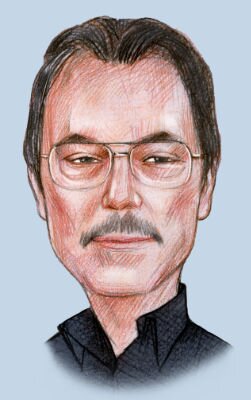
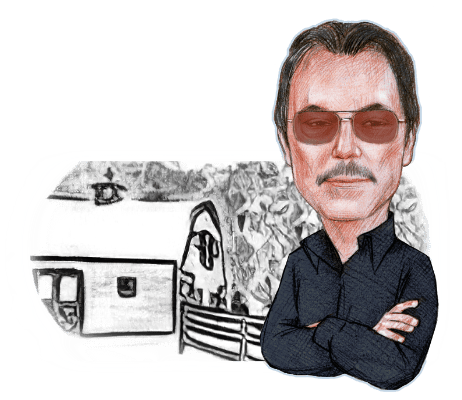
Dennis E. Powell is crackpot-at-large at Open for Business. Powell was a reporter in New York and elsewhere before moving to Ohio, where he has (mostly) recovered.
Pass along this article.
Never Miss Another Article from Dennis E. Powell.
You need to be logged in if you wish to comment on this article. Sign in or sign up here.

Start the Conversation