My friends Pat and Bobby visited briefly over the weekend.
I met them when Pat and I were in ninth grade and we both shot Miranda cameras. The last time I saw Pat, George W. Bush was president; the last time I saw Robert, Richard Nixon was. Pat now lives in Lithuania. Bobby doesn’t.
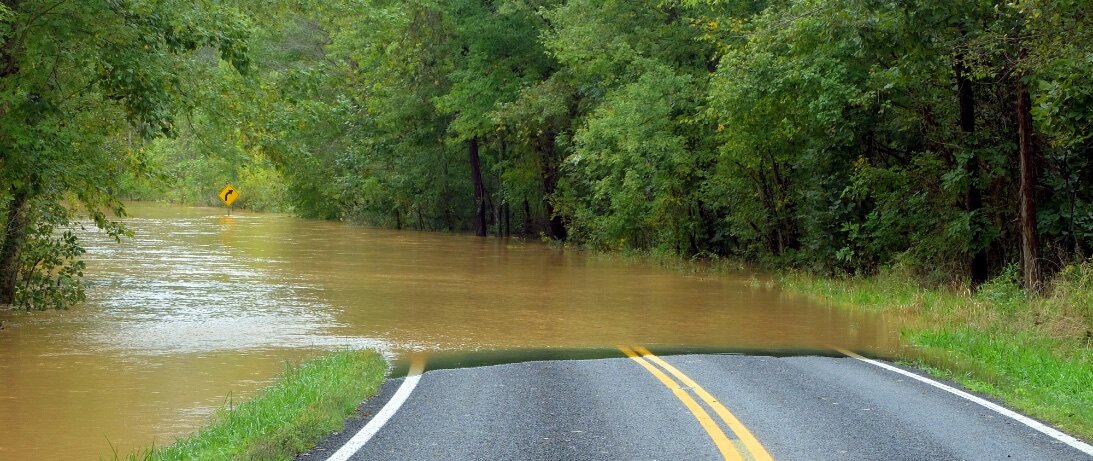
For a time it seemed as if seeing them would be difficult. We had a lot of rain here, and when a lot of rain comes there is flooding. As I’ve previously noted, the National Weather Service seems fond of alerting people to the possibility of floods by making sure the people who are wise enough to have weather radios do not get any sleep.
Nor can one afford to turn off the radio. On Sunday night, the alerts over the course of an hour were approximately this: flood, flood, flood, flood, tornado warning, flood, flood, flood, severe thunderstorm warning, flood, flood, and so on. Wait, what? You get used to the lecture on flood safety that accompanies every flood warning, and then they throw a tornado warning — not a watch, no, a full-on warning — at you. Then they never mention it again. (Nor is there any “turn-around-don’t-drown” little saying for tornadoes. “Hide from the sky if you don’t want to die” would be sufficiently ridiculous and it actually rhymes.)
The flooding came on Monday. Even if I hadn’t heard about turning around and not drowning a hundred times in the preceding 12 hours, I still would have turned around and I still wouldn’t have drowned. I was doing and not doing those things, respectively, long before our government inflicted its little ditty on us.
It floods here every so often, at least a time or two a year. This is occasionally dangerous and always inconvenient.
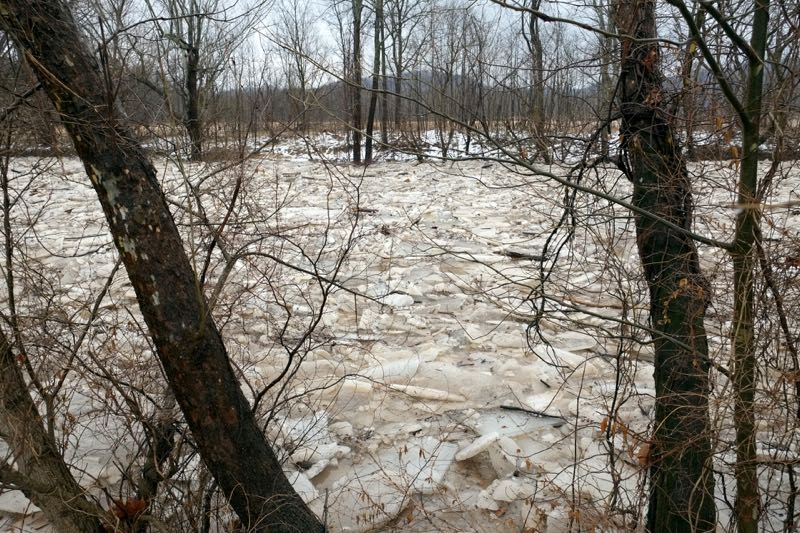
But this year the weather has been peculiar. In January and February there were a few weeks when it was extremely, endlessly cold. This followed a snow storm that got an inch of ice on top, making travel such as walking a few feet impossible. Day after day. For weeks. In July, August, and September, it was hot and extremely humid, also endlessly. People complained of mold growing on the woodwork. Usually in both cases there’s an occasional nice day, a little beam of hope, but not this year. And it all portends nothing.
We had just the one snowstorm, but it was presented in the worst possible way. And the rain this summer hasn’t been appreciably different as to total quantity from most any other year, but its arrival has been different. When it came, there was a lot of it. We’ve had several occasions when there was rainfall of more than three inches in an hour or two. Then things dried out, though the humidity remained.
It makes me think of the moon, where on the sun side it’s 260 degrees and on the dark side it’s -280 degrees. Averaged, it’s within the temperature range found on earth, but you’ll be moving around a lot on the moon if you want to stay in that range. Likewise, the average temperature where I am is pleasant, and the amount of rainfall is adequate. Those phenomena are not scheduled for our convenience.
When we’re inconvenienced we look to place blame. It was hot in Europe this summer. Many people died as a result. They didn’t have to die, but Europe has decided that air conditioning is harmful to . . . something, so it is widely banned there. Then we’re blamed for the hot weather.
Weather has been politicized along with everything else. Stand back — about 18 inches is sufficient — and you’ll realize that this doesn’t make any sense. Weather varies. It always has and in all likelihood always will. In ancient times, bad weather was a religious thing and people would respond by making sacrifices to the gods of the day. Over history, gods were not seen as loving entities who cared about us. At best, they allowed people to live, if they were lucky. Life wasn’t especially pleasant and often was especially unpleasant. We still pray for rain, or for rain to stop, though we don’t generally offer human sacrifice in hope of getting divine attention.
Now we’ve in some measure decided that we are god — competing gods, really. We control the climate, many claim. We control everything. If we find favor with others, when we die there might be bronze gods erected to us. Which we tend to worship. (It seems likely that this is Donald Trump’s religion and he plans to be worshiped, which is why he’s naming everything in sight after himself.)
That is the utterest nonsense, not that it matters.
But do consider: From the mid-1930s to 1940 or so, we suffered what it remembered as “the dust bowl.” It was a series of prolonged droughts. It ruined our food supply and it ruined lives. We didn’t cause it, but we suffered its effects.
We responded with politics. One of the political effects was the Soil Conservation Service, which still exists as part of the USDA more than 80 years after the dust bowl was over. Being government, it has been busily doing all kinds of things that have proved unwise. One is the importation of plants that have now become invasive. While the Soil Conservation Service didn’t introduce kudzu, it promoted it like crazy during the dust bowl, and it has taken over vast regions of multiple states. Likewise the horrible multiflora roses and, on the rise now, autumn olive plants. Where I live, they have proliferated such that there is no place where you can see the horizon. When we do take official action to alter the environment we invariably do harm. We are like the old lady who swallowed the fly.
We go on about “global warming,” which 50 years ago was predicted to be global cooling. And we say our politics is to blame.
Was the “Little Ice Age” political? It started in the middle of the last millennium. Europe and North America got incredibly cold and stayed cold. It is why even now retreating glaciers reveal villages that were covered hundreds of years ago, and the bodies of people who disappeared and died long ago. Those things would not be under the ice if it didn’t used to be warmer than it has been lately.
None of this is our fault nor is it to our credit. It is with excitement that we hear of the possibility of there once having been life on Mars. We can be certain that if there was and there isn’t now, it wasn’t spray deodorant that wiped it out. But for years it was claimed that the propellants in aerosol cans were changing our climate. Those propellants, which had no real effect on the environment, were banned.
Autumn began Tuesday evening. Coincidentally, it got cooler here. I turned off the air conditioner, which had been running since May. (And if it gets hot here again, which it probably will, I’ll turn it back on.)
We go on and on about carbon dioxide in the atmosphere. Do you know what lives on carbon dioxide? Plants do. When there is more carbon dioxide there are more, lusher plants. Do you know what lives on plants? People do as do the animals that we eat. If you’ve been outside the cities where politicians and their supporters make incorrect guesses about the climate, you’ve noticed that everything is far greener than you’ve ever seen.
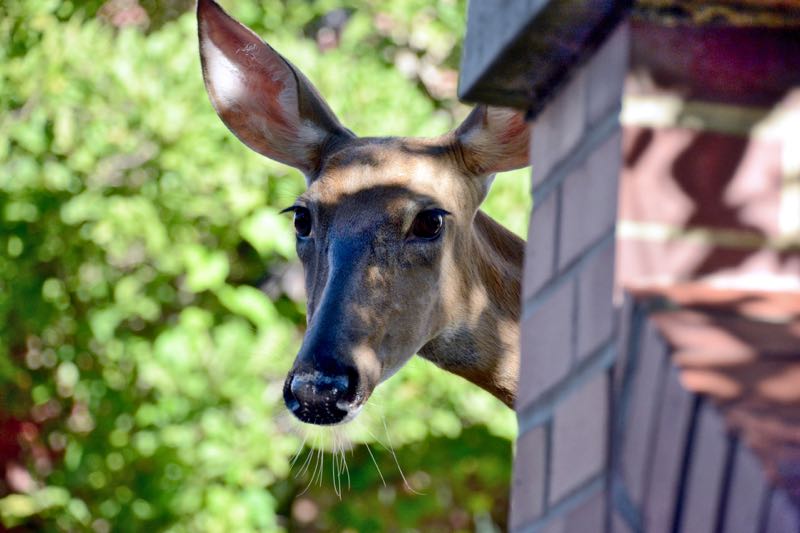
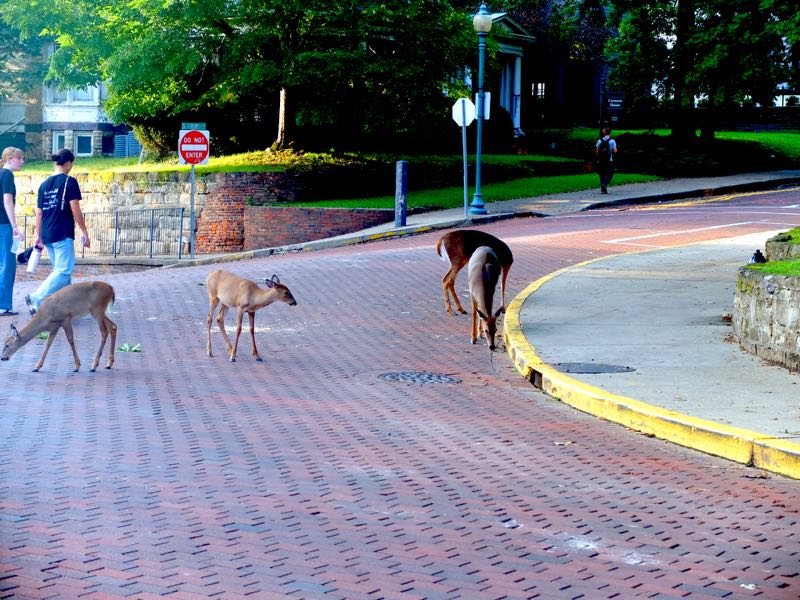
When we walked around town Sunday afternoon, Pat, Bobby, and I encountered a herd of deer on the Ohio University campus. This is a new phenomenon, arrived in the few years since I spent a lot of time there. In fact, a decade ago I saw a deer on campus and it was sufficiently unusual that the paper devoted a page to the pictures I made of it. But now the deer were neither shy around humans nor much noticed by the students, so it seems to have become common.
There is an overabundance of deer because we thought it was a good idea to wipe out the predators, so the deer grew without control. It will be interesting when in a few weeks the bucks go into rut. It won’t be so cute then.
We are desperate to believe ourselves all-powerful. We claim the power to change the world, which from the beginning of time has done as it pleases. We didn’t create the original ice age. We didn’t create the little ice age. We didn’t create the dust bowl. We didn’t and don’t cause global warming or climate change or whatever those who seek to use it to advance their politics call it next.
It will be fun to see what it’s being called the next time I see Pat and Bobby.
If we still exist. We can destroy ourselves, by importing plants and animals and turning them loose, as we have done and continue to do. Or by cooking up some new fatal microbe.
We’ll probably not notice that we’re not as smart as we think we are. Maybe that’s why the government thinks we need to be warned, over and over, that we should not drive into floods and drown. 
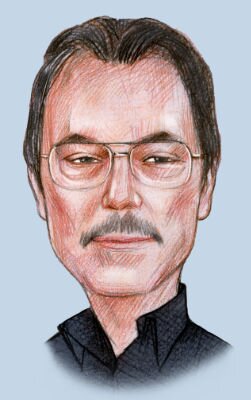
Dennis E. Powell is crackpot-at-large at Open for Business. Powell was a reporter in New York and elsewhere before moving to Ohio, where he has (mostly) recovered.
Pass along this article.
Never Miss Another Article from Dennis E. Powell.
You need to be logged in if you wish to comment on this article. Sign in or sign up here.

Start the Conversation