If the cheerful Pollyanna were given the task of comparing the manufacturers’ claims about electrical power supplies, and power-using devices, to measurable reality, by day’s end she would have hardened into a cynic and by week’s end might well have become a heavy drinker.
Since the blackout here a little over two weeks ago, I’ve been researching products that will reduce the inconvenience that results from the failure of my home’s electricity. This includes both portable generators running on fossil fuels and “power banks,” which are basically one or more batteries in a box with some electronics and various outlets and inputs on the outside.
I’d hoped to describe my new comprehensive installation in full this week, but the exciting news about the innovative generator will have to wait. That’s because after I’d unpacked the new Wen generator from the sorely abused box in which it arrived, removed the metal pieces (bent, as it happened, a sign of bad things to come) that are bolted on to it to prevent it being destroyed in shipping (didn’t work, it seems), was up late attaching the (optional at extra cost, believe it or not) wheels and legs, and putting the proper amount of expensive synthetic oil in its crankcase (which already stank suspiciously of gasoline), I discovered on first pull of the starter that the (brand new) generator was seized up tight as if it had been run from here to Columbus with no oil. I talked with Wen, who gave me the secret number at Amazon that results in an actual person (albeit in southern Asia) and in due course it got straightened out, but the generator part of the story will have to appear another day, after the replacement has arrived.
So this week we’ll limit our discussion to the battery box “power bank.” I got one, and it works. It looks like a 1980s shortwave radio, and it doesn’t store as much electricity as I hoped (nothing could) but it does work, and well.
There are many such available, suited to a variety of needs. Tim Butler has an Anker device that he says is very useful for charging phone, laptop, and the like. I looked at it and it wasn’t well suited to my purpose, which is to keep my Starlink dish and router powered long enough for me to report it when the power is out, and for the wait to find out whether restoration will take so long that dragging out and firing up the generator is worth the trouble (when I have a working generator, which I hope to do again soon).
There are several levels of power bank. Some popular ones store as much as 1 kilowatt of electricity. Another tier will store 2 kilowatts, for twice the price. Some, astronomically expensive, hold even more, according to the manufacturers. There are various smaller ones that don’t store as much but that don’t cost as much, either. None holds as much electricity as you expect or want. Most of them market themselves as “solar generators” even though you have to buy the solar part on its own. What they are is great big rechargeable batteries with settings and switches to control their less-than-vast power.
The first step in poor Pollyanna’s corruption would come when she looked at the claims and numbers for the power of power banks. (They’re really more power ATMs than banks.) In my research of many of these I came to the conclusion that no number included in any manufacturer’s description of any power bank ever has been true for any practical purpose.
(To make it worse, the reviewers online, on YouTube, and everywhere else I looked, can’t be trusted, either. Here’s an important consumer tip: If a “reviewer” includes a link to purchase the item being “reviewed,” and will make money if you purchase the item through the link, he’s not a reviewer, he’s a salesman. Such reviews have zero value when you’re deciding on a purchase.)
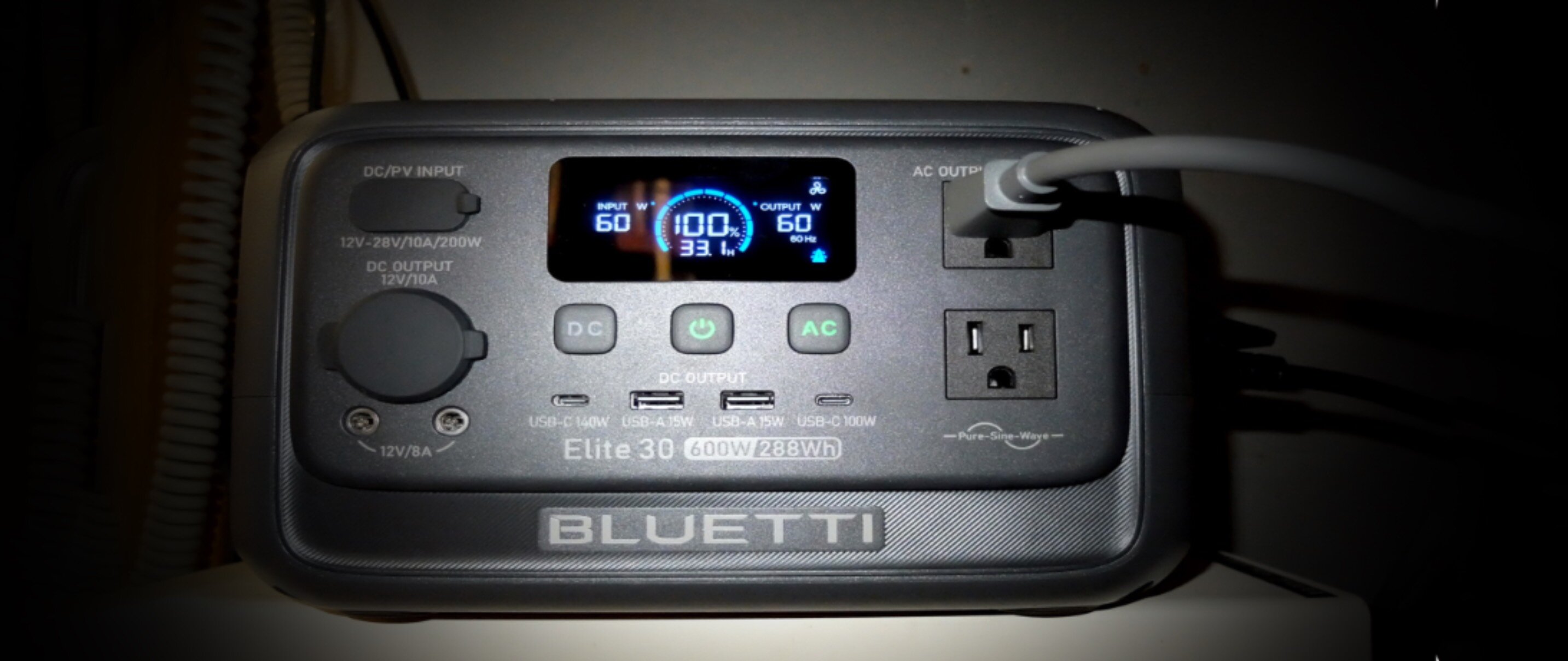
I ended up getting a “Bluetti Elite 30 V2 Portable Power Station 288Wh 600W LFP Solar Generator,” because it is highly regarded and relatively unlikely to burn my house down. It’s the size of a two-slice toaster and carries just about enough power to make two pieces of toast.
(And yes, the Consumer Product Safety Commission has recalled many power banks because they catch on fire. This has become less of a danger with new battery chemistry — lithium iron phosphate, also known as LiFePO4 or just LFP — that is apparently more stable than other lithium ion formulations. It also is said to put up with many more charge-discharge cycles — the standard claim is that the batteries will endure 3000 cycles, or one full discharge/recharge every day for more than eight years, with only 20 percent loss of capacity. We’ll see. Often, pyrotechnic battery boxes are repaired by a downloadable firmware upgrade.)
The first thing one learns is that the specifications listed for any battery box are formulated not by engineers but by lawyers. The claims may be technically true but they’re of use only in comparing them to similar devices.
One of the reasons I chose the Bluetti is that the company has the reputation of disclosing specifications that are closer to real, useful numbers than other makers. Even so, it’s confusing: It claims 288 watts — but also 600 watts, and as you get into it elsewhere it claims even more. What does this mean? Okay: it stores 288 watt hours of electricity in its batteries, meaning that theoretically it could power a device that needs 288 watts for an hour before it would need to be recharged. But its circuitry can rejigger it such that it can power a 600-watt device (for less than half an hour). There’s another mode in which it will deliver even more power for an even shorter time. This stuff is hard on batteries, as are high and low temperatures.
I mentioned recently how little electricity the Starlink dish and router use. The statistic I cited, via screenshot, turns out not to be of much use. It is one of those specifications that technically exists somewhere in the gadget but that is of no help in determining how much electricity one needs to power a Starlink setup.
I got the battery box solely so I could stay online when the electrical grid fails. Based on the power use reported by the Starlink app, I should be able to get eight hours or more of power for the Starlink from the Bluetti’s “288” watts (which can be measured somewhere inside the thing, but what’s actually delivered is a bit less). I charged the box, set it up to behave the way we all erroneously think uninterruptible power supplies work: when the power goes out the device keeps the attached machine going and going. The Bluetti actually works that way. I plugged the Starlink in and after it had rebooted and stabilized, was surprised to learn that the Starlink typically draws 50 watts or close to it, not the 25-40 the Starlink app reports.
Then I unplugged the Bluetti from the wall and timed how long it kept the Starlink system powered, as I went on about my business: browsing, watching television, checking email, and so on. The Bluetti meter hit zero and the internet via Starlink switched off after four and a half hours, almost to the second. The electricity usage countdown from the battery box was spot on. The battery box should have operated for more than five and a half hours if it were really providing 288 watts, but it only coughed up between 225 and 250.
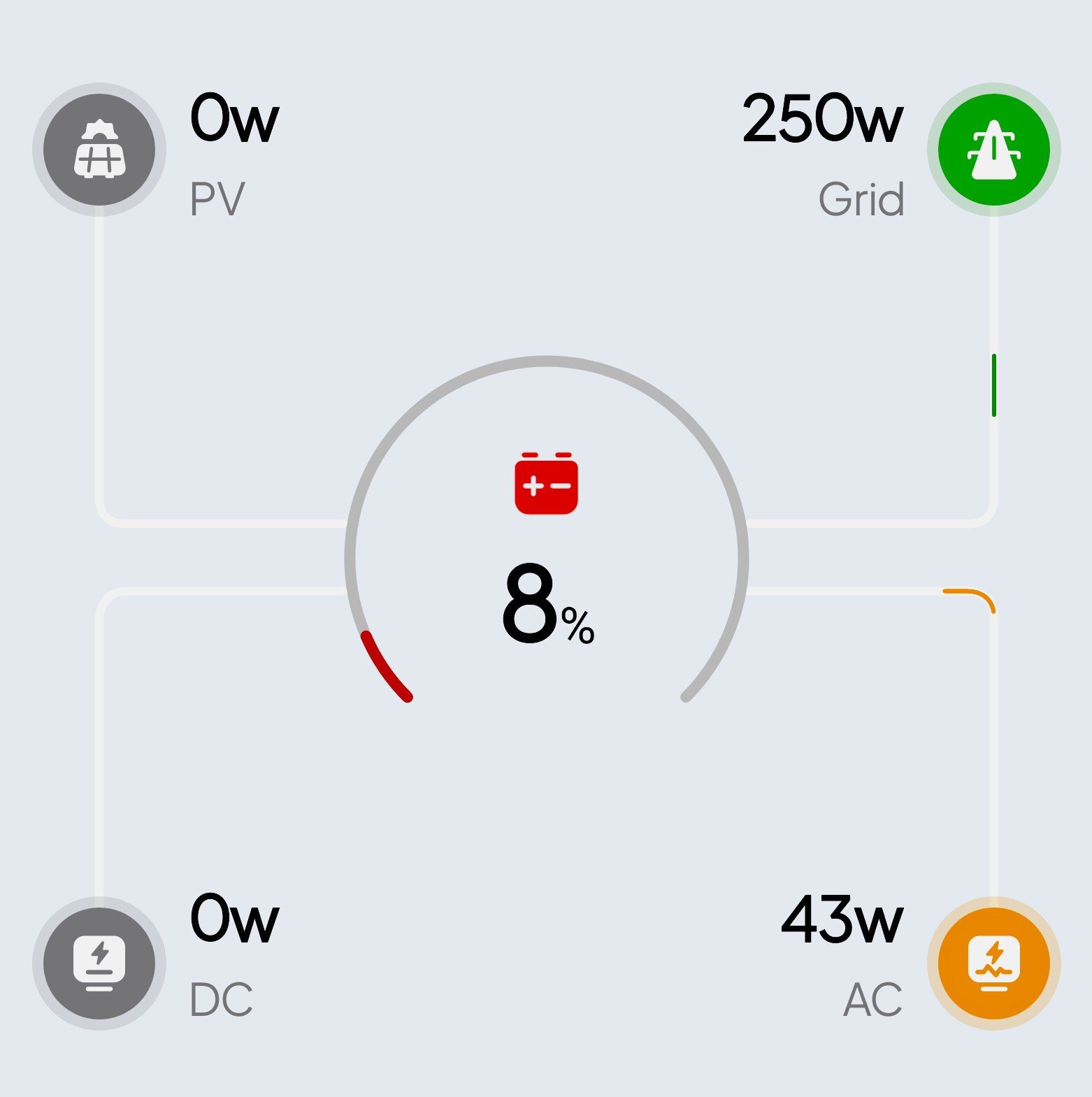
The company is not lying, not in the legal sense. Somewhere inside the box 288 watts get stored. But a lot happens before those watts become useful: The battery box is plugged into the wall and receives alternating current, which it converts, via a thing called an inverter, into direct current — that’s what batteries can store — before being converted back to AC (uninverted?) and sent on its way to my Starlink. None of this comes for free — each conversion collects its fee in some of that electricity. The box has various DC outlets — USB sockets, for instance — and they, not being converted back to AC, deliver more of the electricity that was in the batteries. But the Starlink doesn’t run on batteries or their DC. Not directly, anyway.
In the case of Starlink, the power supply itself, like wall warts large and small, performs an AC conversion. (Ever notice how those little power supplies are always warm? That’s electricity being wasted as it passes through the transformer.) The power comes from the wall as AC, gets converted to DC for the batteries, gets converted back to AC for the trip (via standard wall-type socket on the Bluetti) to the Starlink power supply, where it is converted to DC once again. The entire trip costs between 20 and 30 percent of the electricity that came out of the wall. What Starlink is reporting in its app is the juice it is drawing from its own power supply, not the amount you must feed the power supply (and pay for).
The manufacturers in their marketing pick the point on the journey where the number is most favorable to them and use that number. But it has nothing really to do with the amount of electricity that went in or the amount that comes out, unless you apply “Kentucky windage” for the expected losses. So the Bluetti delivering 225 actual watts when the box says 288 watts is about what one should expect.
(It is not unlike some computer standards: A kilobyte is 1024 bytes; a megabyte is 1024 kilobytes, and a gigabyte is 1024 megabytes. Except when you are selling computer storage. When you’re selling hard drives, kilobytes of 1000 bytes are joined with 999 others to make a megabyte, a thousand of which comprise a gigabyte. It’s dishonest but legal, and it convinces buyers that they are buying more storage than they actually get.)
Then there’s the arithmetic of electricity, a little of which we all ought to know.
Without getting deep into the details, it’s useful to note this: watts equals volts times amps. Volts can be converted to amps and vice versa. It’s all arithmetically simple: 120 volts at 3 amps is the same amount of electricity as 12 volts at 30 amps: 360 watts.
Which brings me to the week’s next disappointment. Hoping to squeeze more online time out of the Starlink-Bluetti marriage, I reasoned that taking the power from the DC outlets on the Bluetti would get rid of some of the overhead. As it happens, SpaceX sells a DC-in-DC-out converter for Starlink which would, I hoped, bring the watts drawn by Starlink closer to those actually reported by Starlink.
But the converter’s specifications say that the converter needs — I used the numbers above for a reason — 12 volts at 30 amps. 360 watts! More than all of the electricity inside the Bluetti! (And the Bluetti clearly runs the Starlink just fine via the Starlink’s AC power supply, so something here doesn’t add up, right?)
I thought it might be a misprint or something, so I went to the Starlink website to make inquiry. There, support in the form of Elon Musk’s pet AI, “Grok,” assured me that no, the 30-amp thing was not the minimum required but instead the maximum allowed, and the transformer would work off the Bluetti just fine.
As I soon found out, Grok lied. (I think it was, as AI is wont to do, telling me what it believed I wanted to hear.)
I went ahead and ordered it. A couple hours later, wanting to learn all I could about the DC power supply, I did some additional research and happened upon a video that shut me right down. While Starlink doesn’t need 360 watts to run, it needs 360 watts, briefly, to start via the DC-DC brick. And the most DC the Bluetti will deliver is 12 volts at 10 amps.
I went to the Starlink site to cancel the order, but you have to be quick with cancellations there and I wasn’t quick enough. (Fortunately, SpaceX is quick with returns. The DC-DC brick arrived Tuesday and was returned within the hour.) A good idea in theory was wrecked by reality. That’s the battery box world sometimes.
Like many similar devices, the Bluetti offers a little app, in this case one that works over wifi or bluetooth. I am using the latter — I don’t need to monitor my battery box over the internet from a thousand miles away. (Also, the wifi version does the standard shady internet collection of information. A rechargeable battery oughtn’t have a privacy policy!) Even on bluetooth alone it is a good app, I think.
So while it isn’t as good as I hoped, it is far better than I feared. It works for my purposes. Mostly.
Tune in next week for more exciting adventures in electricity. Assuming the replacement generator arrives and works, and Pollyanna gets it set up without difficulty. It would be terrible when a little girl erupts in profanity and heads for the bottle. 

Dennis E. Powell is crackpot-at-large at Open for Business. Powell was a reporter in New York and elsewhere before moving to Ohio, where he has (mostly) recovered.
Pass along this article.
Never Miss Another Article from Dennis E. Powell.
You need to be logged in if you wish to comment on this article. Sign in or sign up here.


Start the Conversation