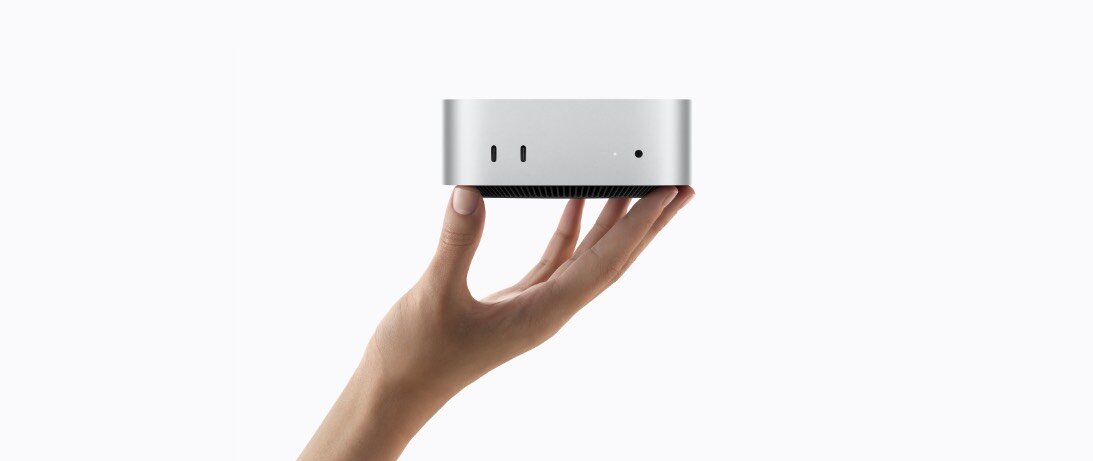
The smallest Mac, which often merely existed to be the cheapest Mac, has been warming up for this moment. Thanks to AI, it is finally a star not a concession. And with this week’s M6 chip announcement, Apple finally has embraced that. You should, too.
It’s worth revisiting where this diminutive machine has been. Introduced 21 years ago by Steve Jobs as the first “BYODKM” (Bring Your Own Display/Keyboard/Mouse) Mac, it was focused on a cheap entry point for new iPod owners who suddenly found the Mac world intriguing. It lived its first few years exclusively in this realm: a nice, low-end option for when you want a desktop and you want it run MacOS.
Five or so years later, though it developed another semi-secret identity: a power user entry point for servers and other less traditional Mac projects. It was a brief period, ended as the iPhone grew to become Apple’s primary line and the company’s partnership with Intel also started to lose steam. By 2017, neglected for years from so much as an update, buying a Mini was a dubious proposition. And, of course, Apple wasn’t the only one distracted from the desktop PC game: in general, all the excitement had shifted mobile-ward.
2020 ended that dark age with the advent of Apple M1, generally, and the Mac Mini M1, in particular. I wrote a few years back about how it became not the slow, also-ran of the Mac family, but for a period of time the best Mac by many standards. In fact, the M1 remains such a good performer, that my church livestream processing continues to run on an M1 six years after that computer’s release. Every week, “Thomas,” our faithful Mac Mini, processes six camera feeds, numerous audio channels (with noise reduction work in the pipeline, even) and outputs it without breaking a sweat.
The Apple Silicon era moved on, and the later models are much, much faster. But, Apple managed to create a base that was really good. Since then, the Mac Mini — if only because it doesn’t take a lot to put the chip in it for those who want it — went back to being that “best kept secret:” a powerful Apple tool that was more than competitive with PC alternatives on a sheer hardware basis, not just in terms of non-quantifiable aspects like OS quality.
The AI era arrived at just the right time for the Mini’s reinvention. Especially with Apple’s redesigned Mini form factor in 2024’s M4 release. Previous M-series ones were still encased in the decade old design created to hold hotter running Intel ones; with the M4 the already small computer modernized and shrunk at the same time. It was an encouraging indicator that Apple wasn’t just phoning in the continued existence of a desktop option.
The M4 Mac Mini was a steal at $599. With it, Cupertino released a modern, fast, tiny and almost always silent Mac with broad expandability via high speed Thunderbolt. While “only” a laptop processor — if that can really be a reasonable charge on these chips — the large (but rarely invoked and quiet) fan means the Mac Mini has often been the best way to experience an M series chip. Adding in Pro chip options showed Apple recognized what their M1 had achieved: making the Mac Mini unquestionably more than a BYODKM concession for the budget conscious. It was a real tool that could be marketed to real professionals confidently.
Nonetheless, for the first year, the M4 variant existed quietly under the radar to most.
As late as last fall, one could regularly find heavily discounted Mac Minis that were crazy good deals. Then RAMageddon struck. With AI labs buying up every drop of memory they could get their hands on, we all watched as everything from budget laptops to gaming systems to backup storage to, well, anything computer-ish skyrocketed in price — a highly unusual situation. As “compute” becomes a rarer and rarer commodity for the latest AI work, the Mac Mini discounts dried up; by this spring, Mac Minis were regularly out of stock and selling for above sticker in the aftermarket.
Little wonder: even a basic 8 GB Raspberry Pi 5 kit clocks in at $200 these days; the far more powerful Mac Mini became an absolute steal even when above MSRP.
Especially given it wasn’t just affordable, but well tuned to AI work at a time when tools like OpenClaw have emerged, making using one’s own machine to do some of that work both accessible and able to blend cloud and local models as cost and availability dictate. With Apple rapidly adding to its own AI support foundation — MLX, RDMA that allows the linking of multiple Pro-class M systems and so on — alongside open source projects like Exo and oMLX that build upon Apple’s tools, the Mac Mini became a gateway for nearly anyone to explore the new frontier without paying frontier lab costs.
While there had been plenty of rumors of an M5 Mac Mini to come this year, as the supply crisis hit, the rumors dried up and every indication remaining suggested sporadic shipments of the M4 line would be the best we could hope for. Clearly Apple (sensibly) prioritized M5 for its higher profit, main tentpole systems like the MacBook Air and MacBook Pro.
Except, there is more to the 2026 story. If anyone ever wanted an indication that Apple really gets what they have on their hands with the Mini in this new era, this week’s unexpected releases are it. Even as the company’s own AI models remain lukewarm, at best, with Google as a backstop for Siri’s struggles, Apple is showing its hardware crafting prowess — including for AI — is as sharp as ever. The M6 didn’t premiere in a MacBook Air or even an iPad Pro, but the Mac Mini. And with it, the best processors from the M5 line — the Pro, Max and (new this week) Ultra — also made their way to either the Mac Mini or its bigger brother, the Mac Studio.
The M6 being paired with a cadre of M5 siblings in this launch can seem counterintuitive, especially since the cheaper machine gets the newer architecture. This is actually a regular part of Apple’s playbook over the last few years. They launch the no-qualifier new generation that is really good, and often a notable advancement for things that fit within its number of cores (and supported RAM limit), while further spreading or at least continuing the higher end Pro, Max and Ultra chips from the previous cycle until production of the new generation smooths out. The M5 launched last October in the iPad Pro, MacBook Pro and Vision Pro; the M5 Pro and Max didn’t show up until March of this year, when the MacBook Pro’s high end filled in.
Everything is out the window in the entire industry right now, so trying to predict when we might see the rest of the M6 family is a fool’s errand. But, it seems safe to say Apple wouldn’t replace systems that just got an M5 Pro/Max/Ultra in August with M6-plus-adjectives equivalents until a full generational cycle wraps up in a year or so. In fact, the rumor mill seems to lean towards what Mark Gurman recently reported: that the M6 might never see the Pro-and-friends, as Apple aims to pour all of its efforts into an even more AI-centric M7 generation that will come out in 2027 and 2028.
In other words, if you need more than 32GB of RAM, or are looking at large models that will benefit from more CPU and GPU cores far more than the new generation neural accelerators, get the M5 variants now. We already know they are impressive in their own right from Apple’s MacBook Pro releases. The M6 will certainly beat them at single core productivity tasks — traditional home and office computer work — but for AI jobs, M5 Pro will likely show its true strength against the smaller M6. A theoretical M6 Pro doesn’t exist, so seize the excellent processors that do.
While the Studio prices can get into eye watering, car-like realms — albeit competitive with Nvidia-based peers — the Mac Mini got a major step up with only a minor nudge on price, given the now standard options included, such as 2.5 gigabit ethernet. The next few weeks will tell the tale as we get benchmarks on the M6 and find out the precise scenarios the M6 will best an M5 Pro and just how powerful the new Ultra variant is.
Normally, in such a “pick your compromise” situation between better old generation processors and lesser new generation ones, I’d recommend waiting for those benchmarks to sort things out. After all, if you’re wanting to do light AI video correction or audio processing, it could very well be the M6 and its first-of-its-kind dual Neural Engines might be better in some cases than the M5 Pro (though who comes out on top with M5 Pro’s per-GPU core accelerators attached to a greater number of GPU cores must remain a known benchmark unknown for now). But, again, we live in interesting times and waiting may not be the right choice.
Here’s what is clear: Apple does have a well earned reputation with the M series chips there’s little reason to doubt. Even in the launch fog, we can be assured these are going to be great systems for anything that can be realistically done with local AI, especially if you spring for extra RAM. (Caveat emptor: Apple RAM is part of the same board as the processor; don’t order thinking you’ll add more later.)
Because of that, before the waits grow long, if you’ve been planning to dip your toes into this realm, you should take the new Mac Minis seriously, just as Apple finally does. I expect the wait times will increase, so preordering makes a lot of sense.
For those considering it, here’s the big things to consider: first, better AI models do require more RAM. If you can afford RAM or storage, go with RAM and use the high speed Thunderbolt port to get near-internal speeds on an external solid state (or even spinning disc hard drive). Unless you are independently wealthy, you can’t buy too much RAM right now. Period.
Secondly, there are highly promising — yet still relatively raw and hard to fully use — developments around Mac clusters, as I mentioned before. You can link multiple recent Pro-or-better chip-based Macs together to create a computing cluster using Apple’s official RDMA support over Thunderbolt 5. Right now, the game in town for supporting this is Exo, an open source project that is still buggy in my experience, but could be hugely useful if it matures well.
There’s a gamble in betting on tools like that maturing by the time you need them, but Apple seems to be invested in the idea of RDMA clusters enough, I think Exo will both mature and gain competition. If such an arrangement makes sense for you in the future — either with multiple current Mac Minis — or even keeping your new one helping out when you later buy a future generation one, go with the Pro models.
The no-qualifier M4, M5 and M6 processors only come with Thunderbolt 4, and while Exo (or a future MLX-based tool) can pool those by ethernet, the higher-end systems’ Thunderbolt 5 is the necessary ingredient to gain RDMA with its “make your own supercomputer cluster” internal component-like ultra low latency sharing of resources, including pooling the RAM between the systems.
(Yes, the Beowulf dream lives on.)
Apple is taking the Mac Mini seriously. If you need a high performance, yet mere mortal attainable computer in the near future, this is it. Prices aren’t going down any time soon and the Mini is anything but Mini when it comes to the jobs it can do. Go preorder. Now. 
Full Disclosure: Tim has long held some Apple (AAPL) stock.

Timothy R. Butler is Editor-in-Chief of Open for Business. He also serves as a pastor at Little Hills Church and FaithTree Christian Fellowship.
Pass along this article.
Never Miss Another Article from Timothy R. Butler.
You need to be logged in if you wish to comment on this article. Sign in or sign up here.


Start the Conversation