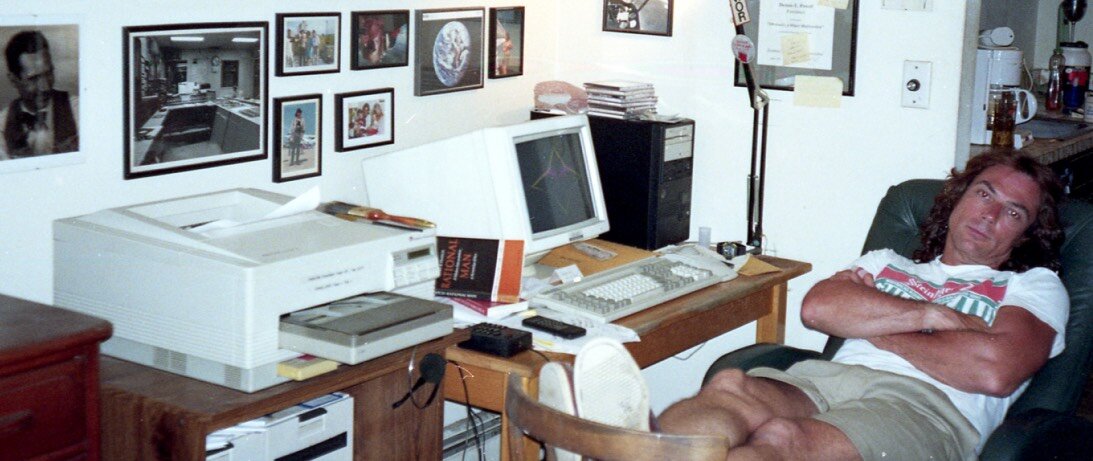
Some big changes are underway in the personal computing world and if you do home or office computing it behooves you to pay attention to them.
In some respects they may return us to the industry we last knew in the previous millennium.
Not everyone was involved with computers in the 1980s and 1990s . Of those who were, surely some have forgotten those days — or blocked them for mental health reasons.
Let’s begin not with the power of the processors but instead memory and storage.
My first personal computer was an IBM clone sold by the Vendex Pacific company. It used an 8088 processor, same as the original IBM PC. Its advertisements featured a professional wrestler, one “King Kong Bundy,” the pitch being that if a simian character like him could make the Vendex PC work, then so could you.
It came with two floppy drives and 640 kilobytes — not megabytes or gigabytes but kilobytes — of Random Access Memory, or RAM. It was desperately slow, but we didn’t know it at the time because there was nothing to compare to it. Also, the software of the day — 1988 — was efficiently written and compiled.
The 8088 processor couldn’t address more than 640k of RAM. We wanted more — we didn’t know why, but we did. The first improvement I made was the aquisition — for nearly $600! — of a 20-megabyte “hard card,” a hard drive that fit into one of the machine’s expansion slots. The cameras I use now produce files so big that in some cases one of them would have filled that entire drive and a little more.
After some anguish I got DOS 3.3.1 to boot directly to a C: prompt. A little more anguish and I got it to boot directly to the legendary Power Menu. I’ll not dive into how we used our machines, but they led to our getting modems and going online, to BBSes, a few online services, and an internet that was nothing like what we know today. (In some ways it was worse and in some ways far better.)
But soon I wanted more computer. I bought on closeout a Motorola 386-16. It had an 80386 processor and was faster than the 8088 in other ways. It came with a 40-megabyte hard drive. Most important, it could use more than 640k of memory. It could take — sit down and lean back in your chair — 3 megabytes of RAM.
I figured that everything would now run orders of magnitude faster. Actually, everything ran a little faster, and I discovered that the speed of the hard drive played a big part, and hard drives weren’t especially fast, even after I had maxed out the RAM, which meant getting individual memory chips, nine with extremely fragile legs per megabyte. It cost $200 per megabyte because Ronald Reagan was mad at Japan and instituted tariffs to prevent that country dumping memory for cheap onto the American market.
But now, by the addition of $400 in memory, I’d be able to run the exciting new IBM OS/2 2.0 that was due for release any old time now. Turns out that IBM’s claims were, um, overly optimistic. But I was able to get an add-on memory board that let me take the computer to 8 megabytes, so I could run OS/2, which by then had gotten released. Fortunately, I lived near Armonk, New York, and knew a lot of IBMers (though I paid full retail anyway).
Soon, because Microsoft Windows was a memory suck and because Microsoft was better at marketing than it was at programming, everybody was running fast machines with lots of memory. Prices on quick chips and RAM came down. But programs weren’t executing faster. Instead, programmers had gotten sloppy and now used programming languages and toolkits that didn’t accent efficiency. That has continued.
Likewise, storage got cheaper. Two years ago I was able to buy 32 gigabytes of fast memory for less than half the cost of a megabyte in 1990. I got a 16-terabyte — 16,000 gigabytes — hard drive for \$300 less than that 20-megabyte hard card cost me.
But the tide has turned. The cost of memory and storage are headed back up by a lot.
I noticed this last week when I was preparing to undertake a little project. When my big desktop machine behaved flakily (it turned out to be a worn-out battery in my UPS), I thought it would be fun to see if I could use a spare Raspberry Pi 5 as a desktop computer. It had 8 gigabytes of memory and a fast chip, built-in wifi, and good video (I use them for my home-made television sets), and two years ago were well under $100. Now they’re more than $200. In each of the three I own I put a 1-terabyte solid-state drive, $105 two years ago next month, and $400 now.
What happened to drive up the prices?
Part is due, of course, to Trumpian 19th-century notions of industry and the tariffs those erroneous views have inspired. But a bigger part is due to the Artificial Intelligence craze sucking up the chip-making and storage capacity. It holds true across the board for RAM and hard drives. It has gotten insane.
Suddenly I am glad that I’ve carted around those old computers these many years.
That 386-16 was the last computer I bought pre-built. After that, I’d pick out the processor and motherboard I wanted, then the case and power supply. More often than not I’d move my existing hard drive into the new computer. New memory was always necessary because it’s tied to the processor.
The reason I’m glad to have a room full of computers is that we’re going to see a return to the old computers. New ones are becoming ever more expensive as AI consumes processing power, memory, and storage.
Nor will we need more powerful computers. Indeed, the opposite might become the case as programmers are forced to return to skilled programming instead of code bloat. I may soon begin to see the speed from old machines I hoped to see when I got them years, sometimes decades, ago.
There were a few programs that lived up to their promise. One is Procomm Plus (or even the shareware Procomm 2.4.3), the tremendous terminal application with a great text editor (that, like me, came from Columbia, Missouri). Another is the last DOS version of Microsoft Word. It is text-based, but guess what, writing is text-based. (Microsoft released it as a free download. It still is perfectly useful as long as you set it to use the .rtf file format.) The best, in my view, is GeoWorks Ensemble, a full GUI and suite of applications that were what Windows should have been. It is small and executes quickly because it was written in assembly language, far better than the inefficient modern languages.
There are even small, highly efficient versions of Linux, the operating system of choice.
If the AI bubble continues, we may see the arrival independent local stores selling older computers and memory, old hard drives (MFM? RLL? IDE?) and, who knows, dot-matrix printers. Computing might get cheaper and more enjoyable. (I doubt I’ll ever need my beloved U.S. Robotics HST Dual Standard modem, but I’ll never forget its sound.)
Computing might soon be like it was — well, kinda — 35 years ago.
(By the way, yes, the dinky Raspberry Pi 5 can be pressed into service as a perfectly usable and efficient desktop machine, though I would hate to have to do much photo or video editing on it.) 

Dennis E. Powell is crackpot-at-large at Open for Business. Powell was a reporter in New York and elsewhere before moving to Ohio, where he has (mostly) recovered.
Pass along this article.
Never Miss Another Article from Dennis E. Powell.
You need to be logged in if you wish to comment on this article. Sign in or sign up here.

Start the Conversation