
It was six months ago today that I first plugged my computer into the Starlink router, connected to the standard-sized Starlink “dish” (it’s a panel) that was flopped down haphazardly in my back yard.
I doubted that the claims made for the thing could be true, particularly given my geographical circumstance. I was right. Starlink has not over this half year met its advertised specifications. It has exceeded them.
For example, if there were trees in the way the speed and reliability of the signal would suffer, I was told. There are trees in the way. When I installed the thing there were plenty of branches in the way but, it being February, there were no leaves. I had gotten the 200-megabits-per-second plan and got: 200 mbps. Occasionally a little bit less but occasionally a little bit more.
(With its predecessor, from the phone company, I never achieved more than half of the throughput for which I was paying, not counting the many, many times when I got no throughput at all. And the phone company charged more than the $80, now $85, I pay to SpaceX each month. I no longer do business with the phone company at all. More about that, too, in a little while.)
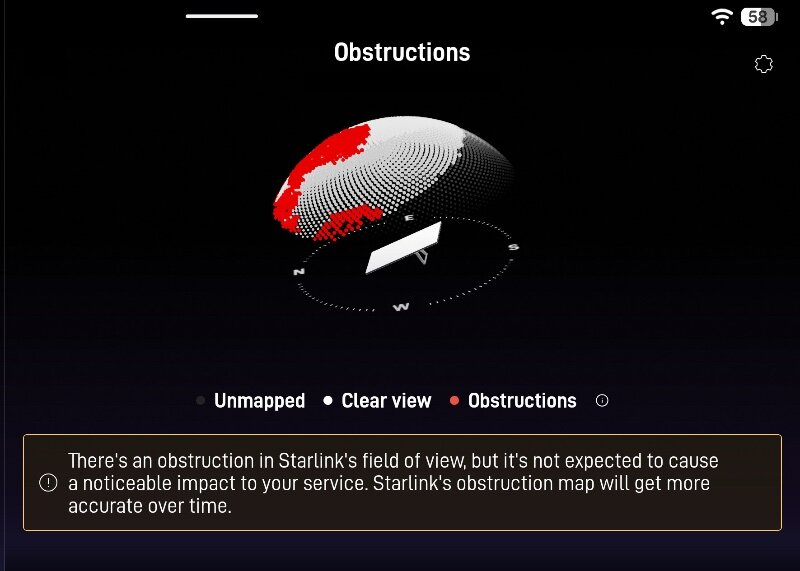
Then spring came along, and those leaves — primarily a large hickory and an even larger sycamore, whose leaves are the size of a saucer — filled much of the sky as viewed by the Starlink dish. Based on what I was told ahead of time, this should have wrecked my Starlink connection. But it didn’t. In fact the built-in sky-mapping application said words to the effect of “Yeah, there’s an obstruction but no problem.”
The slowest result I’ve gotten from running a speed test has been 174 mbps. The 26-mbps difference between that and 200 mbps is greater than the best speed I ever got from the phone company. Which is to say that what I got from the phone company, at its best, was to Starlink almost a rounding error. Leftovers.
I’ve frequently mentioned the poor service from the phone company, as applied both to internet and phone service, so I should, too, mention the time Starlink maybe failed. During one storm, in which we received five inches of rain in an hour, I lost service. (I’m not even sure of that: the Starlink rig reboots daily and it takes a couple of minutes, during which the system is down. You can set the time for it to perform this task. I’ve been online a few times when it happened and have been surprised every time. I am not sure that it didn’t happen during the incident I describe here, which was the hardest rainstorm I’ve ever been through, and I’ve been through hurricanes.) The signal was down, entirely disappeared, for less than five minutes. I haven’t lived through a snowstorm with it yet; the dish detects snow and melts it.
Though I suppose there are those who do, I did not want to leave the dish just plopped down in the yard. So, enlisting the aid of a friendly and skilled neighbor, I arranged for the dish to be mounted on my roof. This involved investigating (and trying and returning) a few of the third-party Starlink mounting systems. (The ones not made by Starlink seem to be preferred — hey, Elon can’t be good at everything.)
Then came the process of routing the cable from the dish at the far end of the house to my office, here in the basement. I did this carefully and so far it has worked as planned.
I did not utterly need it, but when I saw that Starlink had restocked its mesh router nodes and was selling them for $60, I got one. I’m glad I did. A mesh node is when a router talks to and repeats another router — but it does so invisibly, so that if you take an online portable device from the area covered by one to the area covered by the other, the device doesn’t notice, it just stays online. In addition to providing a flawless signal to my home-made television sets, it has given me coverage far into my back yard. That’s especially helpful because there’s no cellular service here, but my $15-per-month Mint cellular subscription gives me unlimited voice over both cellular and internet, so I have my own couple-acre cellular hotspot.
Which is to say I couldn’t be happier than I am with Starlink. Well, I could if, say, they gave me lifetime service for free. (By the way, I receive no discount, no free reviewer sample, no consideration that any other subscriber doesn’t receive. As far as I am aware, they don’t know I’ve ever written a word about them. I’ve never spoken to or otherwise had personal communication with anyone at the company.)
There has been an issue in the last 10 days, but it wasn’t Starlink’s fault.
We have had a huge amount of rain and some spectacular thunderstorms. Roads have been underwater except for the mud road over the hill that turns a half-hour drive to town into one that takes three times as long. It has been hot and very steamy and jungle-like. And twice the power has gone out.
The first time it was for five hours, the second, 20 hours. My pride-and-joy gasoline generator refused to start, for the first time in the 14 years I’ve owned it. I suspect — hope being father to the suspicion — that some water condensed in the bottom of the gas tank, the inevitable result of Congress demanding in exchange for votes that gasoline must now be 10 percent, sometimes 15, corn squeezings. I expect to find out once the weather is a little more clement.
But I have uninterruptible power supplies. Three of them, one for my big desktop computer and one each for the two televisions and the little computers that control them. Their main usefulness is in keeping from having to restart everything whenever the power flickers for an instant, as happens more frequently than anyone likes.
Both times the power went out in the last 10 days, I had one of the TVs on. The situation was surreal: air conditioner goes off, electric fans go off, lights go off, televisions continue playing, oblivious to the power failure.
For awhile. I learned long ago, during a non-flicker power problem, that for a desktop machine, a UPS exists to buy you time to save your work and perform an orderly shutdown, or, when it’s working, to get the generator going and to switch over to it.
But as with the switch to Starlink and using it for internet and phone service, obviating the limited utility of the phone company, I’m rethinking my back-up power arrangements. The weak link, I learned these last two weeks, the likely point of failure, is the generator. Even if I get it fixed, I’d like to have an additional backup.
What would it comprise?
I certainly need to get the generator working, because once I fire it up I can plug it into the house, flip a half-dozen switches, and have just about a full day’s power. For very short power failures the UPSes are sufficient. But what about a longer failure but, for instance, when the generator needs to be shut down and allowed to cool off before it can be refueled? There are on the market a number of “power banks,” which are like more powerful UPS devices. They are expensive. Some of them claim to be readily recharged via solar cells (if your disaster takes place on a sunny day). I have not yet encountered the battery back-up that delivers what it promises, or the solar cell.
(A helpful aside: The food in the freezer that makes up the top third of my refrigerator stayed frozen during the 20-hour blackout because of something I do that I recommend: I long ago filled a couple of big plastic milk jugs with water and put them n the freezer. They keep things cold when the power goes out. I can’t imagine that after several years the water tastes good — at some point I should probably replace it because there are circumstances where it could become emergency drinking and coffee water. Anyway, I recommend it. It has saved me from having to throw away frozen food a few times. And turns the electric freezer into a genuine ice box.)
Anyway, the cream of the crop for battery-powered home backup systems is the Tesla Powerwall, which purports to collect and store enough power to keep the house running during a blackout. The problem is that one spend at least $10,000 just to get into the Powerwall game. Also, being lithium batteries, they are neither especially long-lived or entirely safe; the generation before the present one caught fire from time to time, and lithium ion fires are not easy to extinguish.
A lot of people who do the solar panel thing use banks of golf cart batteries. I would like to find the equivalent of car batteries, but ones designed to provide a steady current rather than the car battery’s high-power-short-time design, then wire several in parallel to provide some power for a day or two.
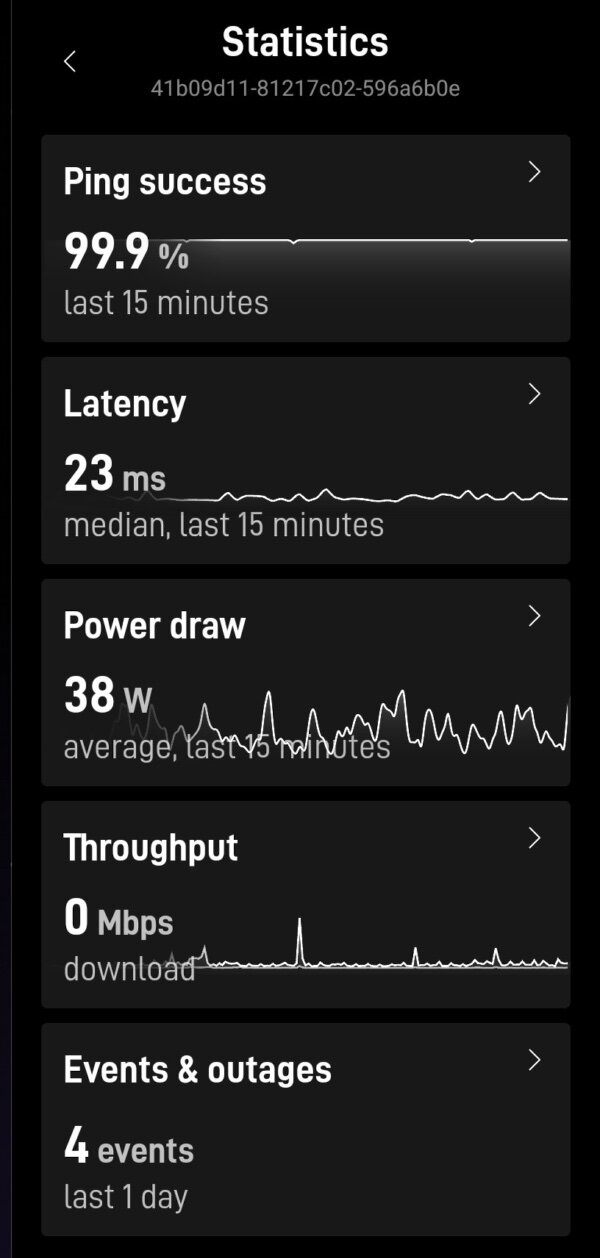
What I’ll do in the short term, I think, is get one of the smaller power-bank contraptions and devote it solely to running the Starlink router and a little 5-volt charger for phone and maybe a Raspberry Pi 5 computer with a low-power LCD monitor. The Starlink (when it’s not melting snow, anyway) draws under 45 watts, even when kept busy. The Raspberry and a 15-inch monitor I have together draw less than that. Even if the solar panel that comes with many of the power bank things is not as efficient as its overly optimistic publicity claims, I should even in bad circumstances then have internet, phone service, and via an m3u application television, without grid service pretty much forever. All under 100 watts, the power used by a standard lightbulb. When communications is your business, those things are important, and it’s possible to have them on low power, it appears, in no small measure thanks to the reliability of Starlink.
(An autumn-winter project will be to build a tiny-but-powerful computer. My 2014 desktop machine is very powerful, but it draws hundreds of watts. I think I can build better.)
Even if things get so bad that there’s no gas at the gas station, it should be possible to stay in business. Generator power is already just about the most expensive electricity you can get. That’s okay for short times, but something more open-ended is needed around here.
The one essential is the Starlink setup. I wish everything here were as efficient and reliable. 

Dennis E. Powell is crackpot-at-large at Open for Business. Powell was a reporter in New York and elsewhere before moving to Ohio, where he has (mostly) recovered.
Pass along this article.
Never Miss Another Article from Dennis E. Powell.
You need to be logged in if you wish to comment on this article. Sign in or sign up here.


Start the Conversation