When one of my sisters phoned the other day, we got to talking about the church in which we grew up.
We were raised high-church Episcopalian. When you went to church there was no other place it could possibly be and nothing but worship could have possibly been going on. As the priest consecrated the body and blood for communion, he — yes, he — faced the altar and crucifix. We received communion on the tongue while we knelt at the communion rail. The lay readers — those who read the Epistle at each service — were enrobed, as were we acolytes.
As an acolyte, I followed specified and unwavering procedures for everything. It may seem like an excess of bowing and scraping, but it also established in our hearts and minds that the Holy Trinity was worth the trouble. We worshiped from the Bible, as delivered by the lay reader and then the priest, and from the 1928 edition of The Book of Common Prayer, which none other than the militantly devout Roman Catholic William F. Buckley, Jr., described as “the most beautiful book in the English language.”
The second half of the last century consisted liturgically in the destruction of everything that brought beauty to the Catholic-derived religions, of which Episcopalianism is one (or was; no idea what it is supposed to be now). The 1928 BCP was replaced. The hymnal was “modernized.” Where once you needed to arrive early to get a seat, now you could wander in any old time and find plenty of room. Among those empty seats was the one where I would have sat when not serving at the altar. The church had effectively announced, to the hearts and minds of many of us, that maybe the Holy Trinity wasn’t worth it after all, or maybe not in attendance, either
There had always been a bit of an asterisk attached to the Anglican-derivative Episcopal Church, anyway. The English had split away from the Church of Rome because Henry VIII wanted to be able to divorce or lop the heads off his wives as he saw fit, and the Pope said no. So, with the assistance of the crypto-Lutheran Thomas Cranmer, a new church was made up.
It should be noted, though, that Cranmer was the primary author of the non-Catholic, non-Lutheran parts of the Book of Common Prayer. Also, that when the Catholic “Bloody” Mary Tudor came to the throne and sought to overturn the Protestant changes, though she failed at that she did manage to have Cranmer burned as a heretic. These monkeyshines suggested to those who took a look that the Tudor family may not have been the last word when it came to the will of God. There was always the sense that Anglicanism was the Opel GT to Catholicism’s Corvette.
When Episcopalianism went into its spiral, I decided I was as well on my own. I always knew there was a void to be filled, and that Roman Catholicism, with its unbroken lineage from Jesus, was it, but I took no action.
In 2010, able to put it off no longer, I decided to convert. And to my surprise I arrived at a church that seemed set on being more like the Episcopalians. Everyone was well-intentioned and sincere, great people one and all, but during months of study I received lots of information on “peace and justice,” and bloody little about Roman Catholicism. I was not well catechized.
My parish had gone off the tracks a bit. For instance, an angry old woman delivered the homilies from time to time. Just last month, even the fairly, maybe highly, liberal Pope Leo’s church announced that that kind of thing is illicit. (I may have benefited from this laxity: at my required pre-confirmation confession — “reconciliation,” they were calling it — I was not given the penance that I deserved or that I would have received at any other time or place, or even from the other priest in town.) As I said, lovely, well-meaning people who just weren’t very good at shepherding one into Catholicism.
The place felt no more like a real Church than the Episcopal church did after it had gone hogwild. It was disappointing.
At least I no longer had the Henry VIII-Cranmer pothole to steer around, and soon the old and kindly left-wing priest was off to missionary work in Africa and a very seriously Catholic priest arrived. He was Father Mark Moore and took no side roads in his Catholicism. I spent a lot of time asking him questions and actually learning the religion of which I was now and for a while had been a member. He arranged — I think and hope my whining played a part — for a Tridintine, or Traditional Latin, Mass to be said at the parish. I was there every time, and for the first time in decades felt as if I had gone to church.
But soon enough, Pope Francis (now dead) decided that the wise encouragement of St. Pope John Paul II and Pope Benedict XVI were not to his liking and banned the Latin Mass. His ban remains in effect — mostly. My thought was that if some loopy Jesuit, apparently chiefly interested in keeping his sex-offending South American pals out of prison, could make such huge changes in the Church on a whim, then the rules of the Church didn’t amount to much. One hopes that Leo will undo Francis’s terrible mistake.
As I noted in the link above, Father Mark died last month. I went to his wake and planned to go to his funeral, but guess what? The parish itself was banned from the funeral. If we wanted, we could watch it online. I am not making this up. Only his family and other clergy would be admitted. I did watch it, as a two-thirds-empty church gave him his sendoff, while to the parishioners whom he had served and who loved him the funeral was delivered in the fashion of a Gilligan’s Island rerun.
It was enraging, yet . . . if watching Mass on television was equivalent to attending Mass, perhaps there was something good to be had. As it turns out, there was.
I found a priory that streams the Traditional Latin Mass daily, Low Mass each morning except Sunday, when High Mass is sung. It is the closest thing to Heaven one can get on television. And I have followed it every day since we were told that watching a stream was as good as being there. (I would still prefer to be there, but inasmuch as the priory is a couple hundred miles away . . . yet I expect to make it there from time to time for confession and the Eucharist.)
Though the place is a small town not close to any city, its congregation is substantial. This is something that many in the Church have noticed: where the Tridentine Mass is offered the number of faithful grow.
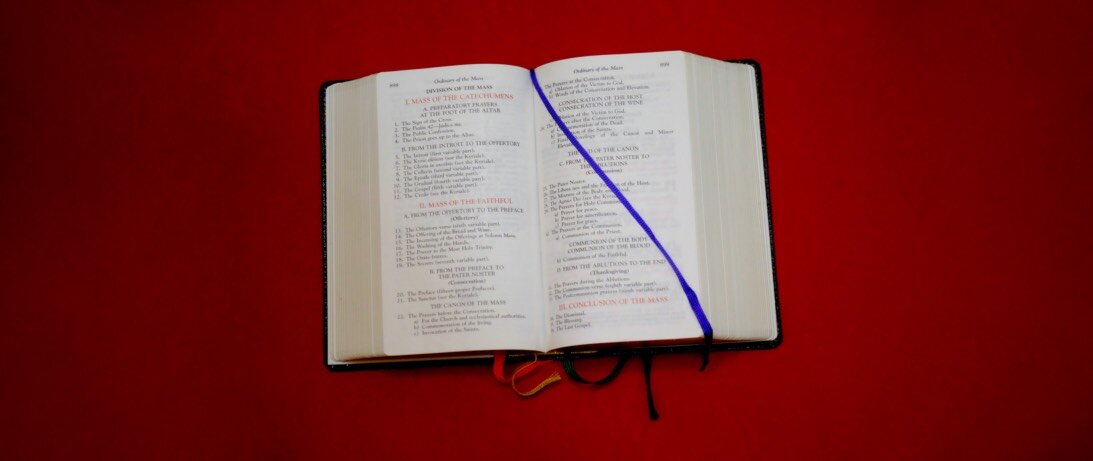
So each morning, there I am, in front of the big screen, my Missal open. At the end of each day’s Mass, I place the ribbons where they will be appropriate bookmarks for the next day. If you are unfamiliar, which you almost certainly are, the traditional Mass has parts that are constant, called the “Ordinary” of the Mass, and parts, readings and prayers, that differ from day to day, which are called the “Propers.” So a Missal, which is as thick as the Bible, has numerous sewn-in bookmarks, to make it easy to go from one part to another. (It is twice as thick as it would be but for the fact that the left page is in Latin, while the right page is the English translation. One learns the Ordinary over time, but it takes someone really fluent in Latin to follow the Propers in Latin each day. The Epistle and Gospel are said in English anyway, either during the Mass itself at Low Mass or right before the sermon at the Sung Mass.)
I used to have, but gave away to a young priest devoted to the Latin Mass, an old copy of the Missal. It was well worn and much more lovingly put together than my more modern copy. Its ribbons were of perfectly limp silk, but the thing I remember (and miss) most about it was its feel and its sound. The paper was very, very thin, yet the pages didn’t stick together. Flipping the pages from front to back produced luxurious tactile and auditory sensations. Perhaps mine, only 15 years old, will wear in, but I kind of doubt it.
The physical setting would be familiar to anyone who has seen a movie of a much earlier time that contains a depiction of the Mass. The priests at the priory each have a tonsure, a patch of hair shaved from their heads. Some of the servers and friars instead wear a flesh-colored skullcap — I call it a “turtle,”because it looks as if they have turtles balanced on their heads — instead.
The result is that Mass becomes a vacation from time, into a timelessness not available any other way that I know of. Nor is the impression misleading. This Mass is largely unchanged since the Council of Trent, 450 years ago. Until the liberties taken following Vatican II in the 1960s, you could walk into any Catholic Church anywhere in the world and take Mass, in the same language and same words. Some of the Eastern churches can claim that longevity, but no Western Christian church can. 
Dennis E. Powell is crackpot-at-large at Open for Business. Powell was a reporter in New York and elsewhere before moving to Ohio, where he has (mostly) recovered.
Pass along this article.
Never Miss Another Article from Dennis E. Powell.
You need to be logged in if you wish to comment on this article. Sign in or sign up here.

Start the Conversation