Sometimes it seems as if the universe is warning us against something. Or, perhaps, it is just measuring our determination. Testing us.
In “The Once and Future King,” the fine telling of the Arthurian legend that set to music became “Camelot,” T. H. White offered the parable that sometimes bad things happen to keep worse things from happening.
I’m pretty sure that at least one of these phenomena took place in my recent acquisition of a new spinning device to carry into my battle against plants. A “weed eater,” as the plagiarized brand name puts it.
Each spring for many years now, I’ve needed to rebuild my Troy-Bilt “string trimmers,” a process that involves replacing a lot of tubing, a gas filter, an air filter, and more often than not the carburetor. I can then yank on the starter cord many times and, just as I’m exhausted, it starts and I can attack any nearby offending foliage. Around here, much of the foliage is offensive. Lately, the leading offender is the “autumn olive.”
I have great fondness for Japan but not for its invasive greenery and insects. A lot of both have come to reside in the U.S., some courtesy of the United States Department of Agriculture. The USDA may be responsible for the autumn olive’s presence here the way it is for the awful, bloodthirsty multiflora roses, as part of its continuing effort to provide relief from the “dust bowl” which ended in 1936.
Both autumn olives and multiflora roses take over any place they grow. And they grow everyplace. That’s in some measure due to the fact that each produces red berries which birds like to consume. Their seeds pass through the birds’ digestive system and emerge, pre-fertilized, every place the birds fly or land.
This invading vegetation is difficult to control, all the more so if you spend more time getting your equipment running than you do actually running it.
This year I decided that it would be more worth my while to devote time to removing the plants than fixing the tools that aid that removal. I believe I was already considering it when my neighbor Tom, a man who has spent more time running a “weed whacker” than anyone alive, probably, showed off his new battery-powered edition. It was, he said and I’d seen elsewhere, at least as powerful as the gas-powered ones he’s used for years.
Doing a little further research, I became convinced.
My experience with electrical power tools has convinced me that the best usually are made by the Makita Corporation of Anjo, Japan. This is not a secret ,so its prices are high. I would love to have a Makita string trimmer, but the one I need costs more than the price of my first car (a 1965 British Ford Cortina, for the record). Second in the quality list are the products of the Andreas Stihl AG & Company of Waiblingen, Germany. That’s what Tom got. I might have, too, but for issues with my two Stihl gasoline chainsaws, neither of which works at the moment. My sense (it might be superstition) is that Stihl chainsaws are very reliable if and perhaps only if you use them all the time, which I don’t. (My electric Makita chainsaw, though, has never even hiccuped when I occasionally have need of it.)
Poking around a bit, I came to the conclusion that third in the listing of quality (and in its longevity as a company, which matters as we’ll see), is Ryobi Limited, originally of Fuchi, Hiroshima, Japan, but whose power tool company for export to the U.S. got sold off a few years ago to Hong Kong’s Techtronic Industries. TTI, as it’s called, makes Ryobi but also a vast number of other brands of power tools and electrical devices, including many brand names you wouldn’t have guessed. It would be nice if they had interchangeable parts, but they don’t. Well, mostly, anyway.
Looking online, I found that people seem generally happy with their Ryobi outdoor power tools, which are cheaper than Stihl products and much, much cheaper than Makitas.
Armed with this knowledge, I set about the task of getting a Ryobi device and battery. It was a much more complicated project than it should have been, though some of that is my fault.
The simplest solution (I thought until now, but not anymore) was to fire up Amazon, find the best model I could afford, and order it. It would, Amazon said, by here in a couple of days. It wasn’t here in a couple of days though. It took almost two weeks to arrive.
Time is of the essence when you’re cutting weeds and brush in the spring. Once the rains come and the air warms up, new growth — and, worse, leaves — erupt. Easily spied stems and trunks are no longer easily spied. Flexible new growth gets in the way.
Okay, my fault, should have ordered sooner. But on top of that, though it arrived apparently sealed in the factory box, the thing didn’t work. It would spin up for a couple of seconds, then stop. The battery would seemingly charge, but when I used it its indicator lights showed something wrong. The price of batteries for any of these things is very high — in this case more than half the price of the machine.
I turned to the internet, specifically to the Ryobi forum on Reddit. There I found people knowledgeable in Ryobi products. There I learned that the model I purchased from — I thought — Amazon had been discontinued a while back, and that it was sold to me not by Amazon but by a company called “Any Thing For Cheap,” via Amazon. (Sadly, every day it seems more and more as if Amazon is morphing into eBay without the auctions. I had noticed that for many things such as small computer accessories and parts the great American retailer has come to resemble the cheap Chinese retailers. It seems to have expanded beyond that, with numerous people selling their stuff there, not all of it good.)
To Amazon’s credit, they facilitated a return (though disassembling and repacking a Ryobi trimmer is a frustrating experience) and soon it was on its way back to Amazon for a refund. The people on Reddit said that the safest way to get Ryobi products is from Home Depot, a reputable company. One of its stores is 20 miles away, but it also offers its products online. So I went to its site, looked around, and found what I believed I wanted. Delivery was free and would be accomplished in two days. Though I hadn’t gotten my Amazon refund yet time was a’wastin’ so I went ahead and ordered it.
And immediately regretted it, because I ordered the wrong thing. It never occurred to me that there were trimmers that were not “attachment capable,” as Ryobi puts it. I looked and, sure enough, I had ordered one that couldn’t use any of the many attachments I already owned. It was 1 a.m. and it turned out that canceling an order (if you don’t have a Home Depot account, which I didn’t) is not especially easy at that hour. I had received an email from the company saying they were busily packing my order for shipment to me, so I was in a bit of a hurry. After an hour (I won’t admit I was frantic, but I kinda was) I discovered that the chatbot on the website could cancel the order if I knew the order number and my zip code, both of which I did. I received an email saying I’d receive a refund in from a few days to a couple of weeks.
I then went back and ordered the one I wanted. It crossed my mind that at that point and for a few days more I owned, on paper at least, three Ryobi weed whackers without having possession of any of them. Oh, and this time instead of two days the one from Home Depot would take almost a week to deliver. (I ordered it from the Home Depot store in nearby Parkersburg. I then watched the tracking updates as it took a national tour, visiting Oregon, Colorado, my old home town in Missouri and then — this was surely just to annoy me — the shipper’s depot in Parkersburg before finally getting delivered to me. But at least it was now here, and after unpacking it (a process as irritating as repacking the earlier broken one was), I found that it works. And the new model is clearly better than the discontinued one, even if the old one had worked.
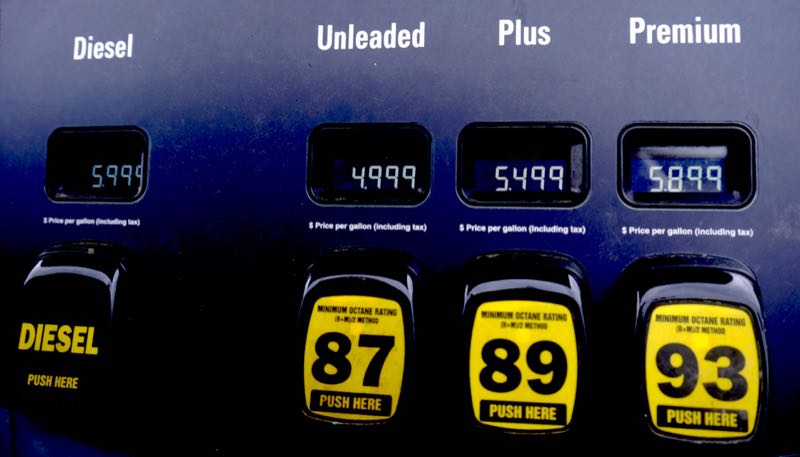
I probably should have gone to Parkersburg to begin with but — thanks, orange man — gasoline here is $5.49 a gallon. (Also, thanks again, Mr. President, the prices of both the machine and its batteries are higher due to tariffs. Though if you want to get any foreign-made equipment, the time is probably now. The tariffs are due to rise even further this summer, again to the proclivities of a man who does not seem to have done a day’s work in his life. Certainly not a day of physical work.) While I’m here I’ll mention that I pay slightly over 11 cents per kilowatt hour for electricity, and have calculated that charging a 6-amp-hour 40-volt battery from flat to full takes half a kilowatt hour. So currently, running an electric machine is loads cheaper than a gas one.
(In due course the refunds trickled in and I think I have both of them now.)
Whereupon I was equipped for the destruction of unsightly vegetation. It had rained a lot and been warm during my trial by online commerce. so where once there were sticks easily cut down there was now a lush jungle.
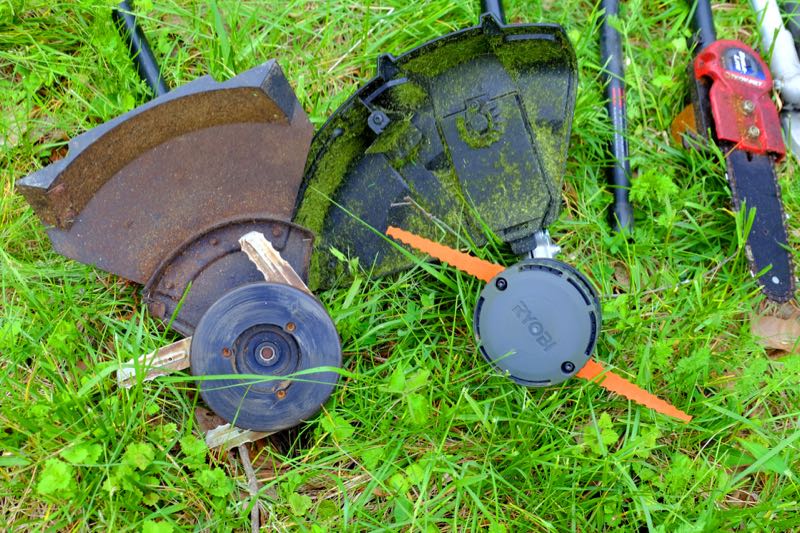
I hate to call the machines by their marketing name, “string trimmers” (and the popular name, “Weed Eater” is a trademark of the Husqvarna company). The rolls of plastic fishing line on these machines are in my experience useful only if you want to replace your grass with many short lengths of plastic. So in the past I have replaced the string mechanism with various aftermarket substitutes that last longer and are more aggressive toward their botanical enemies. But I won’t be doing this with the Ryobi machine — it comes with such a substitute in the box, a string-head replacement that snaps right on and that uses strong, sharp, orange plastic serrated blades that are easy to change when needed; when they get worn out new ones are a dollar or two, rather than the much higher prices of the aftermarket ones (when the company still even exists). These were my first tests of the Ryobi machine, once I’d charged the battery.
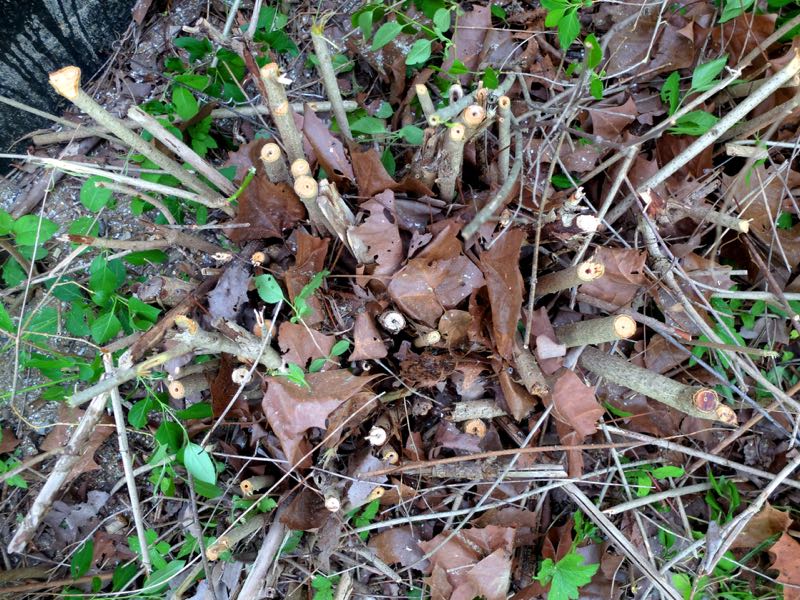
The Ryobi blades are by far the best I’ve ever used. I lit into a bunch of multiflora rose stems, stubborn and thorny and a quarter-inch in diameter, and the tough plastic blades sliced right through them — and showed no discernible wear afterwards. I considered this a stress test, the most difficult task I’d ever put them through.
About the machine itself. Based on my use so far, which has been a lot over less than a week, it’s at least as powerful, probably more powerful, than the gas versions I’ve used over the last many years. It has both high-speed and low-speed settings. The latter is said to extend battery life. I can report that while I’ve tried the high-speed setting I’ve found no advantage to it in the things I need done. I think the high setting is for the suburban lawn warriors (Heck’s Angels?) who want to be to the outdoors as Pete Hegseth is to the military.
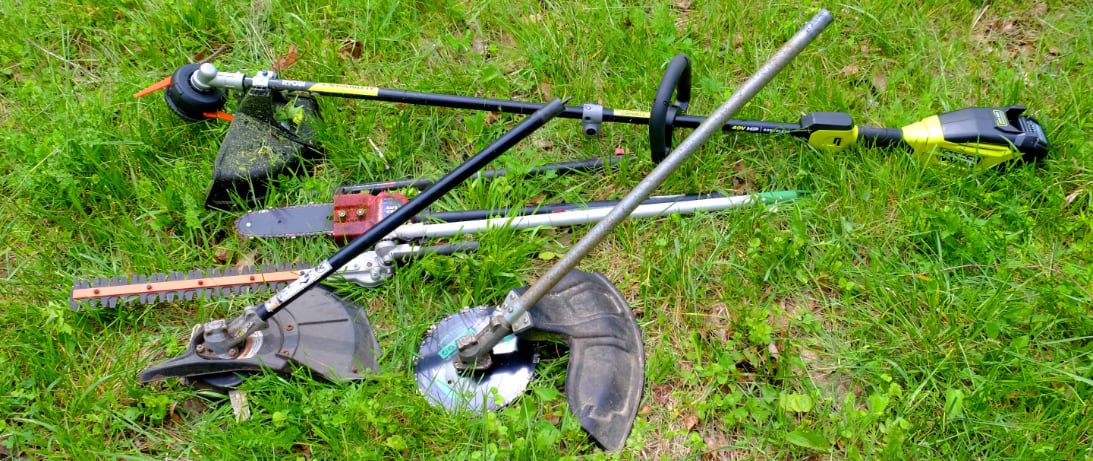
The attachments I have include a chainsaw-on-a-stick, which over the years I’ve found very useful as a limbing saw and for other purposes, a hedge trimmer (which like other hedge trimmers I’ve found to be fairly useless), and an adapted version of the string head which replaces the string mechanism with a circular sawblade. The last of these is useful but for the blade quickly going from very sharp and effective to as dull as a fast-food butter knife. The blades are thin and apparently made of mild steel. They might be useful for heavy weeds, but they fall short for other purposes.
The most useful for getting rid of heavy-stemmed brush, in my experience, is a replacement for the sawblade that instead uses a circular blade festooned with chainsaw teeth on its perimeter. On Saturday I set it against some of the many walnut saplings that grew where they didn’t belong — thanks, squirrels! — and were up to a couple inches in diameter, maybe a little more. I thought I’d approach them carefully, to get a sense of how much strain they would give the motor, but by the time I’d figured out how slowly to proceed, the little trees were down. It zipped right through them.
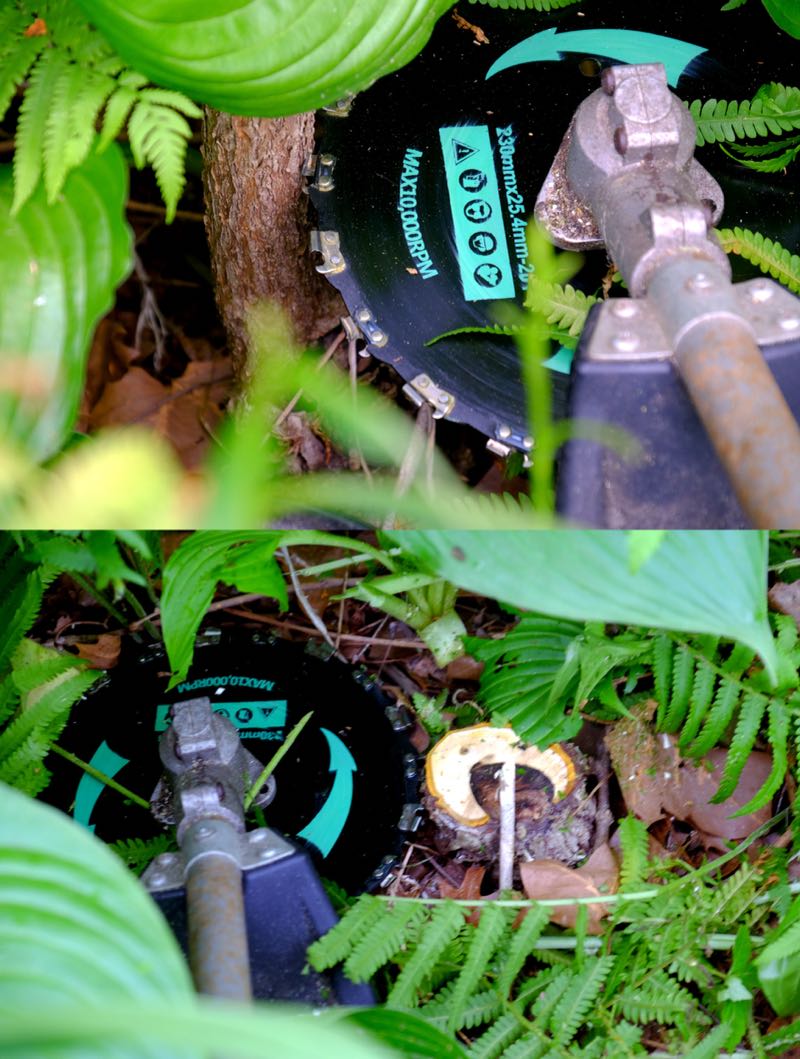
People in reviews and elsewhere wonder how long the battery charge will last, but even the question itself is misleading. With a gas-powered machine the engine is running the whole time, but with the electric version it isn’t, especially if you’re using it to cut down things, not to trim the periphery. I used it Saturday afternoon to lop down rose canes and little trees of both the walnut and autumn olive variety, and after an hour or so I was sufficiently tired that I feared I might become careless. I can guarantee that carelessness can be expensive, even crippling. I’m glad those implements are a distance away from my feet. So I went indoors and stuck the 4-amp-hour battery on the charger. I’d used a little more than a quarter of its charge.
I shall now sermonize on lithium ion batteries. They must be treated carefully, neither fully charged nor, especially, fully discharged. The 4-amp-hour versions cost $100; the higher-capacity ones cost from considerably more to a whole lot more. (There are cheaper ones available at discount stores. I have been warned against them but got one anyway for testing purposes. It seems to be fine for now, but I have no idea what its lifespan will be.)
In any case, I wish the charger were slower — the faster you charge a lithium ion battery the more damage is done to it, so you end up paying for quick chargers. The one that came with the machine charges it in an hour or so. I wish it took twice as long, and not just because I’d like to spend two hours sitting indoors waiting for the charge to finish on hot summer days. There are four yellow-green LEDs on each battery to show the level of charge. Having some experience with lithium batteries I can say that for battery health it’s best to stop charging when the fourth LED has been flashing for a few minutes, and to stop using the battery and recharge when the first LED is the only one that still lights up. This is especially true on hot days and cold ones. If you run the battery stone dead, there is a possibility that it won’t recharge at all, and the likelihood of this increases every time you do it. So don’t.
The batteries will lose capacity over time, and how quickly this change takes place is up to you. Handle your batteries with care. And don’t throw them around. They’re delicate.
It is good that the attachments are interchangeable across brands, because there are some that one uses only occasionally and would not like to have to replace when a different brand of trimmer is acquired. Apparently much of the money is in batteries, because those aren’t interchangeable. That’s a shame. To get a sense of it, I just ordered also on sale a Ryobi high-performance lawn mower with a 6 amp-hour battery. Based on the price of the battery alone, two-thirds of the cost was the battery. It was as if by buying a battery I was able to get a mower at small extra costs and, truth be known, that was the spirit in which I purchased it. (This isn’t me being clever. One of the Reddit people advised me to keep an eye open for such sales.)
Well tended lithium ion batteries are good for 400 recharges or more. That, along with the cost of electricity, works out to about 60 cents per charge. Based on my brief experience with the electric version and extensive experience with the ones that run on gasoline, that makes the electric one much cheaper to operate than a gas-powered machine.
My Ryobi delivery nightmare, it turns out, isn’t over. The mower I ordered, I was informed a few minutes ago, has been delivered. Except that it hasn’t. I saw the UPS driver go by and he didn’t even slow down. Nor did he kick it off the truck as he passed. It might have been delivered to someone but it wasn’t delivered to me. I phoned the Home Depot at the provided 800 number and spoke with a nice woman in, I believe, India. After a few minutes she said, “I can refund that to you,” and in a few seconds I received an email message saying that the price of the mower would be refunded. That was it. If there was any concern about the whereabouts of the mower it was not conveyed. Someone seems to have received a nice gift from the Home Depot company. (Well, from me until the refund arrives.)
I daresay our great online shopping economy seems to be collapsing.
Oh, well. I’m not sure the dinky mower would have been of much use on my little farm. I was getting it for the battery anyway. And I’m reaching the point where I wear out before the batteries I have do, anyway. This may turn out to be one of those situations where something bad prevented something worse.
Update: That evening a neighbor from down the road stopped by saying that he got home to discover a lawn mower belonging to me in a box there, so I drove down and fetched it. It’s good to have honest neighbors.
Now I guess I’ll wait for the email from SpaceX, announcing the new worldwide Starlink lawn mowing and brush cutting service, offering to precisely mow my lawn and trim the bushes via machines controlled by a swarm of tens of thousands of satellites in low earth orbit. I look forward to it. And their laser snow-removal, too.
Here’s hoping. 

Dennis E. Powell is crackpot-at-large at Open for Business. Powell was a reporter in New York and elsewhere before moving to Ohio, where he has (mostly) recovered.
Pass along this article.
Never Miss Another Article from Dennis E. Powell.
You need to be logged in if you wish to comment on this article. Sign in or sign up here.


Start the Conversation