It needed to be done, but the adults hadn’t done it, so I thought I would.
The result was a useful lesson. One that was painful both to me, who was guilty, and to many others, who weren’t. I never would have supposed that many years later it would become the kind of mistake the president of the United States would repeat on a much larger scale.
Where I grew up we had stinging insects. There were the long-waisted, solitary mud daubers, which in retrospection are kind of cute. They build tubular nests of mud, which they gather from the edges of puddles. They sting spiders, paralyzing them, and place them in the earthen tubes, then lay their eggs on them. The eggs hatch and the larvae diet on the stoned spiders and ultimately emerge as new mud daubers. Mud daubers can sting you, but I never knew anyone who got stung by one. Their nests are often found in barns and garages, which are good sources of spiders, too.
We had a yard mostly of clover, which meant we had a lot of honeybees. These mostly leave you alone if you leave them alone, but this runs counter to children frolicking barefoot in the grass. When this happened, the grownups would pour ammonia on the site of the sting so that it not only hurt but stank, too.
We had velvet ants, a kind of furry, wingless wasp whose sting is said to be extremely painful. Despite my best efforts, I never managed to be stung by one. There were smaller wingless wasps, too, which were sort of half way between wasps and ants — some ants sting, too.
We had sweat bees, so called because they would sting you on the inside of the elbow joint or behind the knee. (Actually, those were places where you’d most likely annoy them when they landed on you, causing them to sting. As with the stinging ants, they punch above their weight.) It seemed as though half the time they would sting you while you were in the car. I don’t know why.
There were also cicada killers, a very big solitary wasp that would sting and paralyze cicadas, then drag them to burrows whereupon the cicadas would have done to them what the mud daubers did to spiders. You wouldn’t see them often, and they were frighteningly large, with very long stingers, but somehow we never got stung by them.
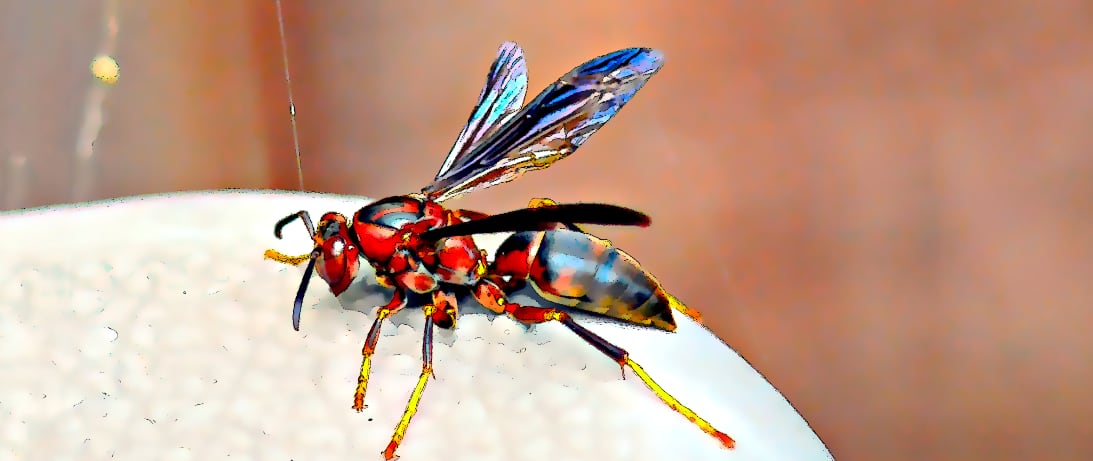
Then there were the paper wasps. These are pugnacious, sometimes out-and-out belligerent. Thoroughly dislikable insects, really.
Paper wasps were and are a permanent annoyance in the Midwest and probably elsewhere. They build their nests of papery cells under the eaves of houses and barns and in trees (or so we’re told; I never saw one in a tree). Some nests are are small but occasionally they get as big as a dinner plate.
When my father, with my assistance, was re-roofing the house, one day he put the ladder right above a wasp nest he hadn’t noticed under the eaves. That evening as he finished up he was coming down the ladder when, for some reason, the wasps decided he was a threat and attacked. I was there and saw him descend the ladder very quickly, landing on a shoulder. His shoulder was injured and we counted 18 stings.
Everyone agreed that paper wasps were a problem, but we never did anything about them. The only insecticide we ever had around was a petroleum-based, foul-smelling substance in a brown glass squirt bottle. Its brand name was “RealKill.” I see that the company name still exists, but I very much doubt the current product is anything like the stuff sold back then, which in my experience killed insects only if you drowned them in it, but its odor would give humans a headache. (Nowadays there is pyrethrin, a compound found in chrysanthemums, that is quickly effective and that comes in a spray can that will launch it 20 feet or more. A good, soaking application of a nest an hour after sunset takes care of the issue.)
I was about 10 the summer of the big wasp nest at our house. It was huge and near the front door. Occasionally somebody would get stung, but the tiny terrorists only lit into us one at a time (what the television cliché reciters would call “lone wolf” attacks).
My cousin Kirsten says she remembers a wasp landing on her and my grabbing and crushing it with my bare hand, saving her but me getting stung in the process. I do not remember this, but far be it from me to deny a tale of my heroism, there being so few of them. Still, it would help explain something I did that summer, possibly that day.
I knocked down the great big wasp nest. And all hymenopteric hell broke loose.
Soon there were wasps all over the place. The house was surrounded by angry wasps. The place soon looked like Pearl Harbor on December 7, with tiny fighter planes everywhere. There were wasps outside. There were wasps inside. Everyone got stung, including my poor elderly grandparents next door. I thought that the wasps would go away after a little while. They didn’t. They remained a problem for the rest of the summer.
The thing is, I knew better. Whatever one did with wasp nests one needed to do at night, because that was when the wasps were all at home. One popular method involved a long stick with a rag, soaked in coal oil or something, tied to the far end. The rag would be lit and applied carefully to the nest. The goal was to burn the wings off the wasps without setting the nest afire. I knew about this method but didn’t use it (which is why this story is not about my childhood of wasp-free homelessness following my having been put up for adoption after our house burned down).
Yes, a grownup should have done this, after dark, with someone, maybe me, standing by with a hose. The fact that no grownup did scarcely suggests that my action was a good idea.
All of which reminds me of what the Trump administration is up to in the Middle East.
Yes, everyone agrees that Iran and its smaller nests are a problem. We would all be better off if it and its allies went away. And any sensible person knows that the solution involves more than just knocking it down, because that’s not enough to make it go away.
The president and the tattoo-monkey who played a military expert on TV before proving that he’s a poor real-life military leader, keep going on about how the nest has been blown up. Yes, they hit many targets, sank many ships, destroyed many airplanes on the ground. They go on about this because it’s all they have to say. But that didn’t solve the problem and, like 10-year-old me, they have no idea as to what should come next, other than blow up more stuff — ineffective in solving the problem.
As with the doors to our house after I knocked down the nest, it has become difficult to pass through a crucial entrance to and exit from Iran and its neighbors. The neighbors are currently very patient allies. I doubt that their patience is infinite, particularly in that they can no longer sell the goods that made them rich and kept the rest of the world running.
Many years ago, at age 10, I got myself and my family into a mess with no way out. Today, almost 80-year-old Trump, with much the same motivation did much the same thing. We can’t be surprised if we soon feel the sting in many places in the Western world.

Dennis E. Powell is crackpot-at-large at Open for Business. Powell was a reporter in New York and elsewhere before moving to Ohio, where he has (mostly) recovered.
Pass along this article.
Never Miss Another Article from Dennis E. Powell.
You need to be logged in if you wish to comment on this article. Sign in or sign up here.


Start the Conversation