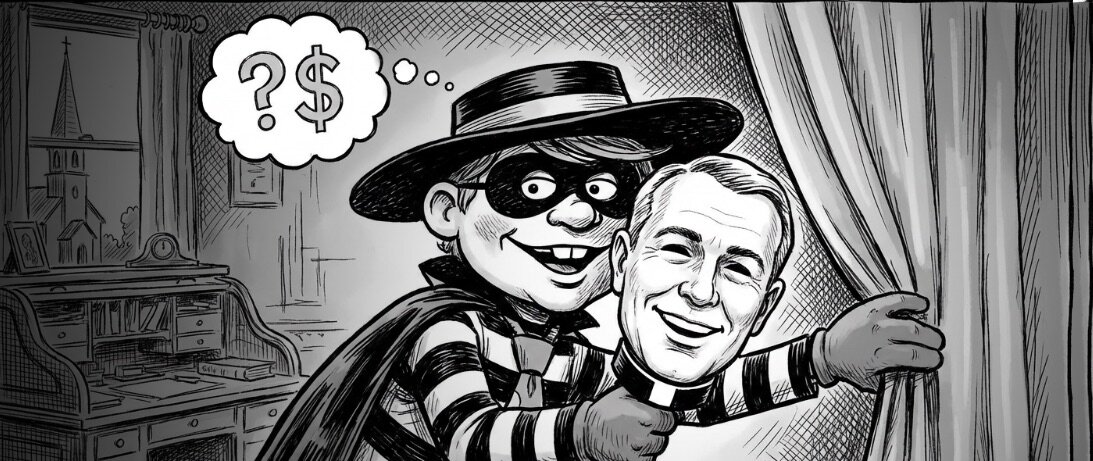
If there is anything as embarrassing as confessing one’s sins it has to be confessing one’s stupidities.
Yet here we are. Instead of describing how well my cool new Starlink-based phone-internet setup is coming together, I’m obligated to detail how I fell for a swindle so obvious that there’s no escaping the fact that my mind must have got disengaged for a while.
Yes, I’ll tell it in a way that casts myself in the best possible light, The best possible light isn’t good at all.
For years I have each week received by email a copy of that Sunday’s sermon by a priest I know and very much like. He returned to the area about a decade ago and went into semi-retirement, serving one of the smaller churches associated with the parish of which I’m a member. The homilies are emailed out by a perfectly lovely woman, a parishioner who correctly thinks it’s a nice thing to do. She occasionally sends other bits of news and announcements.
Sunday night there was a mass email from her, which was ostensibly a message forwarded from the priest. “I fractured my distal radius (at the wrist) my dominate hand and hope to get by without surgery but unfortunately i will be having my surgery done tomorrow. Please send me love and prayers.” Alarming, so much so that I jumped over the illiteracies. I sent a note of support to the priest, at the email address in the forwarded messages. (Which email address I thought was a bit odd, in that it was not a diocesan address that priests here normally use. In my defense I’ll note that it was late Sunday night and I was exhausted.)
Very quickly I got a reply, ” Thanks for your concern. I appreciate your kindness.
Sorry to bother you. Do you order online from Amazon?” That was weird, but I’d gotten the original forward from someone I regularly hear from so I was idiotically unskeptical. I wrote back that yes, indeed I do.
Then came: “Actually, I need to get DoorDash E-gift card for my Friend who is down with cancer of the Liver, It’s her birthday today. I tried purchasing them myself, but my card got declined. Can you get it from your Amazon account and have them sent to her email address? Let me know so I can provide you with her email address. I'll reimburse you with the money spent.” Wow (I thought, still not getting it), they must have him on some powerful painkillers. But sure, I’d be happy to aid a universally beloved priest.
There was a back-and-forth of details, the upshot being that I sent via Amazon $300 in Door Dash gift cards. Yes, that really happened. The fact that it was a scam couldn’t have been more obvious, and I went through with it anyway. Was I going to question a priest? On a Sunday? During Lent? My mind was rejecting how this was obviously a swindle and instead trying to figure out how it might be true. (I’ve been spending too much time around politics, obviously.)
There’s something especially awful about the sinking feeling one gets when it becomes undeniable that one has been had. For me it came with this message:
“Thank you very much. She got it already, Thanks. But unfortunately, she just told me that it couldn’t suffice what she needed to get on DoorDash site, so I was wondering if you could help me purchase another $200 DoorDash gift card so it will be $500 in total. I want her to complete what she wants to do with it. Also let me know how preferably you want me to reimburse you with the money spent.”
The switch finally flipped on. This was right up there with the “Nigerian prince” routine, about which we all laughed close to a generation ago. And this time I faked an auto response saying I would be out of the office until Monday afternoon, so get in touch then. I foolishly figured that maybe by then I could get in touch with someone interested in catching the bad guy in the act. I did not find such a person, though I did learn that scams can be reported to the Federal Trade Commission, which I did though I doubt it will do any good. Likewise, Amazon was of no help. My bank was sympathetic but offered no aid, though it did cancel my debit card, so I’ll have to drop in and get a new one.
I would be crankier with them than I am, but the fact is that they’re not responsible for my doing something stupid. I wouldn’t want them to pay for everyone’s misadventures so I can scarcely expect them to pay for mine.
I did allow myself to send a note to the con artist, pointing out (accurately) that his offense had been reported to the U.S. government, (also accurately) that the U.S. government takes a dim view of such things, and (again accurately) that the U.S. government has AI tools that could track him down almost instantly. I mentioned, too, that the last thing people who anger the U.S. government often hear nowadays is the sound of a drone. I suggested that sending back my money was advisable. All of this is true; I leave making the connection to him. If nothing else, perhaps I spoiled his serenity. Maybe now his eyes widen and he runs away when he hears faint buzzing sounds.
But there is no escaping the fact that I should have known better. I have written about this kind of thing. I have laughed at the YouTube videos of clever people tracking down the scammers. In an earlier day I delighted in the exploits of those who turned the tables on the Nigerian 419 scammers. (Which is basically what I fell for.)
This time, there was just enough that seemed real — the message forwarded by someone I know, and allegedly originating with someone I know and respect, to catch me entirely off guard and flip the switch on even the most basic thought processes.
I did send the priest a note at his diocesan address, asking if this had come from him. He of course wrote back: “Dennis this is a scam. My computer has been hacked. Nothing in that message is true. You should block payment.” But by then it was Monday.
I don’t think his computer was hacked. To get lists of people connected with each other, you write a little application — a game, a calculator, doesn’t really matter what — that gets access to your contacts. I don’t have any of those applications. I make a point of not having those. I use GrapheneOS, which blocks access to applications getting permissions they can’t legitimately need. But many people (I’m one to talk) are too trusting. They let any application have access to anything it wants. Seconds later, all the contact information they have is in the hands of the bad guys.
The nice lady who sends the emails sent a note on Monday: “Father is fine. He does not have a broken wrist. I received emails from five people stating this is a hoax. . . . If you prayed for Father’s successful surgery, healing and recovery (as I did), I am certain God will use our prayers for someone else.”
Nor was this the first time I have encountered this stupid scam. I’ve gotten obviously crooked email messages that claimed to be from people I knew before, many times over the years. Fortunately, the English in those was pidgin-gibberish.
It is going to get worse. With AI and associated technologies scams will become ever more sophisticated and difficult to identify. We need to be even more watchful.
That may be part of the reason I’m so annoyed by the theft by some bargain-basement scammer. There was nothing complicated in his technique. It’s been around for decades. It used to be done by mail!
I have no idea why I fell for it this time. Maybe the government is conducting discombobulator tests in preparation for the November elections. But fell for it I did.
Giving it some thought, my anger diminished. It is, after all, Lent and we’re supposed to think about forgiveness. When there is the grand accounting, I suspect that it will be found that I’ve been forgiven far more than I have myself forgiven others. The Lord’s Prayer itself offers advice in that regard.
There is a Japanese proverb that offers the advice that the person who seeks revenge needs to dig two graves.
I know people who are consumed by desire for retribution over minor offenses that took place decades ago. You can see how it has harmed them, while the offender probably has forgotten that it ever took place.
So, I lost $300. Not a cheerful thing to be sure, but as the deductible in my stupidity insurance it’s not high. If it caused me to consider the things for which I’m glad to have been forgiven, it was a bargain.
And if it makes anyone reading this a little more alert, maybe it was an actual service. You can be grateful for having been forgiven in your life, and do it on my nickel.
Whether wisdom or, more likely, rationalization, it nevertheless lets me avoid it gnawing at me, and might actually make me a little bit of a better person.

Dennis E. Powell is crackpot-at-large at Open for Business. Powell was a reporter in New York and elsewhere before moving to Ohio, where he has (mostly) recovered.
Pass along this article.
Never Miss Another Article from Dennis E. Powell.
You need to be logged in if you wish to comment on this article. Sign in or sign up here.


Start the Conversation