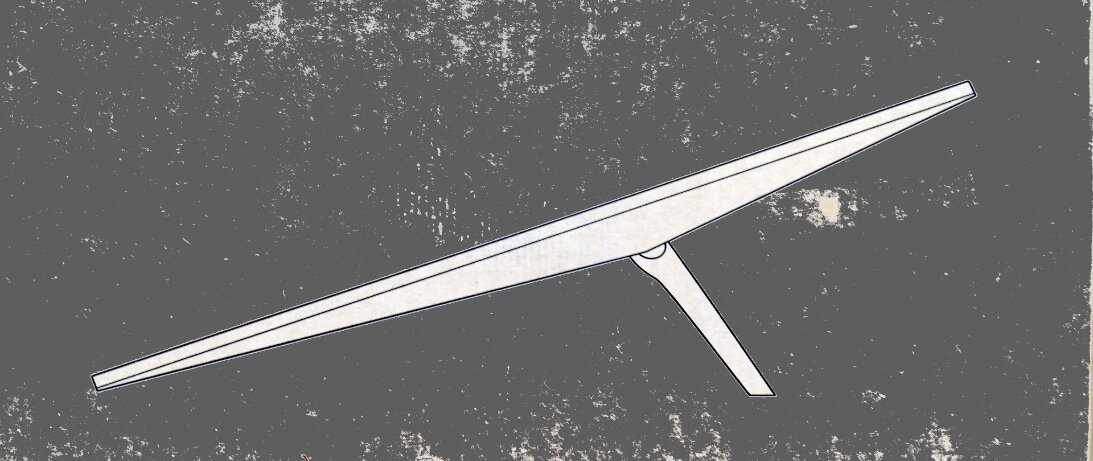
If only I can get the dish on top of the stick!
As I wrote that I was suddenly reminded that a few decades ago it was popular for performers on variety shows to spin dishes on the tips of what looked like pool cues, the trick being to get many dishes spinning on many pool cues at once. At some point the studio audience would applaud. We were more easily pleased in those simpler times.
“Variety show” you ask? There were a lot of them, from Ed Sullivan to Perry Como, Andy Williams, Red Skelton, and others, even to some extent Jack Benny and, Carol Burnett. The star would do whatever he or she was famous for doing, and there would be singing groups or soloists, maybe dancers, perhaps skits, sometimes a magician, sometimes a plate spinner. (I looked it up. “Plate spinner” is what they were called.)
There were also, come to think of it, “variety pack” cereals. Here, you would buy small boxes of a company’s various cereals, all packed together in a cardboard tray. It was half the cereal for twice the money. Some came with an H-shaped perforation on the front of each little box, so that you could supposedly cut along the perforation, fold the flaps back, and pour milk into the actual box to add a refreshing hint of wood pulp to the flavor as you raced to consume the cereal and milk before it all leaked away.
I think variety packs are still made, but you’re not likely to see plate spinners except maybe at the state fair or a local talent show. Variety shows, if they still existed, would probably be called “diversity shows.”
But it is not a plate spinner that I need to get my still-in-the-box Starlink dish atop the small radio tower that’s bolted to my house. Up there, it’s likely but not certain to work.
You’ve probably heard of Starlink. It is one of Elon Musk’s ideas and many people say it works as well as the idea sounds ridiculous. If you follow tech subjects you rejected the whole thing when first you heard of it a few years ago.
The idea is this: You launch tens of thousands of little satellites into low earth orbit. They zoom around the world, one behind the order, all connected to the internet. They provide internet service to the millions of subscribers below, each equipped with a surprisingly small, rectangular dish of the sort I’m trying to install. On the face of it it’s something that could never work. It would be far too expensive, all those satellites. Being in low earth orbit, they’d all the time be falling from the sky and burning up. Maybe there would be “Starlink showers” instead of meteor showers. It just makes no sense.
Yet here we are. Starlink exists and you can subscribe to it, as I have for good or ill. It’s even cheaper than some of the alternatives. You can get respectably fast internet for $50 per month, twice that speed for $80, and twice that speed, more than you’ll ever need unless you have a large family who all watch different 4k television channels at once, or else have an apartment building, for $120. I selected the middle tier. A payment of $21 and change got the dish and connecting cable and router shipped to me far faster than I expected.
It’s not — well, won’t be — my first experience with internet via satellite. A couple years after I moved here to the woods, sick of the inconvenience and unreliability of the dial-up service I could get even with my superb U.S. Robotics Courier HST Dual Standard (it was said that Alexander Graham Bell had strung the phone lines here himself, and given the noise I could believe it), I got something called Wild Blue satellite internet service. It was faster than dial-up, but it wasn’t faster than anything else.
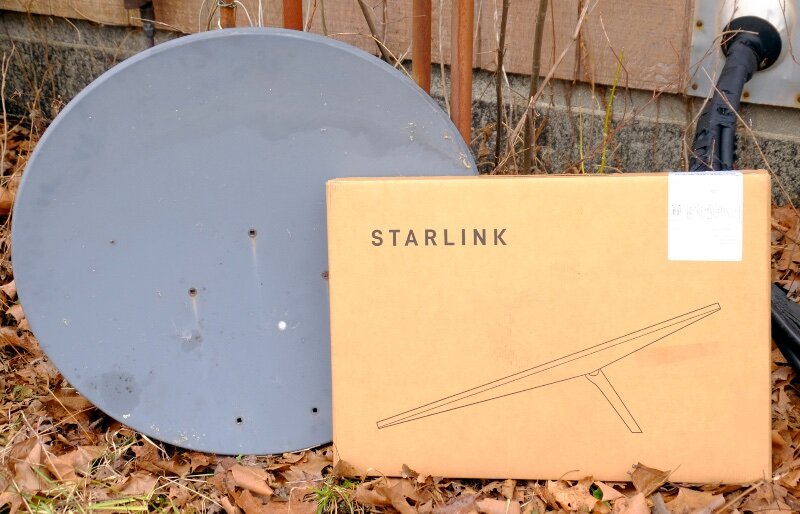
It arrived via a fairly big dish that seemed small at the time. The dish focused the signals to and from the satellite onto a small receiver. There was one satellite involved. It was in geosynchronous orbit — it orbited at the same speed the world rotates, meaning that it was the same place relative to the earth all the time. That also means that it was more than 22,000 miles above the equator. In that I live far north of the equator, you can add thousands of miles to that. So it wasn’t instantaneous. It was not something that allowed, for instance, internet telephonic communications. In retrospection, it kind of sucked, subject as it was to signal corruption during bad weather without it being that fast to begin with. But it was via satellite and that made it cool.
It was cool to me, anyway, as it surely was to others old enough to marvel at participating now in the things that until recently had been the stuff of science-fiction romance. You don’t have to be all that old to remember the excitement surrounding Telstar and the first live broadcast from across the Atlantic Ocean.
You would have had to look to science fiction, too, to come up with the likes of Elon Musk, both the person and the name: a brilliant though crazy fellow whom you hoped would turn out to be a good guy by the end of the story. He’s half Wernher von Braun, half some weird Ayn Rand character, with a sprinkling of random, wild-eyed lunacy.
He’s the one who thinks that a better idea is thousands of satellites in orbit, 300 miles high, about 6,000 so far but five times that many planned. Even at the speed of light — the speed of radio waves, not the speed of the satellites — the difference between transmissions 30,000 miles to and from geosynchronous orbit and to and from satellites a hundred times closer is significant. You can do a lot more with the closer satellites, such as talking on the phone. The time spent sending and receiving is called latency, and Starlink connections are 100 times quicker.
The price of this is paid in complexity. Instead of being focused on one satellite all the time, transmission is passed from one to another, several times per minute, and they all have to keep track of what’s going on. Nor is any of that calculation done on your own computer, to which Starlink plugs in just like any other network, or is connected like any other wifi. The connection to the heavens is accomplished by a phased array antenna — the Starlink dish. The happy news is that I don’t have to actually understand any of this to capitalize on it.
But to be in contact with many satellites at once so that they can hand off my business from one to another means that the dish (called “dishy” by people who oughtn’t be allowed online at all) must be able to see many satellites at once. Which is Starlink’s weakness.
It may not be necessary once the many thousands more satellites are placed in orbit, a few hundred at a time, but right now the standard Starlink dish — the one on a small, flat box in the other room — wants to see a 110-degree cone of the sky. Okay, you might think at first, no big deal.
It is a very big deal in large parts of the world.
If you live in a place that is perfectly flat for miles around, horizon-to-horizon is 180 degrees. Subtract the 110 degrees needed by Starlink and you’re left with 70 degrees — 35 degrees above the horizon in every direction. You don’t have to remember your high school geometry to recognize that 35 degrees ain’t much.
Added to this concern is that at the frequencies used by Starlink a lot of things can block the signal. These include not just hills, houses, and mountains but things like leaves. Starlink provides an application for smartphones that (it is said; I haven’t gotten it to work yet, but I haven’t spent much time in the attempt) is supposed to identify obstructions and help you find the right place to put your dish.
The dish (and lord knows how much computing someplace else) also tries to work around at least some obscructions: “Starlink is designed to keep you connected, even if your view of the sky isn’t perfect. The system automatically detects obstacles such as trees or buildings and proactively switches between satellites to maintain a strong connection. These switches happen many times per minute and are generally imperceptible to users.”
I do worry about that “generally” part, but as the hive of satellites grows it is likely to become less a concern.
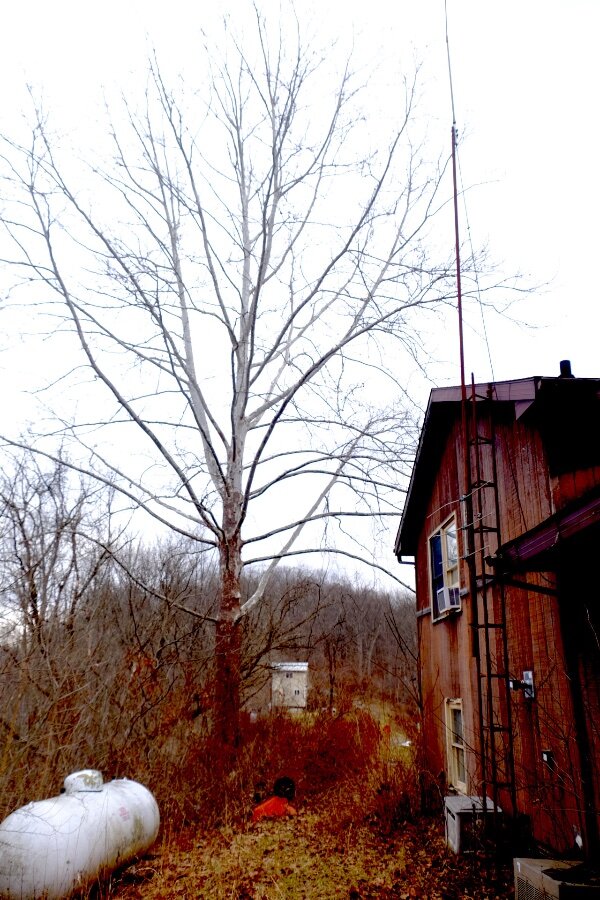
Still, it’s best and in many cases essential to mount the dish as far as possible above obstacles, keeping them below the approved 35-degree horizon. Which brings me to my dish-and-stick problem.
There is no place on my property that has an uninterrupted 110-degree view of the sky. I live on a hill. I have trees. I have a house. The dish will need to be elevated.
As luck would have it, I own what if you squint you could call a small radio tower. It’s triangular in cross section and about 15 feet tall. Bolted to it is a heavy steel pipe, also about 15 feet long, but it extends eight or nine feet above the tower, which is bolted to cement at the bottom and to the eave of my house ten or 12 feet up. At the end of the pipe is some sort of long whip antenna — the woman who lived here before I bought the house used to be the local school bus dispatcher. The whip antenna can be removed with no loss to anyone, leaving me a place 20 feet in the air to mount the dish.
A few years ago I would cheerfully have taken a ladder to the roof, unbolted the pipe so it would go lower, removed the whip antenna, bolted on the Starlink dish, and raised the pipe back skyward. There would have been a bit of aiming and tuning to get it just right, but it would have been quick and efficient.
Well, for now, before the leaves appear on the enormous sycamore tree that I’ve wanted to be rid of for years anyway. But it has no leaves at the moment. I hope getting it cut down won’t be as expensive as I fear.
And in any case, my days of going onto the roof, I fear, are behind me. Among the lingering effects of COVID-19 is an inability to entirely trust my balance. This was not accompanied by a devil-may-care attitude, pun intended, as to falling off the roof, which may help explain my continued existence.
I got in touch with Ted from the local amateur radio group, seeing if he knew anyone who does that kind of work, but they are all also past the point of climbing on roofs and towers. He got in touch with my neighbor Constantine, who thinks my existing tower is too rusty to reliably support the dish in a wind. (I think that the dish, two feet by a little over a foot and to be mounted only a few degrees away from horizontal, won’t offer much wind resistance, and if the tower were that weak it couldn’t support the weight of the pipe.)
That’s where things are now. The adapter that will — would, anyway — allow attachment of the dish to the pole is supposed to arrive Friday. By then I hope to have a better handle on how to align the dish for the best signal.
Or I might just forget the whole thing, send back the dish, and take up dish spinning. Or develop a taste for tiny boxes of cereal. 

Dennis E. Powell is crackpot-at-large at Open for Business. Powell was a reporter in New York and elsewhere before moving to Ohio, where he has (mostly) recovered.
Pass along this article.
Never Miss Another Article from Dennis E. Powell.
You need to be logged in if you wish to comment on this article. Sign in or sign up here.


Start the Conversation