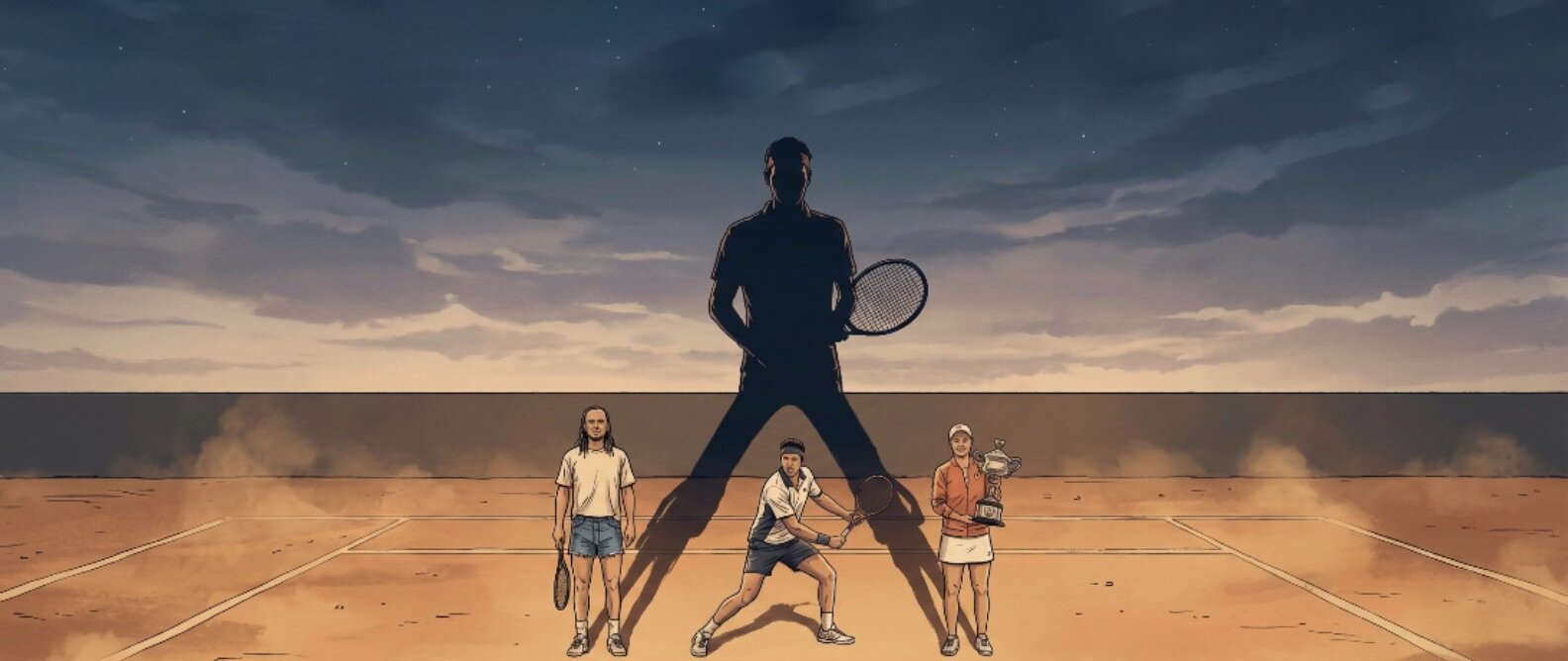
The gala which precedes the tournament is not a ball, but exhibition tennis, which featured legends Roger Federer, Andre Agassi, Patrick Rafter, and 2022 women’s champion Ashleigh Barty. Long-time OFB readers will know how much seeing Federer again means to me.
Roger also played a tie-break against 13-seeded Casper Ruud. I know objectively that Casper was going easy on Roger, but to see him out there gliding across the court and hitting his trademark beautiful shots was a great joy for me, and I know I wasn’t alone. He’s 44 now, but trust me, they won’t let him play the Legends Tour until he’s 60.
The tournament itself was highlighted of course by Novak Djokovic’s quest to add to his leading total of 24 major titles. In this he was assisted unintentionally by two of his competitors, who forfeited due to injury. Lorenzo Musetti, currently ranked number 5 in the world, was up two sets to none in the best-of-five-set match when he succumbed to injury in the quarterfinals against Djokovic.
Would the now 38-year-old Djokovic be able to ride this welcome extra rest all the way to a record 11th Australian Open title?
As it turned out, no. Because waiting for Djokovic was world number 2, Jannik Sinner.
The Frazier to Alcaraz’s Ali, it was supposed that Sinner would face Alcaraz for the title. Djokovic couldn’t win the title, but he had enough to shock Sinner in the semifinal. The noted crusher of dreams and suspected tennis android Sinner finally ran out of energy. I don’t feel too bad for him: he has 96 match wins out of his last 101 contested on hard courts. Alcaraz, for his part, seemed to be cruising through the semifinals over Alexander Zverev, but Zverev made it a five-set war. Alcaraz seemed at one point to injure himself, but eventually triumphed.
In the final, the legend Djokovic was in peak form to start, but the first set would be his high point. Alcaraz triumphed 2-6, 6-2, 6-3, 7-5. The 22-year-old now has 7 major titles, and is the youngest man in history to win at least one of all four majors—the career Grand Slam. It’s even more impressive that he has two each at the other three.
Aryna Sabalenka appears to be a notch above her main rivals in the women’s game, at least on hard courts. But this year, she fell to Moscow-born Kazakh, Elena Rybakina. Rybakina triumphed, 6-4, 4-6, 6-4 in the final. The clay court season, with its pinnacle at the French Open at Roland Garros, looms. Is Rybakina heading toward being a factor at the majors routinely, along with Iga Swiatek, Sabalenka, and Coco Gauff? Swiatek unexpectedly found form on the grass at Wimbledon last year, so she is a clear favorite at the French Open where she’s won 4 times already, and at the All England Club as defending champion.
What adjustments will the American Gauff make? Can anyone actually contend regularly with Sabalenka’s power on hard and grass courts? We’ll find out in what is sure to be an amazing 2026.

Jason Kettinger is Associate Editor of Open for Business. He writes on politics, sports, faith and more.
Pass along this article.
Never Miss Another Article from Jason Kettinger.
You need to be logged in if you wish to comment on this article. Sign in or sign up here.

Start the Conversation