I suppose there is a psychological essay to be written about it, on the order of Elizabeth Kübler-Ross’s five stages of grief. In both, the first stage is denial. “No, I’m not really getting a cold…”
But the cold arrived, as they always do, and I prepared for a couple weeks, maybe more, of discomfort.
It turned out nowhere near as bad as I anticipated, due to actions I took and that you can take, too, if you want to endure a cold and related maladies with minimum inconvenience. If you follow them — as I didn’t until it was too late — you might keep from catching a cold in the first place.
I’ve written about it before, but it is worth repeating every year.
The first thing I’ve been doing is eating well. This doesn’t mean eating expensively or luxuriously. It means paying attention to your diet and consuming what your body needs. It’s not that hard. Fruits and vegetables are good and good for you.
Where I shop, in a small town in the middle of the country, good, big avocados are 59 cents each. Select them carefully, so that you can have one that will be ripe tomorrow, one that will be ripe the next day, and so on, up to about four of them. (You can’t predict their development much beyond four days.) I try to eat one each day. Be sure to scrape out and eat, too, the greenest part of the flesh, right next to the skin. It is full of goodness.
Likewise, bananas. They’re cheap and good for you.
Other fruits as well. There’s always something in season and more and more now there are fruits that are always in season. I cannot speak to apples as physician repellents, but I can say that if you eat one each day your life will be better.
As to vegetables, I dive into the frozen stuff, due to consistent availability. George H.W. Bush famously disliked broccoli and now he’s dead. There are ways of preparing broccoli and even Brussels sprouts that render them edible and possibly even delicious. When I was growing up, we had those and some other cruciferous vegetables with a sprinkling of cider vinegar. (Though not cauliflower, which was always with a simple cream sauce.) I’ve learned that broccoli and Brussels sprouts are really good if you take some mayonnaise and mix in a little garlic powder and some powdered chipotle. (I get mine here, though I’m angry that it’s no longer available in the handy, economical half-pound bags — I go through a lot of it.) Use it as a kind of dip. A little is all that’s needed.
Frozen peas can be used for more than cooling bruises. They’re good for you, too.
And so on.
You can’t really get the nutrients these things provide in pill form. There are subtle interactions that come through getting vitamins and minerals as they naturally occur.
My favorite example of this is lycopene. This nutrient is proven quite effective in maintaining prostate health and preventing — even treating — prostate cancer. But there’s a catch. Studies done by real scientists who aren’t looking to sell you anything have shown that lycopene pills seem to do you no good at all; one even showed that lycopene alone might actually increase the incidence of prostate cancer. On the other hand, a couple of dollops of tomato paste each day have an unmistakable effect in reducing prostate enlargement and cancer of that annoying organ. Why? no one has pinned it down, but the theory is that lycopene is effective when combined with other trace nutrients found in tomatoes. Why not just eat tomatoes? You could, but tomato paste concentrates them, so a couple big spoonfuls give you as much tomatoey goodness as a half-dozen tomatoes. The stuff I get is from Aldi. It contains tomatoes and citric acid, nothing more.
A lot of tomato paste contains all kinds of other flavorings and additives. I avoid them. You should, too.
Likewise heavily processed foods in general. The processing is for the processor’s benefit, not yours. (As a child I loved a canned meat-ish product called “Vienna sausage.” Then I became old enough to read the ingredients, and that day there was a can of Vienna sausage minus one bite in the garbage at my house. It was the “pork lungs” that settled it for me. Grownups have had similar reactions to the ingredients of the “McRib” sandwich. And the bargain frozen versions of many products contain things you wouldn’t want in your house. Remember, now “pork lungs” can be listed simply as “pork.” The old saying is that if you like sausage, you shouldn’t watch it made. I’d update it: If you like sausage, you shouldn’t. Meat is fine, but get it in identifiable form.)
Pay attention to your nutrition and eat what you should, not what you crave. Soon enough, you’ll want to eat what you should. And — I’m not exaggerating — you’ll feel much, much better. Doing that will help prevent colds and a multitude of other ailments and diseases.
But when talking specifically about colds and its winter viral fellow travelers, influenza and SARS-CoV-2 (which gives you COVID-19 whether you’ve vaccinated or not), there’s something you could and should do, without fail, every year.
It’s something I failed to do this year, until it was too late.
You must keep your house (and if you can, your workplace) at at least 42 percent relative humidity, though no more than about 58 percent.
At that level of humidity, airborne viruses die in just a few minutes. At a higher level, molds and similar microbial villains take over. You can look it up. I find 45 to 50 percent most comfortable.
Keeping your house humidified is easy but not automatic. While keeping a pan of water on the stove (or, especially, the wood stove) is charming aesthetically, it won’t do the trick. Nor will having lots of house plants. You need to actively humidify the place.
And you need a reliable way to measure the humidity. I assign this latter task to three multi-use devices from China that I got online. They measure temperature and humidity where they are in the house and, through a wireless remote sensor, outdoors (make sure to place the outdoor sensor out of the rain and in a constantly shady place). From them I’ve learned that temperature sensors outdoors are accurate to within two or three degrees, and that indoor humidity varies a lot from room to room, so rather than one big humidifier you need several small ones in different locations.
About humidifiers: in most situations, the cheap ones will do just fine. They have a fan that sucks air through a filter kept wet by a reservoir of water that you have to refill. They do the job and, because water evaporates more slowly as the humidity increases, they tend to be self-adjusting. The frequency you need to refill them gives you a sense of how much good they’re doing. Right now, I’m pumping between two and three gallons of water into the air each day; in deep winter it’s twice that or more. I got four of these last year on sale at Walmart for $20 each. As a bonus, they use a standard, easily replaced filter. Replacing the filter each year is a good idea.
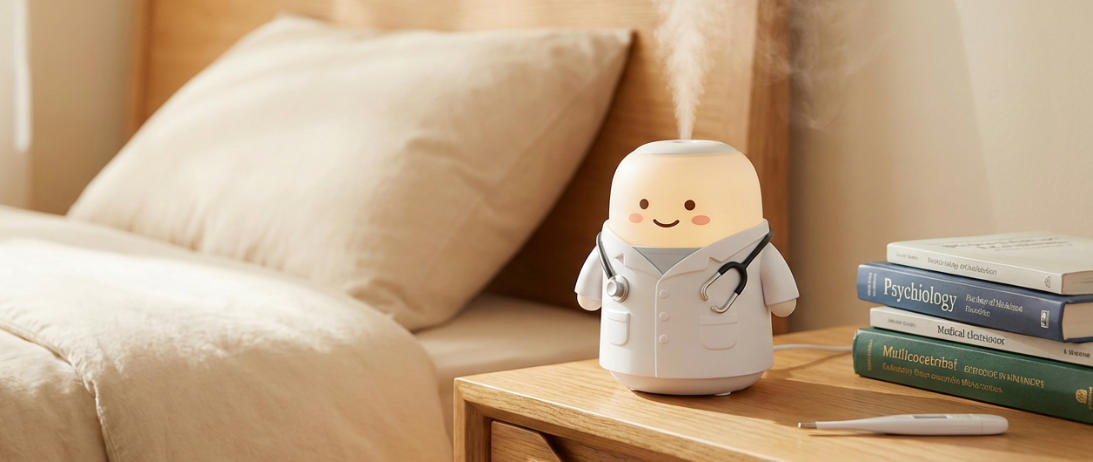
There are two other kinds of humidifiers. Popular, pretty, and impractical in some ways is the variety that shoots a continuous puff of fog into the air. They are nice to look at, but they’re not governed by how humid the air already is. You could put one on a shelf in the shower (though don’t!) and it would chug along even as the hot shower has the bathroom all fogged up. By the way, if you live alone, leaving the bathroom door open when you shower is a free way to increase the humidity in your house.
The third kind of humidifier is normally called a “vaporizer” and is thought of mostly for sick-room use. It releases humidity by heating water. There’s usually a little cup in front that you can fill with Vicks VapoRub or something, which it is thought will help clear your chest as the minty vapor fills the room (and which will certainly keep mice away). These are pleasant to use, and comforting, but they have two problems. First, because they heat the water they are likely to clog due to the minerals in your water, and unclogging them takes an hour or more and doesn’t always work. Second, because they heat the water they use a lot of electricity. So they are best for, yes, sick-room use.
(This year I fell for an expensive, washable, reusable furnace filter. It needs to be carefully washed and dried every few months. I imagine I’ll have to clean mine more frequently than that, because my humidifiers spew tap water into the air, and here that means some minerals, too. The filter is supposed to make any tiny airborne thing go no further. It’s too early to report if it turned out to be a good idea.)
I’ve gone on about humidifiers and how they eradicate viruses. But wait, there’s more!
As I mentioned, I got out the humidifiers too late to prevent my cold, so what’s the point? Aha! There is one! More than one, actually.
In the winter, when the air is dry, you’ll notice that your nose dries out. Some people even get nosebleeds as a result. But with properly humid air that doesn’t happen. So if you do get a cold and you have kept the air humid, blowing your nose is easier and more effective. Instead of a dry hack, coughing is productive and satisfying. Your eyes don’t feel as dry. And you generally feel more comfortable.
So my cold was not the inconvenience that colds often are. Rather than the constant discomfort, I mostly forgot that I had a cold at all. It’s still sticking around a little, but it doesn’t much matter.
When it gets colder and dryer, with the air properly humidified there will be no spark from my fingertips when I touch, say, the kitchen faucet. If you have pets, humidity will make them happier and healthier, too.
I should note that it’s not the best idea to place humidifiers next to an external wall, because the water can condense on the cooler wall and ruin paint or wallpaper and aid in the growth of mildew. Best to put them in the middle of the rooms or near interior walls.
Christmas and the new year approach, and for many of us this means seeing many more people, sometimes in our homes, and coming into contact with the season’s infections. Keeping the house humidified makes it less likely that you’ll catch something you or a family member picked up elsewhere. Even if you do get whatever bug is going around, proper humidity will make it a lot less bothersome. 

Dennis E. Powell is crackpot-at-large at Open for Business. Powell was a reporter in New York and elsewhere before moving to Ohio, where he has (mostly) recovered.
Pass along this article.
Never Miss Another Article from Dennis E. Powell.
You need to be logged in if you wish to comment on this article. Sign in or sign up here.


Start the Conversation