A controversy at a Christian publication this week gives us an unusual twist on the AI debate. The great medieval theologian Thomas Aquinas and self-driving cars now have something in common.
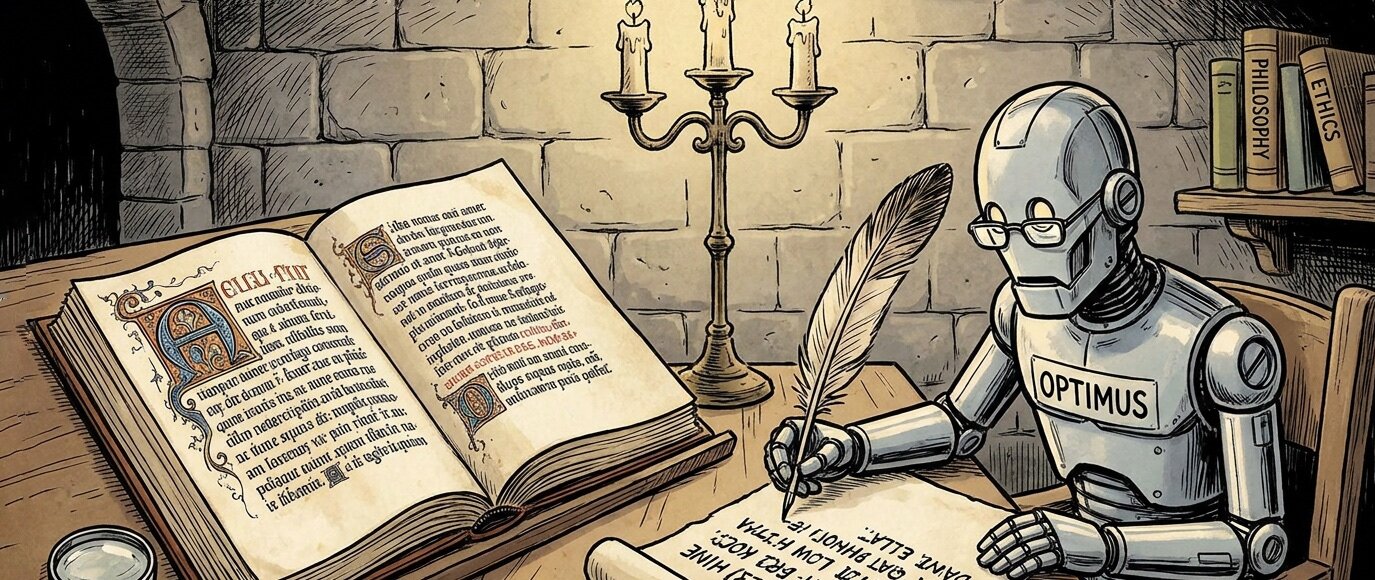
Mere Orthodoxy announced something I’d actually had in the back of my mind to do for some time: take the massive collection of public domain historic Christian texts not before seen in English and translate them. Neither Mere Orthodoxy nor I have the resources to fund such a project with a massive team of translators; they did what I’d been pondering: hire AI to do it.
It’s a perfect AI-shaped project. Anyone interested in theology knows that the inherited wisdom of centuries past that has been brought into English (or any modern language) exemplifies “tip of the iceberg.” Even texts from greats like Aquinas have been left untranslated for centuries. Too many have appeared destined to remain that way.
No longer. Mere Orthodoxy’s effort was able to clear through over 15,000 works so far and no doubt many other similar efforts will follow.
There was an immediate reaction against the effort, just as we see with nearly any notable AI deployment today. One translator of a relatively obscure Reformation-era theologian, Girolamo Zanchi, for example, noted with exasperation how his long labors now feel relegated to the realm of a hobby.
I can understand his pain. If you labor closely with a “lost” author’s work for years and then watch a machine do laps around you, it isn’t going to feel particularly good. But there is neither the funding, nor crucially, the speed to get through the back catalog, even with such translators’ dedication.
I think our visceral reaction is to see this as dehumanizing: the care of a dedicated individual being lost to a machine soullessly translating without that human spark of care. And, if it is “good enough,” the effect is not only to replace a human on a particular effort, but to invalidate a whole field of “handmade” scholarship.
But this effort is one that is bringing human works back to humans. Mere Orthodoxy’s Jake Meador distinguishes between the distinctive benefits to the translator and the reader in his own case for why his publication’s effort is justifiable, even as they also hesitate to have AI write columns. As nice as it might be if humans did the process from end to end, we can’t miss the very human-centric and profound result.
To Meador’s point, it is worth keeping in mind writing and translating are related, but distinctly different activities. When we read a newly written work, be it a column like this, a long form essay or an academic journal article, we are intentionally seeking to hear another human mind engage with an idea or ideas and help us understand them. We often weigh our valuing of the work based on what we know or can know about the person with the byline.
The translator’s authority is meaningful too, but that person’s task is primarily to get out of the way. Translation ought to convey what the original author said as close to the way the original author would have said it had he or she spoken the destination language. When reading Aristotle, I want to be focused on Aristotle and his reputation and largely forget about the intermediary between us. Inevitably, translators leave fingerprints on the result, but in an ideal world they would not.
AI actually has the possibility of bringing us closer to that ideal world of encountering the original, very human writer, not drawing us farther from it. To be sure, human translators will notice things the AI-powered process will miss. Some nuance won’t get conveyed, some wooden turn of phrase will be chosen. But, you know what? Human translators do that, too.
Yes, our current generation of AI is still flawed. It’s so capable it seems able to do nearly anything until it maddeningly ignores the most glaring of errors. We’re not there yet, but we can see where this technology is inevitably headed.
What can AI already do well — and will soon be able to do even better — at a scale, and with certain qualities, humans cannot match? AI can tap into a breadth of knowledge about works in a language even the most erudite cannot match. It can also measure the semantic range of an incomprehensible number of existing cases of those words already translated and probabilistically choose the most likely English word for, say, a Greek word rather than the word a translator just prefers. They’re only going to get better at this. And, because computing resources will eventually catch up with demand, someday it’d be trivial to do this multiple times over to gain a high confidence that any errors had been caught and smoothed out.
Not human and missing that momentary genius of human touch, but perhaps actually better at conveying the human touch of the original author across vast swaths of works. And able to do it repeatedly at speeds we cannot match.
We are right to be cautious, but we are also right to ask why we are cautious. And when the why is “we’ve taken away the joy of translating,” but the goal of translating was to convey the joy of the original author, asking why suggests we should consider moving to “why not.”
And this is where Thomas meets driving. I am among those nervous about the prospect of self-driving cars. I can’t say I’m overly anxious to be a passenger in one. Handing control of a massive device capable of mowing people over to an AI brain seems like an odd choice. What if it doesn’t recognize a situation? What if it misses a rule?
I like that human element behind the wheel when it is me and when it is the driver in the lane next to me. But, why?
Statistics turn our fears largely on their heads. After millions of miles, self-driving cars are not perfect, but they are astoundingly safer than human-driven ones, with Waymo’s well-respected data suggesting 95% fewer “serious” accidents. A few mistakes have been made and make headlines, but humans make similar mistakes every day.
An AI-powered car hits a cat and it is national news for a week; a human-driven truck kills a family coming home in their SUV at rush hour and it is no longer news by 10 o’clock. This is far more our (understandable) bias driving fear than anything objective.
Acknowledging that Waymo can out-steer us or that Claude can probably out-translate a legend like Robert Fagles is not the same as eliminating the fear. But we will benefit by weighing times AI is simply better at doing something and admitting when our fears are wrongly placed.
It would be better if a lot of distracted drivers became distracted riders. It would be better if incredible authors could be read in the languages we know.
Does that mean the aforementioned translator is wrong to mourn his job’s seeming twilight? No, of course, not. I feel the ache when I read his words and when I see AI nip at things I love to do — and I do — I feel it, too. Society-upending changes inevitably lead to lost jobs and a real human cost. We cannot ignore that.
But even for those whose jobs seem at risk, they could very well be paying unseen costs right now hindering their full vocations. Technological revolutions have often allowed those whose careers are upended to use their gifts more effectively after the change, if they’ll roll with it. Self-driving might take away a delivery driver’s job, but maybe she’s alive to find new work because she was spared a distracted driver’s error. And maybe that next-generation translator never translates a single line of Thomas, but devotes the years the translation would have taken to pushing forward an unexplored idea Thomas hinted at and no one has run with.
We are far better served if we figure out how to adapt than to hold back. After all, another generation without all of Thomas? There’s a genuine human cost to that, too. 

Timothy R. Butler is Editor-in-Chief of Open for Business. He also serves as a pastor at Little Hills Church and FaithTree Christian Fellowship.
Pass along this article.
Never Miss Another Article from Timothy R. Butler.
You need to be logged in if you wish to comment on this article. Sign in or sign up here.

Start the Conversation