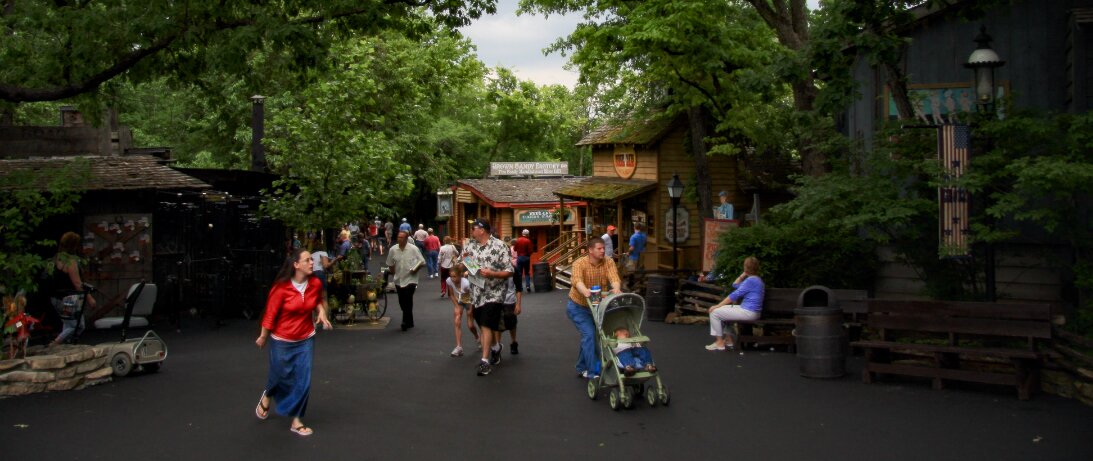
A few hours away from me you can visit Silver Dollar City — a scenic, wooded theme park in the Ozark Mountains where craftspeople blow glass and mill flour 19th-century style. It’s charming and memorable. It’s also not the way I buy glassware or food normally.
Silver Dollar City is an immersive experience. As you walk to the various artisans’ shops in that throwback world, music constantly wafts about courtesy of talented musicians. So too wafts the aromas of delicious food produced much more conventionally, but nonetheless with far more handcrafted care than, say, McDonald’s.
These two layers describe the knot we need to untangle with AI. The current tech bubble’s frontier is moving forward relentlessly and it will devour many things we humans have typically done. But not all of that devouring is equal — some devouring is inevitable and even desirable.
We moved out of the 19th century for a reason. For all its faults, industrialization has allowed us to live more comfortable (and, yes, even more healthy) lives. It isn’t that every person who previously milled flour was happier in a flour processing plant’s conveyor line, but as a whole, our lives are better for the readily available flour (and an array of other needs and wants). Riding our horses and buggies down to the mill and spending a larger portion of our income on labor intensive flour isn’t a theme park treat when you depend on it for dinner each night.
Which isn’t to say all automation is good. Something the “MAHA” movement seems to have caught onto is what many of us have observed for years: that we’ve increasingly industrialized our food system to the point that it creates food that is unhelpful to our well-being. Much of it isn’t even recognizable as food in its makeup or how it (fails to) deteriorate.
Freshly milled flour is an amusement today, mercifully replaced with something far more affordable as part of industrialized farming. But a skillet filled with freshly sliced vegetables and olive oil is undeniably better for us than the space age approximations of nutrients most prepackaged or fast food aspires to be. We may not all need handblown glasses to drink out of, but we’re all better off with natural nutrients our bodies need.
And even where we don’t need it we want it: while much of a park like Silver Dollar City is built on nostalgic novelty we otherwise have moved beyond, we still enjoy live music when rooted in the 21st century. Real humans playing real instruments with real emotion matters — it isn’t an archaic luddite protest.
In all of this from tech revolutions past, we find a mold for our present technological winds. Some things are just inefficient for humans to do and those will be replaced by AI. Better to embrace the best of that than try with AI what the Amish do with electricity.
Meanwhile, other realms may be partially replaced, but we will discover those “clean food” realms within the AI revolution. Consider what I wrote in my column the other week:
The fear for many, including the poster I’m riffing off of, is that AI will do the whole process [of film making]: write the script and output it. Perhaps it will become capable of such. But I think there is a misunderstanding shared between the most pro-AI and anti-AI contingents that AI can do it all (for good or ill, respectively).
Right now, certainly, that’s not the case. I’ve constructed narrative pieces with generative AI in recent years and while a single moment can be captured quickly with AI, it still takes an incredible effort to weave together an actual story.
Most of us can agree there is something disturbing about the idea that AI might take over all creativity. But so far it can’t. I can get it to bring a story I write to life in video, but it’s still a human composed story and a human policed one. Even as I have a story nailed down, I have to keep correcting and guiding its “filming” because AI doesn’t catch things we humans would immediately know are off.
Even if it eventually does mostly, I strongly suspect that creativity will remain — at worst — like healthy food: the approximations from the purely AI drive through will have obvious deficiencies compared to what is at least human guided. In that, AI will become like modern farm equipment: way more productive than, say, a donkey and a plow, but not entirely autonomous either.
Ironically, farm equipment itself will surely move to autonomy, because in a controlled, precise environment like a farm, AI can check itself. It can see if the seeds went in the soil. It can test for fertilizer application. It can measure crop success. All the things it can’t do when crafting a story or even algorithmically choosing which social media posts we ought to see.
AI can’t “test” whether pushing one more angry post might lead someone to despair, only whether the person will come back for more. It can’t weigh the laughter evoked by humor or catharsis of a tragic plot. Without an “emotion chip” like Lt. Cmdr. Data’s long promised one he finally received in Star Trek: Generations, it can only make probabilistic guesses at whether we’ll chuckle or cry or tune out.
Nor can it build a reputation and personality. Sure, LLMs like ChatGPT and Claude can give snark or crack a joke — even be crude as Elon Musk loves to have his AI be — but it’s all context, nothing genuine. If I feed Grok one of my sermons, it’ll talk about praying for me and discuss how amazing Jesus is. But for the atheist writing a disputation of God’s existence, it’ll no doubt cheer on the end of “superstition.”
That’s why I believe we’ll keep caring who writes books and columns — knowable people who are guided by sometimes changing whims but bounded by a knowable soul. I’m not reset every time I start a new conversation, nor are my OFB compatriots or whomever else you read.
The same with our artists and musicians and doctors and counselors and so many others we place trust in. When our valuing of the person’s output is deeply intertwined with a sense of knowing the producer (whether personally or not), AI comes up short.
That doesn’t erase the genuine loss when AI cuts into less subjective realms it is increasingly good at conquering. The co-hosts of the Accidental Tech Podcast put it into perspective well recently on an area more in their and my wheelhouse than the agrarian examples I cited above: coding. AI is getting incredibly good at programming because you can give it a starting point and an easily defined end goal and the “agent” will go try things repeatedly until it achieves the goal.
As a pastor, I often use programming as a sort of — here it is again — catharsis. Development is very predictable, defined goals make it appealing as a resting spot from a decidedly less predictable calling. As I was programming something this week and then experimented with Claude Code and GitHub Copilot, I felt a sense of loss at the thought of a day when none of the technique was even relevant any longer. What makes it a break from the work I am usually blessed to do is precisely what makes it vulnerable to AI replacement.
Still, even when I do it for an escape, it has practical goals — the things the programs ultimately do. Like the move from plow-and-donkey to tractor to mechanized agricultural wonders of today, it’d be wrong to insist on the tandem livestock-and-human over the modern human guided mega plow just because it is more enjoyable to pat a donkey than flip control panel switches. The newer approach saves millions of lives by warding off starvation.
And AI will do the same whether it be with coding or a thousand other areas it can excel well beyond our abilities. As solace, I suspect it will be at its best with a skilled human guiding it to amplify the human’s abilities.
Certainly, right now that’s true in both the creative and programming realms. Claude Code overlooks things obvious to a programmer as Veo does to the cinematographer. It certainly regularly lacks a sense of elegance and clarity — aesthetics — a skilled programmer would deploy.
I suspect the gap will narrow more on the programming side since AI can test and iterate itself there. But I’m not utterly convinced its drive through will ever completely supplant the human predecessors’ “clean food.”
Instead, we should be open to those areas where once necessities may indeed be reduced to artisanal novelties while expecting many more where it augments — à la the modern farm — rather than replacing. In both cases, the Industrial Revolution made us ultimately better off after the growing pains.
The AI revolution likely will too.
And some fields, especially the creative and interpersonal, where the throwback theme park and the present day never drifted far from sync, will remain so. A banjo in the hills will always speak to something we humans need, even if we no longer listen after a long day at the mill. 

Timothy R. Butler is Editor-in-Chief of Open for Business. He also serves as a pastor at Little Hills Church and FaithTree Christian Fellowship.
Pass along this article.
Never Miss Another Article from Timothy R. Butler.
You need to be logged in if you wish to comment on this article. Sign in or sign up here.

Start the Conversation