
People love this year’s Budweiser commercial. I get it: it’s beautifully filmed and feels good when so much is angry, ugly or both. It is also real to a surprising degree: the commercial was filmed with cameras, not constructed with computers.
Forget about AI for a moment, we’re all accustomed at this point to something between the “could be seen with our eyes” real of photography and cinematography and AI: CGI, computer generated imaging.
If you’re old enough, you remember the wonder at early CGI triumphs like Jurassic Park. Over the 1990s, we watched as what previously would have involved laughable props of, say, extinct species suddenly could appear as real as the actors around them in a movie. Given a good plot, good direction and, yes, a soaring John Williams musical score, it was amazing.
Then came full out CGI animation ushered in by Pixar’s Toy Story. That studio’s embrace of kids’ movies that had appeal to all ages was revolutionary. Dreamworks’ Shrek might be the pinnacle of such efforts before they became entirely ordinary.
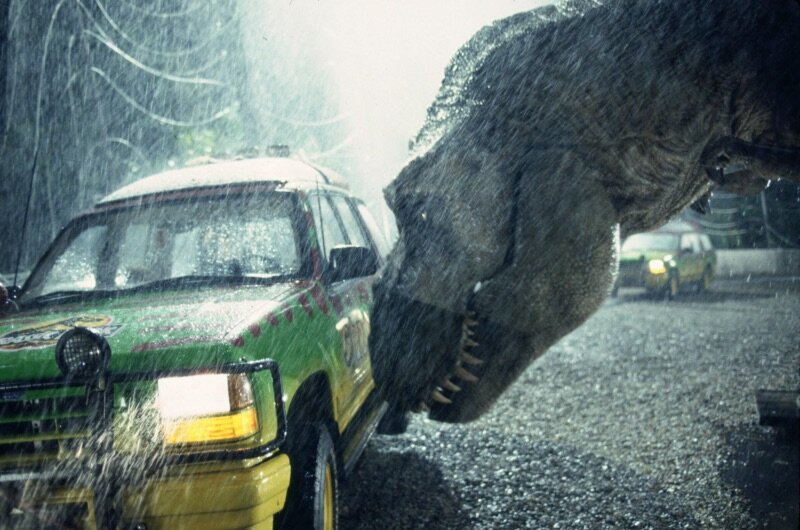
In the years since, it’s become all too common to throw in computer generated effects for no reason other than it is easier than cinematic alternatives. A common critique of recent years’ summer blockbusters is the extreme overuse of such imagery — close to real in appearance, but overexposed to the point that we see through the illusion.
No longer a tasteful addition at key points to do what can’t be done in real life, it became a crutch when storytelling is left wanting. Spectacle overrode story and we leave encountering that “art” empty. (I’m looking at you, Phase Five Marvel Cinematic Universe.)
The new AI revolution was only the next logical step: if computers are doing the heavy lifting that would previously have been done by careful set design and restrained plots, why not let AI create the complete world? Current models like Kling-Pro and Google Veo 3 can create unquestionably realistic scenes — in appearance more true to life than many of the computer generated efforts that came before.
As one X poster summed up what many said in response to the Super Bowl’s glut of AI-generated commercials: that generative content is “soulless trash.” I get the pain: if we regularly outsource to computers “creativity,” it does lack the je ne sais quoi of human effort.
Anheuser-Busch isn’t the company we’ve typically said has read the moment right the last few years, but in this case, clearly they did with that “American Icons” ad. Set to celebrate my hometown’s brewery at its 150th anniversary and the country’s 250th, what is better than an iconic Clydesdale paired with an equally iconic bald eagle?
Those two things when they are real.
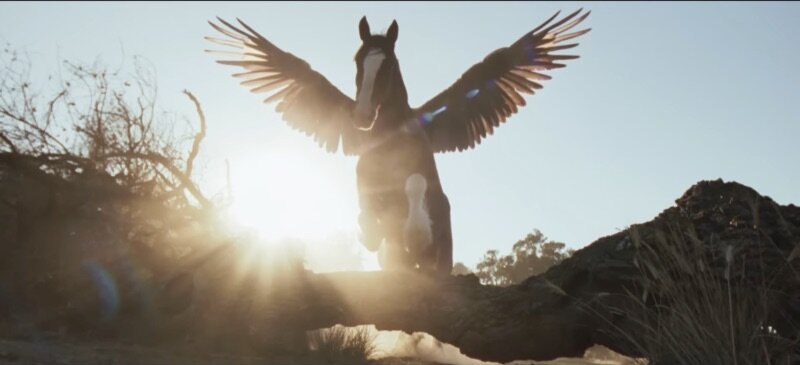
The plot is charming in itself: a stray baby bird is sheltered by a young clydesdale and the two become fast friends, with the bird riding on the horse’s back as it tries to learn how to fly. The climax “pegasus” moment, where the horse leaps over a log as the bird, now mature enough to be revealed as an eagle, stretches out his wings to fly, is clever and powerful at once.
But what brings it home and made the commercial for so many of us, is that it was real. At first I thought A-B had computer generated (or even AI-generated) the scene, but no: the scene was practically filmed — that is, using real world objects, not post-production special effects — with a real eagle taking flight as the real horse leapt.
The backstory adds to the authenticity: the eagle is a rescue eagle, albeit not rescued by a horse. Even the farmer is a real barley farmer for the brewery. It’s mighty real as commercials go. We love it for the genuineness.
This is the second time I’ve seen significant fanfare over a practical shot in the last few months. Many fans of classic technique celebrated when Apple, of all companies, filmed its new logo sequence for Apple TV productions practically instead of using computer animation.
That delights something inside of us as we grasp for the real in an uncanny time. We still react positively and forcefully to things anchored in reality. Our reaction should assure us as we fear what comes next.
So where does that leave generative AI? Is, as that one X poster said, it a mere soulless monolith?
I suspect the lesson is more akin to the larger one around computer generation that has been brewing. We loved Jurassic Park, but jeered the MCU’s replacing decently developed plots for fake spectacle, because touches of unreality to explore fascinating alternate realities of fiction can be wonderful, but it isn’t enough in itself. Human story and its anchoring in our reality is what speaks most deeply to us.
JP wasn’t great because it had realistic looking dinosaurs but because it was a new iteration of the old human grappling with “what happens when we go too far?” Frankenstein for a different generation. The argument was never that we should abandon exploration of scientific domains, but understand where care and moderation are required.
The tools used to create these stories are no different. Should we use computer generation — whether traditional CGI or trendy AI — to bring to life imaginary realms that confront our real fears and express our real joys? Absolutely. But they must be anchored in the human soul.
That is the critical ingredient. It’s why a green ogre and his talking donkey can become timelessly meaningful even as live actors and actresses in an overproduced green screen popcorn flick fall flat.
The fear for many, including the poster I’m riffing off of, is that AI will do the whole process: write the script and output it. Perhaps it will become capable of such. But I think there is a misunderstanding shared between the most pro-AI and anti-AI contingents that AI can do it all (for good or ill, respectively).
Right now, certainly, that’s not the case. I’ve constructed narrative pieces with generative AI in recent years and while a single moment can be captured quickly with AI, it still takes an incredible effort to weave together an actual story.
It requires a director — a soul — with a creative vision to guide the model, just as a director guides humans or computer animators to make great cinematic creations in more established approaches. Perhaps that will change, but I suspect we will always be able to tell the difference when it happens and when it doesn’t.
We will still react when a living, breathing eagle leaps off of an equally alive horse to fly. But then what of the very constructed realms of Shrek? What’s behind the technique — be it practical, traditional computer animation or AI — matters. We have and will still react when a real human story is the pulse behind the “camera,” whether that camera is a physical object or a metaphor.
It isn’t the use of AI that makes content soulless. It’s how we leverage the tools we have that determines their life or lack.
Yes, give me real horses helping real eagles, please. But also give me that ogre — or the iconic AI figure yet to be produced — any day over an in-the-flesh, but formulaic, production-by-checklist, soulless alternative. It’s about having enough sense in what we do to be restrained when we should. That is art.
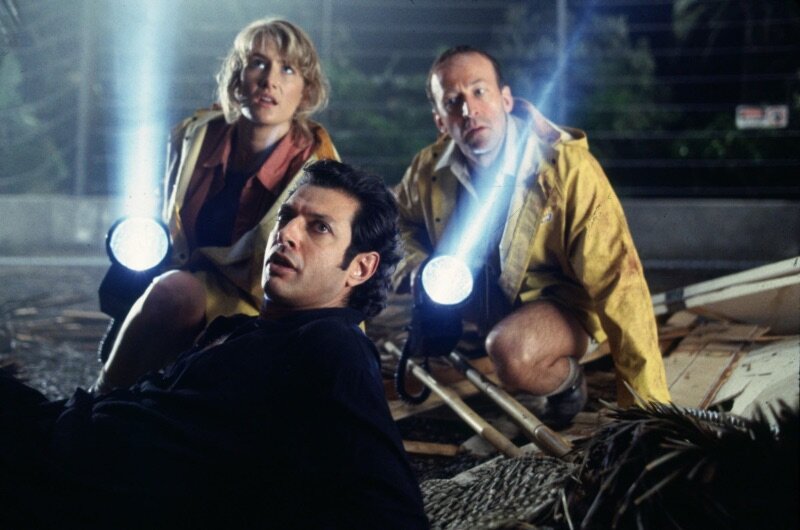
As Michael Crichton’s Dr. Ian Malcom famously observed, “Yeah, but your scientists were so preoccupied with whether or not they could, they didn’t stop to think if they should.”
Sometimes we should do something, sometimes we shouldn’t. The question in the ill-fated park wasn’t whether understanding DNA was good, but whether trying to reconstruct extinct species willy-nilly was good. Shortcuts and carelessness become its undoing; so too in the creative arts.
The question here shouldn’t be whether we should explore generative AI or not. By all means, explore it and keep pushing the traditional craft further at the same time. But don’t mistake traditionally presented as the thing: it’s the DNA below the surface, just like with those reptiles.
We need restraint and thoughtfulness: we need “soul” to be given to art, no matter how it is constructed. CGI, but not just for its own sake. AI, but not for its own. Practical, but also not for its own. To express our hopes and dreams and yearnings, it needs one ingredient consistently: a human soul at the helm. 

Timothy R. Butler is Editor-in-Chief of Open for Business. He also serves as a pastor at Little Hills Church and FaithTree Christian Fellowship.
Pass along this article.
Never Miss Another Article from Timothy R. Butler.
You need to be logged in if you wish to comment on this article. Sign in or sign up here.

Start the Conversation